
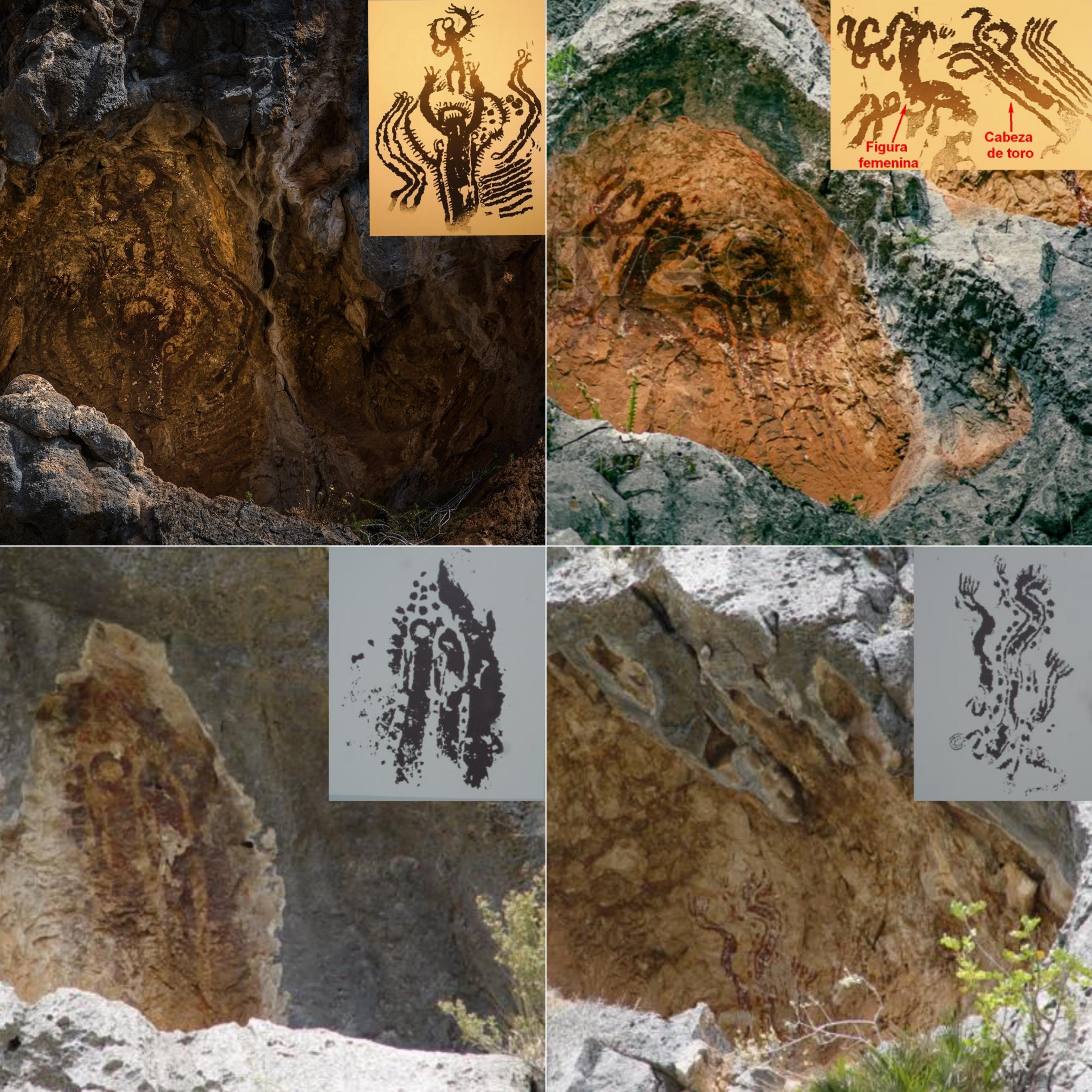
The Plá de Petracos site is one of the most important Neolithic rock art sites on the Iberian Peninsula. It contains pictorial manifestations of Macroschematic Art and Levantine Art, represented in the various shelters, linked to the beliefs of the first groups of farmers and ranchers who arrived in the lands north of Alicante, some 8,000 years ago.
According to the most widely held explanations and theories, the paintings depicted there represent the concerns and religiosity of their creators: the early farmers and ranchers who arrived in the Iberian Peninsula some 8,000 years ago. Levantine Macroschematic Art is unique, as this type of painting is only possible to see in this part of the peninsula. It is so named for the large size of the figures depicted and the schematization of the community's religious sentiment in simple, linear symbols that must be interpreted.
The motifs reflected in these cave paintings seem to represent supplications and prayers for the gods to protect the health of the tribe and its animals, as well as good harvests. What is clear is that the choice of this space was not accidental. It was considered a sanctuary, a sacred enclave, a meeting place, and a place of worship by people with deeply held beliefs in fecundity and fertility, both human and animal, in agricultural cycles, and in the very bonds between families or clans.
For these people, the sun, family, crops, and livestock were sacred, as sources of wealth, food, and clan survival. For this reason, they are symbolically painted on the sanctuary walls. Serpentine geometric and stylistic motifs abound, formed by stylized vertical bands. Some of the figures depicted in red have been identified with family, fertility, women, bulls, and stalks of plants or grain. The main subject of the paintings is the human figure.
- ORANTE (top left):
The most significant figure in the enclave is the so-called Orante, who dominates the central shelter of the complex. It is large, measuring over a meter in length. It represents a man with his arms extended upward in an attitude of prayer or worship, probably to the sun, as the sun's rays appear to fall upon him. His arms and legs extend from his body, and his fingers and toes can be seen. The curved lines on the sides of the main figure are interpreted as consecrating vegetation. Above the figure of the orante, a human silhouette can be seen in a clear attitude of movement, with an object hanging from his right arm. Although this is the scientific and rational explanation for the meaning of the paintings in this shelter, the shape of the so-called Orante is so imposing and revealing that other interpretations could be made.
- BULL AND WOMAN (top right):
The figures on this panel seem to represent and promote the fecundity and fertility of this early agricultural society. In the Mediterranean area, the female figure's outline is often associated with fertility, while that of the bull is linked to fecundity. In this shelter, the head of a bull can be seen, schematically painted, seen from the front, with its eyes and horns prominent. The lines to the right of this figure are interpreted as a representation of the animal's neck. Beside the bull, the figure of a woman (her head missing), dressed in a long skirt.
- FAMILY (bottom left):
The figures depicted in this panel seem to highlight the importance of social ties for these early peasants. Protection from the new environment lies in the unity of the clan and in animism, or the constant remembrance of their own ancestors. Human figures appear in the shelter that could be interpreted as a representation of the family, with the central figure standing out among them, with a triangle made of large dots above its head. On either side of this main image, two other human figures appear (although the one on the left is very blurred). The figures seem to be trying to leave the shelter. The stain on the right is interpreted as a representation of the walls of the adjoining sanctuary cave.
- CROPS (bottom right):
The paintings on the third panel could correspond to planted plant stems, drawn to represent, in a sacred and symbolic way, the agricultural cycle on which the clan's survival depended. The circles within the stems have been interpreted as seeds from which the plant within them emerges.
by SkellyCry
1 Comment
Very striking and mysterious imagery. I wonder how the artist would feel knowing we still look at their work and discuss it even after thousands of years.