
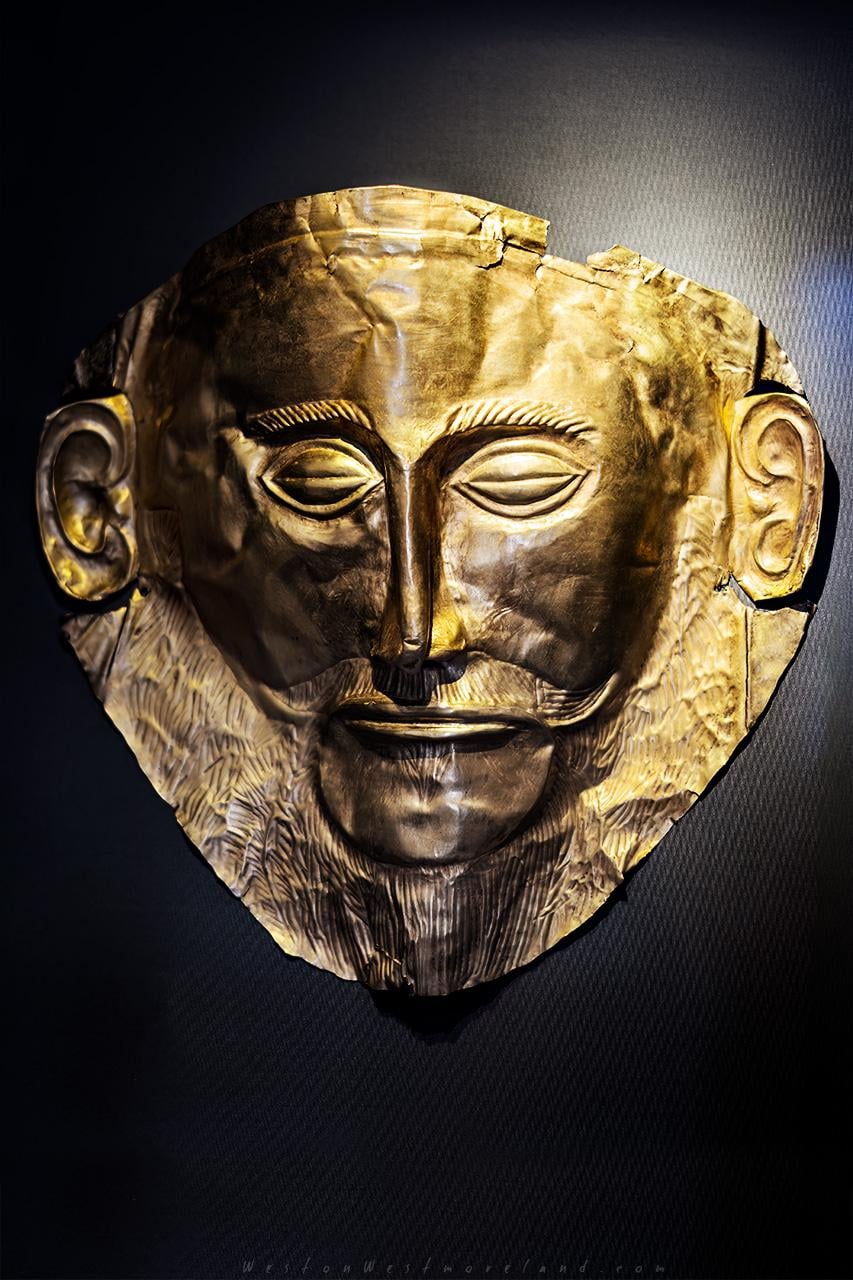
Mycenaean gold Mask of Agamemnon, Mycenae c. 1525 BC. The Mask of Agamemnon is a gold funerary mask discovered at the Bronze Age site of Mycenae in southern Greece. Heinrich Schliemann found the artifact in 1876 and thought,wrongly, he had found the body of king Agamemnon… [1280×852] [OC]
by WestonWestmoreland
1 Comment
…Mycenaean king Agamemnon was the leader of the Achaeans in the ancient Greek epic of the Trojan War, the Iliad. Modern archaeological research suggests that the mask dates to about the 16th century BC, pre-dating the period of the mythical Trojan War by 300–400 years.
The mask was found still on its corpse in a shaft grave of Grave Circle A and was in fact one of five masks discovered, but due to its nobility and level of preservation Schliemann claimed it to be that of the famous king.
Much controversy has come up regarding the identity of the mask. Nonetheless, not all bodies were buried with such riches and the mask still indicates that it covered somebody of some sort of importance, presumably some other Mycenaean king.
The mask was created by hammering gold into a thin leaf over a wooden form. It is three-dimensional and includes cut-out ears, full detailed facial hair, and eyelids that appear open and closed simultaneously. Because of its uniqueness it has come to be representative of gold-work from the age.
As usual, apologies for inaccuracies and mistakes.