
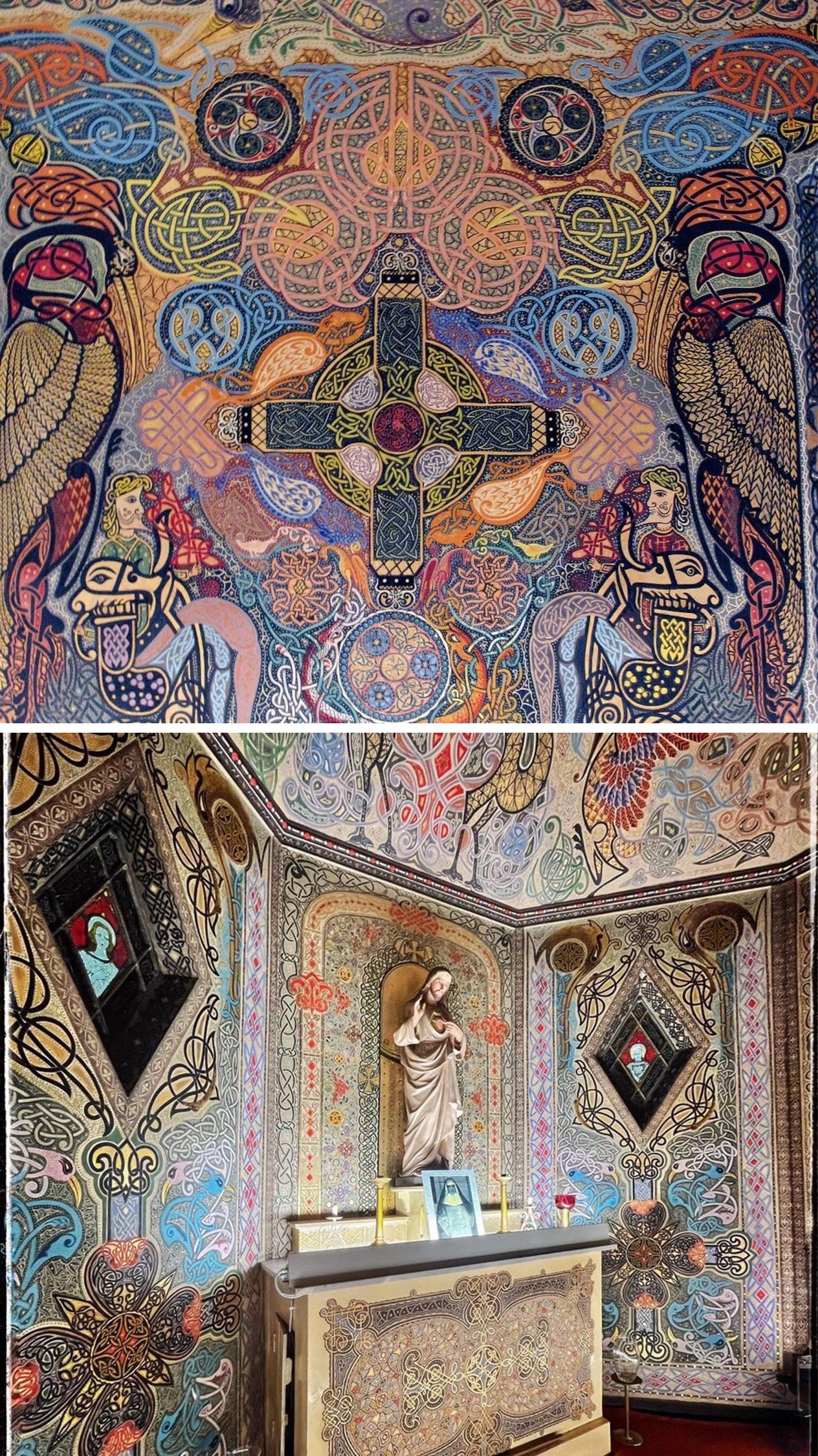
Mary Concepta Lynch was an Irish nun and skilled artist, illuminator, and calligrapher, who spent 16 years (1920-1936) ornately decorating the Celtic design in the Oratory of the Sacred Heart at St. Mary’s Dominican Convent in Dún Laoghaire, County Dublin, Ireland [2426 x 4320]
by Persephone_wanders
1 Comment
To commemorate the end of the First World War, a small oratory was built at the convent, to house a statue sent in recognition of the men of the area who died in Belgium.
The oratory was dedicated to the Sacred Heart in 1919. Beginning the next year, in 1920, Lynch first worked on the wall behind the statue, which stood above the altar, to provide it with a proper setting, in an Eastern Christian or Byzantine medieval style; and on the Gaelic script over the entrance door. After that she sought and was given permission to take on the whole interior of the oratory. The project was supported by her cousin, Shaun Glenville, and his wife, Dorothy Ward, who would regularly visit the convent. The couple were music hall entertainers, famous in their role as Pantomime dame and Principal boy, and raised funds for the oratory through benefit concerts. The studio of Joshua Clarke & Sons, father of Harry Clarke, created the seven stained-glass windows. One window is dedicated to her father, Thomas J. Lynch, represented by the Holy Family and another to Shaun Glenville and his family.
Lynch worked chiefly on her own as an act of religious devotion and decorated the walls of the oratory in an elaborate unified scheme of Celtic Revival design, utilising her father’s Lynch Method, continuing until ill health forced her to stop in 1936. The medium used was household paint mixed to her colour requirements by a local hardware shop. She worked long hours, in her spare time from regular duties, in conditions of poor light and without heating. The overall artistic scheme was inspired following a vision at night in which the oratory appeared ‘alight with colours in serpentine bands’ and the design conceived was rigidly adhered to from the start throughout the years. Working stensils exist from 1921 to 1923 for different parts of the scheme including the ceiling, so the complete scheme was first marked on the surface in preparatory work and then Lynch built up the design to increasing states of completeness. The outline of the scheme was probably in place by the celebration of her Silver Jubilee, 11 November 1923, when family and friends came to visit her and were invited to view her work. She first elaborated the altar wall, worked up the side walls, then designs on the doors and exterior tympanum (not yet evident in March 1927). Probably for reasons of access, work on the ceiling was less further on. For this she lay on her back on a board between two ladders, and it was the ceiling and back upper wall which remained unfinished when she was finally forced to stop. The Lynch Method determined that one part of the whole should never be entirely finished but that the pattern was kept in a state of constant accumulation, thus while the ceiling is not in a finished state it is not painted in patches but rather worked to a uniform level giving a satisfying impression of artistic completeness.