
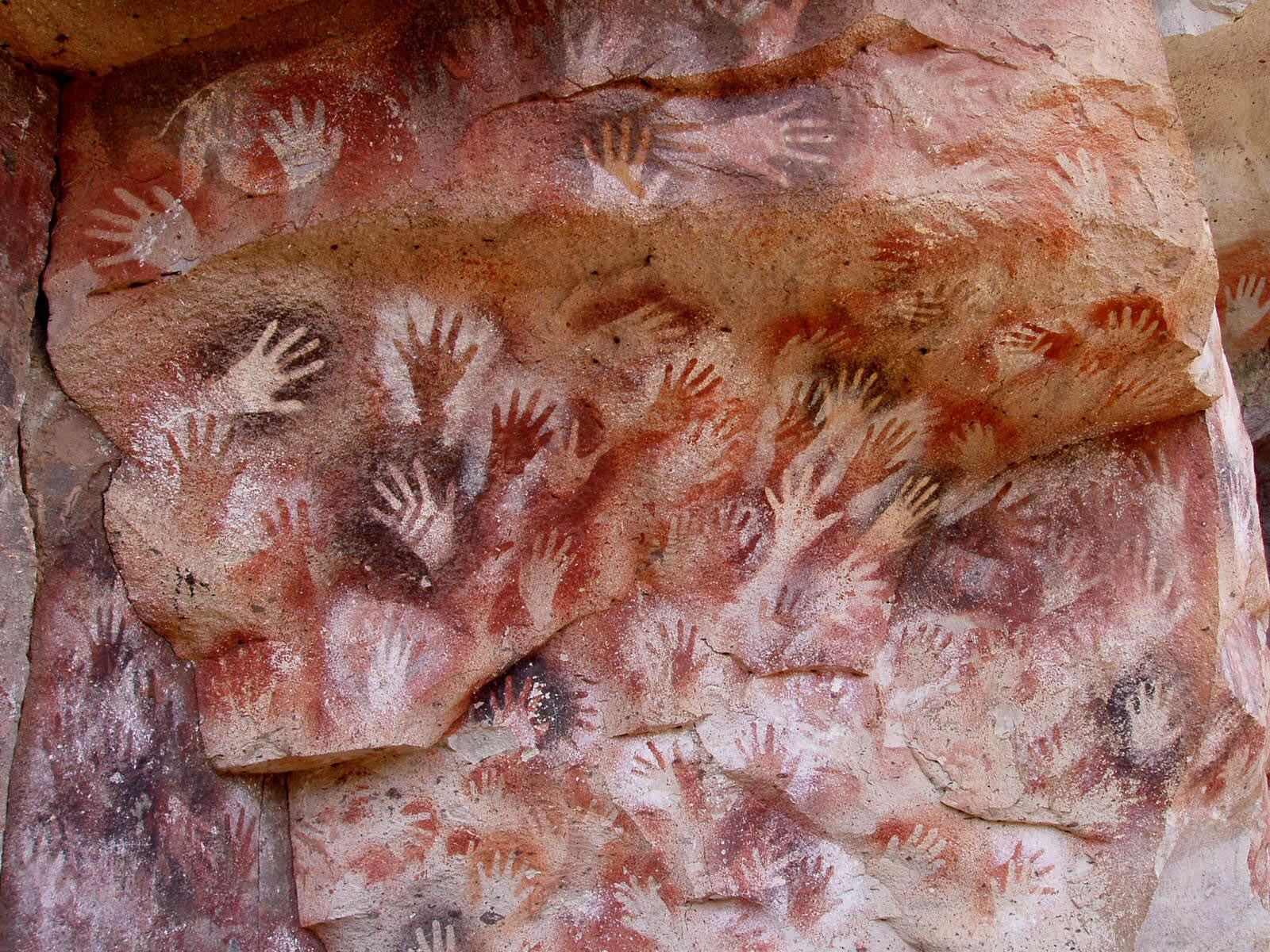
Hands at the Cuevas de las Manos upon Río Pinturas, near the town of Perito Moreno in Santa Cruz Province, Argentina. It is named for the hundreds of paintings of hands stenciled, in multiple collages, on the rock walls. The art in the cave is dated between 7,300 BC and 700 AD [1600 x 1200]
by Persephone_wanders
1 Comment
Cueva de las Manos (Cave of the Hands or Cave of Hands) is a cave and complex of rock art sites in the province of Santa Cruz, Argentina, 163 km (101 mi) south of the town of Perito Moreno. It is named for the hundreds of paintings of hands stenciled, in multiple collages, on the rock walls. The art was created in several waves between 7,300 BC and 700 AD, during the Archaic period of pre-Columbian South America. The age of the paintings was calculated from the remains of bone pipes used for spraying the paint on the wall of the cave to create the artwork, radiocarbon dating of the artwork, and stratigraphic dating.
Cueva de las Manos is named for the hundreds of hand paintings stenciled into multiple collages on the rock walls. The art in the Cueva de las Manos is some of the most important art in the New World, and by far the most famous rock art in the Patagonian region. The art dates to between around 7,300 BC to 700 AD, during the Archaic period of Pre-Columbian South America. Scholars Ralph Crane and Lisa Fletcher assert that the rock art at Cueva de las Manos includes the oldest-known cave paintings in South America.
The artwork decorates the interior of the cave and the surrounding cliff faces. It can be divided by subject into three basic categories: people, the animals they ate, and the human hand. Inhabitants of the site hunted guanacos for survival, a dependency reflected in their artwork by totemic-like depictions of the creatures.
Several waves of people occupied the cave over time. The age of the paintings can be calculated from the remains of bone pipes used for spraying the paint on the wall of the cave to create the stenciled artwork of the hand collages, radiocarbon dating of the artwork itself, and stratigraphic dating, including from a piece of the rock wall that had fallen with art on it. Chemical analysis of the pigments used to create the painting, and analysis of the stylistic aspects and superimposition (overlap) of the different parts of the art has verified that it is authentic. According to scholar Irene Fanning and colleagues, it is “the best material evidence of early hunter gatherer groups in South America.”
Earlier works in the cave were more naturalistic—they looked close to how the subjects of the art would have looked in real life. Over time, depictions became more abstract and different in form from how the subject would normally look.
There are over 2,000 handprints in and around the cave. Most of the images are painted as negatives or stenciled, alongside some positive handprints. There are 829 left hands to 31 right hands,suggesting that most painters held the bone spray pipe with their right hand. Some handprints are missing fingers, which could be due to necrosis, amputation, or deformity, but might also indicate the use of sign language or bending fingers to convey meaning.
The varying depth of the rock face alters the “canvas” of the artwork, and the different depths from the viewer alter the way the images are seen, based on where the viewer is standing. There is a large amount of superimposition of the handprints in different areas, with some areas containing so many handprints that they form a palimpsest background of layered color. Along with the superimposed masses of images, there are many purposefully placed single hands. You can read more [here](https://en.m.wikipedia.org/wiki/Cueva_de_las_Manos)