
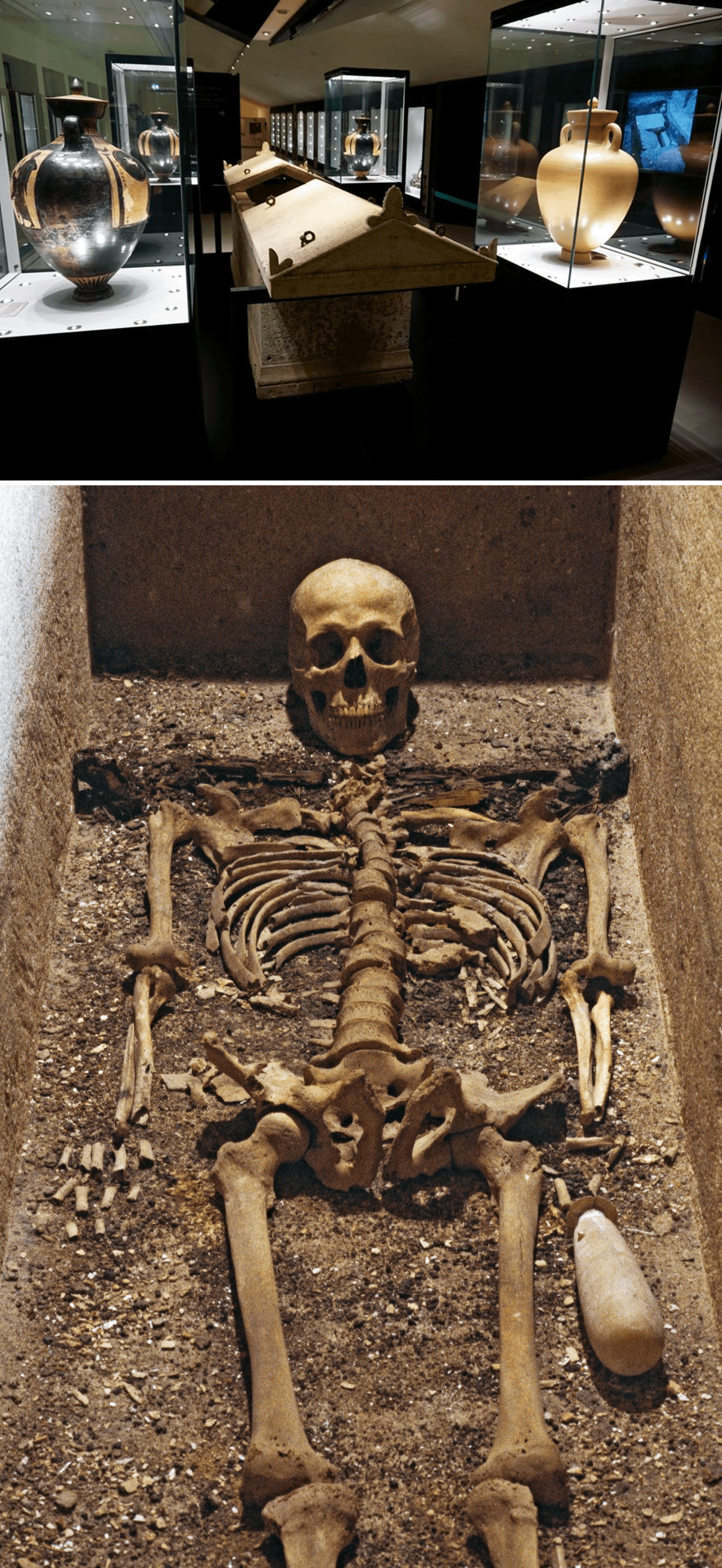
This 2,500-Year-Old skeleton is the oldest known remains of a Panathenaic Athlete. The man who lived in the city of Taranto, was a champion of many Panathenaic Games in the Pentathlon specialty. He was found buried in a stone sarcophagus with an alabastron jar and 4 amphorae [1200×2606]
by Fuckoff555
3 Comments
> Inside the coffin lies his well-preserved skeleton, to the point that a well-known anthropologist specializing in ancient finds, Gaspare Baggieri, was able to reconstruct the life of the Athlete of Taranto by providing a detailed description; from the bone structure, perfectly intact when it was found, it was possible to trace his diet , his age and the style of his hairstyle. [ 4 ]
> He was a man of about 30 years of age and of robust build, about 170 cm tall (an exceptional height for that time), and weighing 77 kg . There were also evident signs of his power in throwing the discus , in the long jump , in throwing the javelin , in running and in wrestling , the typical sports disciplines of the Pentathlon. His hair was curly and dark like his eyes . He was therefore a taller man than the average of the time, with a strong and massive build, with broad shoulders, powerful back muscles and strong and explosive arms and legs. The development of the lower part of the leg (large, solid and robust shins) also suggests that he was very skilled in the long jump. Through a simulation, it was even possible to reconstruct how high the athlete from Taranto could jump, that is, up to “3 meters”. [ 5 ]
> He was a person who was very careful about his physical fitness and his diet and training regime were extremely rigorous. His diet consisted mainly of cereals and fruit , rich in carbohydrates , as his colleagues also used to do, but he accompanied it with a good dose of protein sources , such as small blue fish such as anchovies , sardines , mackerel , shellfish and oysters , and sometimes even meat . Vegetables and cereals were the main food of our ancestors which, in the long run, could cause the deterioration of the teeth, while our athlete instead has perfect teeth, a clear indication of his perfect state of health. [ 6 ]
> There are mainly two hypotheses about the athlete’s death. First of all, based on the examination of the bones, it seems that the hard training and the excessive physical effort led the Athlete of Taranto to the exhaustion of his strength and to the formation of arthritis since signs of premature deterioration were detected between the joints of the shoulder blade. For this reason he was forced to retire, and then passed away at a young age, between 27 and 35 years old, paying a high price for the success he had achieved. The second hypothesises a possible poisoning by arsenic , when the athlete was about 27 years old, probably murdered for sporting interest.
[https://it.m.wikipedia.org/wiki/Atleta_di_Taranto#:~:text=L%27Atleta%20di%20Taranto%20%C3%A8,panatenaici%20nella%20specialit%C3%A0%20del%20Pentathlon.](https://it.m.wikipedia.org/wiki/Atleta_di_Taranto#:~:text=L%27Atleta%20di%20Taranto%20%C3%A8,panatenaici%20nella%20specialit%C3%A0%20del%20Pentathlon.)
> The Panathenaic Games (Ancient Greek: Παναθήναια) were held every four years in Athens in Ancient Greece from 566 BC[1] to the 3rd century AD.[2] These Games incorporated religious festival, ceremony (including prize-giving), athletic competitions, and cultural events hosted within a stadium.
[https://en.m.wikipedia.org/wiki/Panathenaic_Games](https://en.m.wikipedia.org/wiki/Panathenaic_Games)
> A pentathlon is a contest featuring five events. Five events were contested over one day for the Ancient Olympic pentathlon, starting with the long jump, javelin throwing, and discus throwing, followed by the stadion (a short foot race) and wrestling.
[https://en.m.wikipedia.org/wiki/Pentathlon](https://en.m.wikipedia.org/wiki/Pentathlon)
> Panathenaic amphorae were the amphorae, large ceramic vessels, that contained the olive oil given as a prize in the Panathenaic Games. Some were ten imperial gallons (12 US gal; 45 L) and 60–70 cm (24–28 in) high. This oil came from the sacred grove of Athena at Akademia.
[https://en.m.wikipedia.org/wiki/Panathenaic_amphora](https://en.m.wikipedia.org/wiki/Panathenaic_amphora)
That is one big radial tuberosity in the left radius. Possibly due to lots of traction from the bicep pulling in the bone.
Look at the teeth, and no fluoride