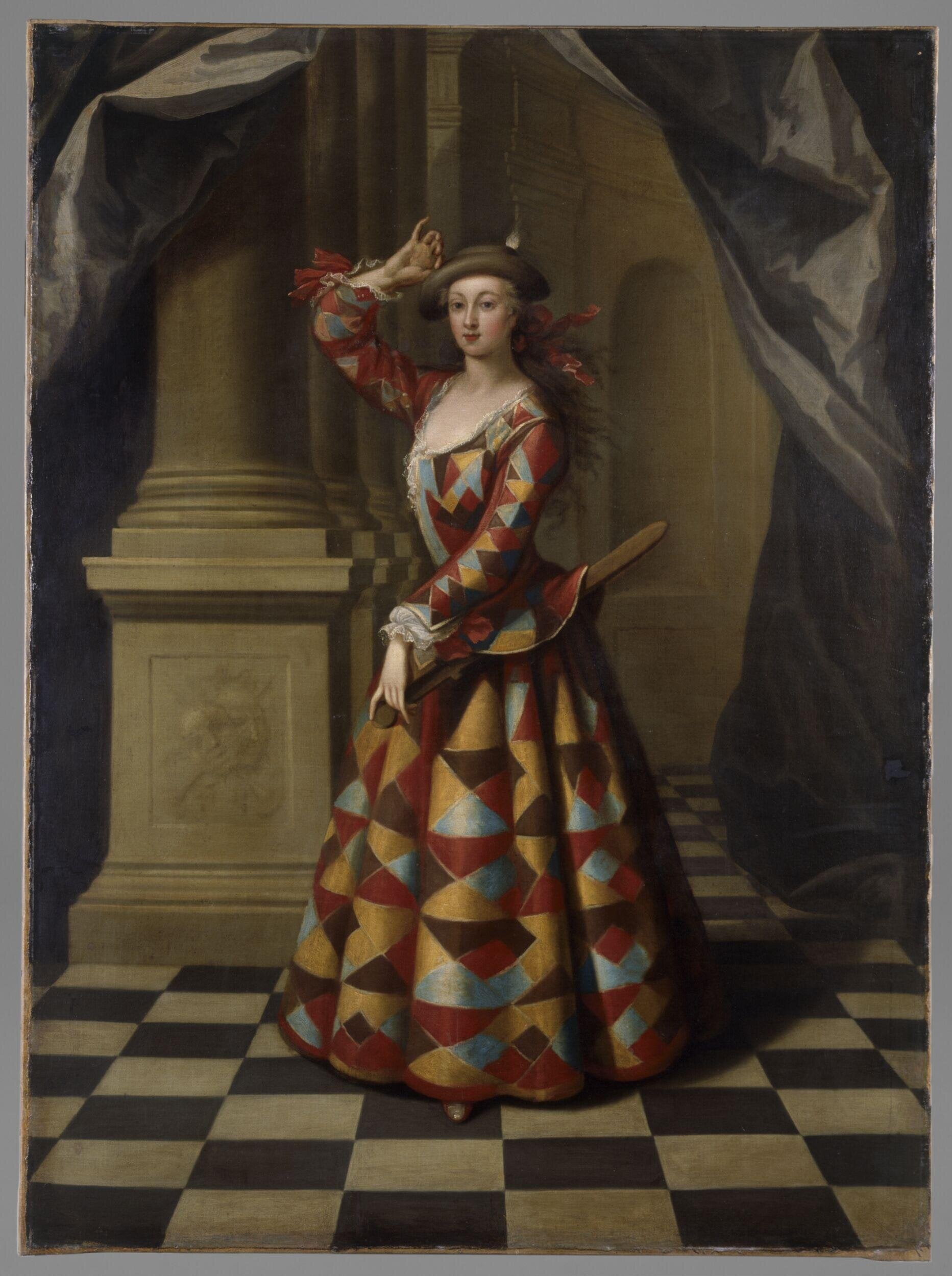
>Hester Booth (ca.1690-1773) was a leading dancer and actress on the London stage in the 1710s and 1720s, and was well known for her appearances as Harlequin, the commedia dell’arte character usually played by a man. Born Hester Santlow, she trained with the French dancer and choreographer René Cherrier and made her stage debut at Drury Lane Theatre on 28 February 1706. There are no surviving records of the performance but a month later her ‘Harlequin Dance’ was being advertised on Drury Lane playbills. In 1709 she appeared in her first acting role, as Prue in William Congreve’s comedy, *Love for Love,* and went on to take leading dramatic parts, including Cordelia and Ophelia, while continuing to dance as Harlequin. According to a German tourist, von Uffenbach who saw her in 1710, she was so popular that her portrait in Harlequin costume was used to decorate snuff-boxes. In 1719 she married the celebrated actor, Barton Booth, but continued to appear on stage, eventually retiring in 1733.
>This portrait is unsigned but is thought to be the work of John Ellys (ca.1701-1757). Ellys, a pupil of the artist James Thornhill, became principal painter to George II’s eldest son, Frederick, Prince of Wales, in 1736.

1 Comment
>Hester Booth (ca.1690-1773) was a leading dancer and actress on the London stage in the 1710s and 1720s, and was well known for her appearances as Harlequin, the commedia dell’arte character usually played by a man. Born Hester Santlow, she trained with the French dancer and choreographer René Cherrier and made her stage debut at Drury Lane Theatre on 28 February 1706. There are no surviving records of the performance but a month later her ‘Harlequin Dance’ was being advertised on Drury Lane playbills. In 1709 she appeared in her first acting role, as Prue in William Congreve’s comedy, *Love for Love,* and went on to take leading dramatic parts, including Cordelia and Ophelia, while continuing to dance as Harlequin. According to a German tourist, von Uffenbach who saw her in 1710, she was so popular that her portrait in Harlequin costume was used to decorate snuff-boxes. In 1719 she married the celebrated actor, Barton Booth, but continued to appear on stage, eventually retiring in 1733.
>This portrait is unsigned but is thought to be the work of John Ellys (ca.1701-1757). Ellys, a pupil of the artist James Thornhill, became principal painter to George II’s eldest son, Frederick, Prince of Wales, in 1736.
[Source](https://collections.vam.ac.uk/item/O84860/hester-booth-painting-john-ellys/)