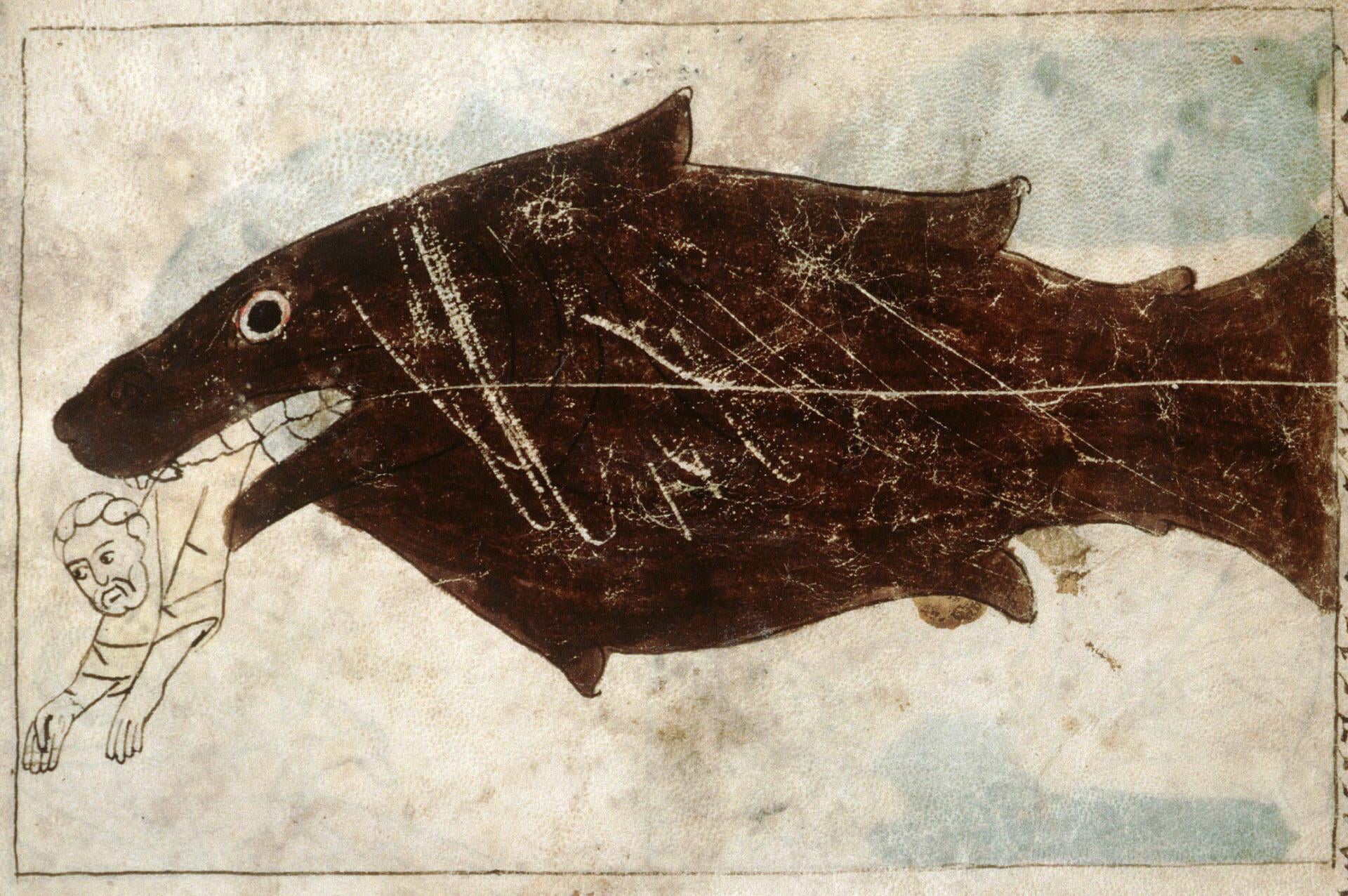
Jonah and the Whale. Detail from the Pamplona Bible, Navarre, c. 1197 [1920 x 1276]
by Persephone_wanders

Jonah and the Whale. Detail from the Pamplona Bible, Navarre, c. 1197 [1920 x 1276]
by Persephone_wanders
1 Comment
In the last decade of the twelfth century, two monumental illustrated bibles were produced in the Kingdom of Navarre, Spain. Named after the city where they originated, they are known as the [Pamplona Bibles](https://muse.jhu.edu/pub/50/article/925554). Encompassing around a thousand illustrations each, the two bible picture books were commissioned by King Sancho VIII el Fuerte of Navarre: the oldest was completed in 1197 and produced for the king’s use, while a second was finished not long after for an unknown female reader. In 1328, a third Pamplona Bible was produced in a different style by commercial artisans in Paris.
The Pamplona Bible is comprised of scenes from the Old and New Testaments, as well as legends of saints and the end times. It was created presumably at the behest of Sancho VII, “the strong,” King of Navarre. With nearly 1,000 surviving scenes, it is an enormous compendium of visual material.
Petrus Ferrandus—probably Sancho’s chancellor—determined the picture book’s contents. He may also have been the scribe of the descriptions of the events depicted. Among the sources for the texts are the Bible, biblical apocrypha, saints’ lives, and the prophecies of the Tiburtine Sybil. The compositions rely little on existing visual tradition, partly because so many scenes are rarely found in art. The drawings focus on narrative. The section devoted to the saints reflects the arrangement of a litany, starting with Saint Michael and the male saints of apostolic times and concluding with female saints.