
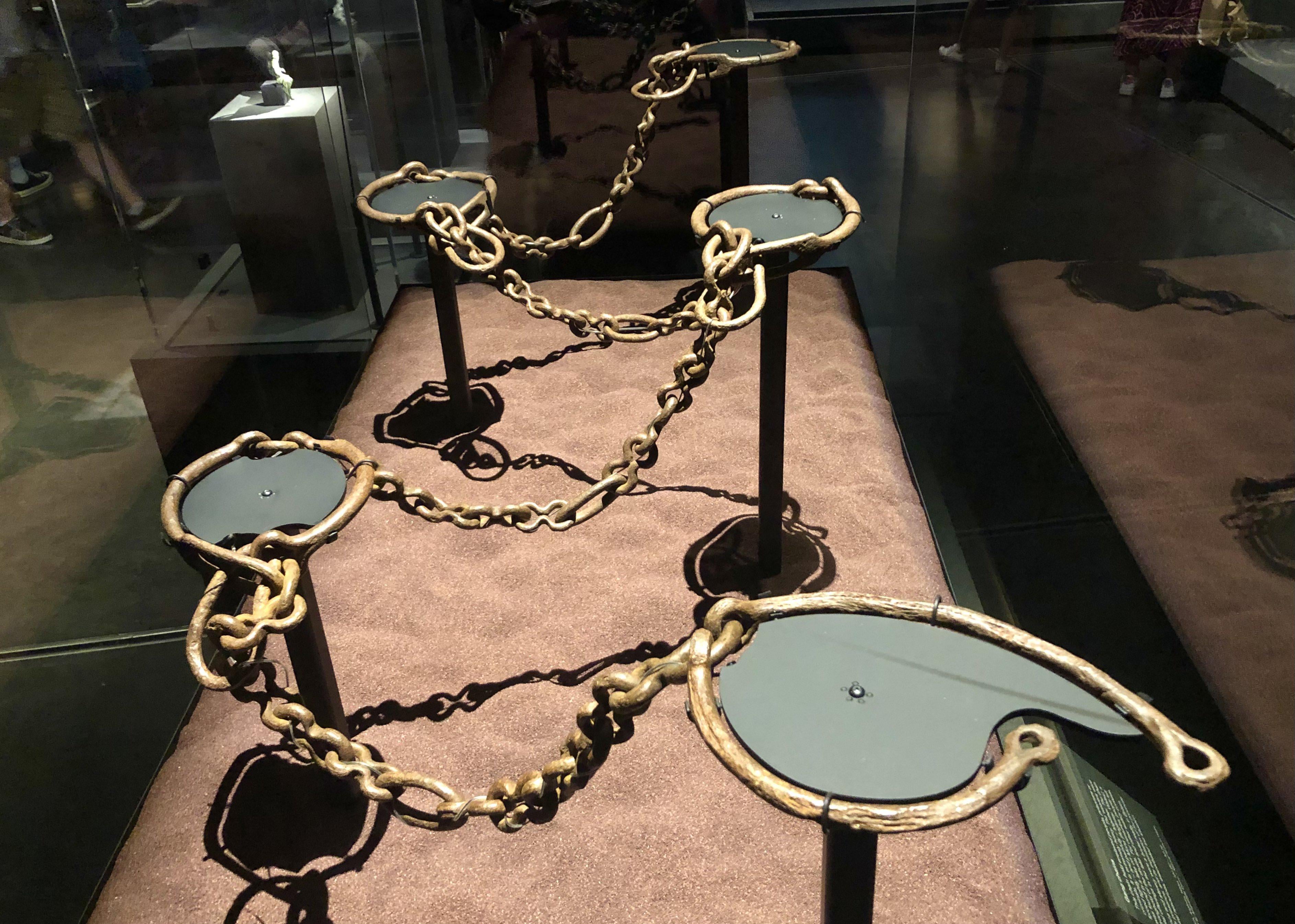
Slave collars of an iron age chain gang. The 6.6 kg iron chain connects 5 neck shackles used to bind slaves or criminals. When it was discovered in 1943 during construction of an airfield on the Welsh coast, the chain was still so strong the workers used it to tow vehicles. 100 BCE-60 CE [3773×2692]
by Fuckoff555
2 Comments
The chain was discovered at the lake Llyn Cerrig Bach, and it’s now housed at the National Museum Cardiff in Wales.
[https://en.m.wikipedia.org/wiki/Llyn_Cerrig_Bach](https://en.m.wikipedia.org/wiki/Llyn_Cerrig_Bach)
The chain was found with a myriad of other objects, including:
A fragment of an Iron Age trumpet;
Numerous swords (many of which had been deliberately destroyed before internment);
Chariot fittings (wheels, terrets etc);
Spears and spearheads (one of which had wood which was radiocarbon dated to the 3rd century AD);
Cauldron fragments, possibly part of whole ones which were likely destroyed by the recovery process during the Second World War;
Blacksmith tools/materials – including tongs and ‘currency bars’ (there is to date no evidence of Iron Age coins being minted in Wales, although a hoard was recently found on Anglesey from the Corieltauvi);
A sickle.
It is currently thought that the hoard represents ritual deposition over a long period, into and beyond the Roman occupation of Anglesey. Our evidence of the Roman invasion of the island comes from Tacitus’ famous account of the destruction of refugees and the notable elite religious sect, the ‘druids’, in A.D 60 by Roman General Suetonius Paulinus.
A theory that the hoard represents a shipwreck has been discredited by archaeologists such as Philip Macdonald.
While it was initially assumed that this was the only site of it’s type on Anglesey, another has come to light recently by metal detectorists near Llanfair Mahafren Etihaf a few years ago.
It’s a brilliant hoard, the metalwork reflects a sophisticated trade network between Anglesey and parts of Northern, Eastern and Southern England. Intriguingly, the sheer lack of Irish metalwork, in comparison to the Bronze Age, suggests a cultural shift of influence from Irish Sea Zone traffic to that from both England and the Continent.
What isn’t talked about as well with regards to the chain is letters by Cyril Fox, who researched and catalogued the hoard for the National Museum of Wales, stating that human bones were also found, although none of these survived. Could the chain have come from a human sacrificial group? We certainly have evidence of human sacrifice being practiced in Britain and Ireland at this time through the numerous bog bodies which have been found.
Lots of great literature about it.
Edit: I know of it because my PhD is about archaeology in the area.