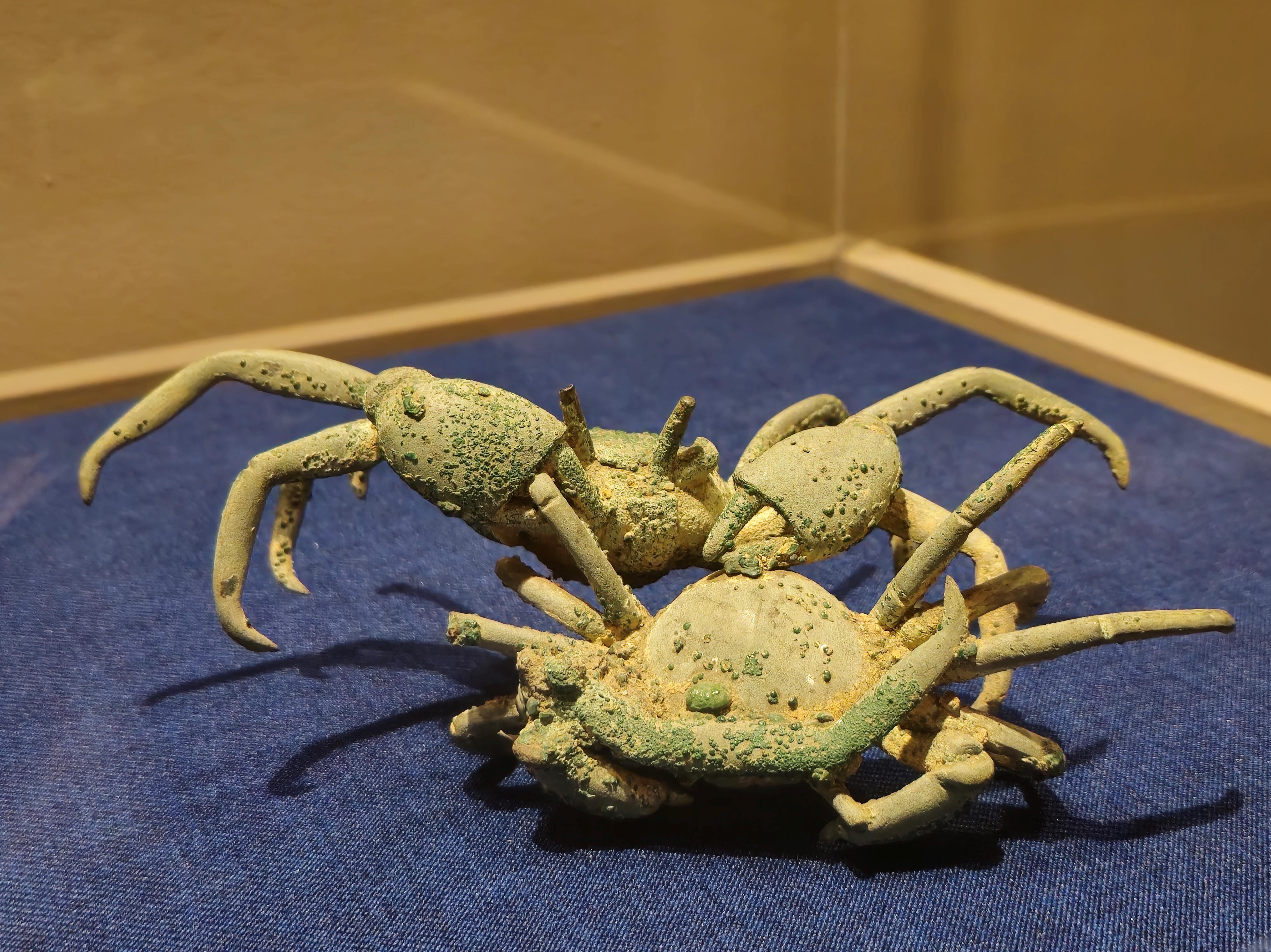
Two crab-form paperweights, originally separate, which fused together during centuries of burial. China, Yuan dynasty, 14th c. Copper alloy. Loaned to the Metropolitan Museum of Art from Fujian Museum, Fuzhou [6528×4890] [OC]
by oldspice75

Two crab-form paperweights, originally separate, which fused together during centuries of burial. China, Yuan dynasty, 14th c. Copper alloy. Loaned to the Metropolitan Museum of Art from Fujian Museum, Fuzhou [6528×4890] [OC]
by oldspice75
1 Comment
[display description](https://i.ibb.co/N606RFpn/20250313-161908.jpg)
[Paperweights in the shape of crabs
Yuan dynasty (1271-1368), 14th century
Copper alloy
Unearthed in 1954 from a hoard in Nanping, Fujian Province
Fujian Museum, Fuzhou
In the fourteenth century, bronze artists excelled at casting not only vessels with archaic designs but also diverse sculptural objects. Fused together after more than six hundred years underground, these two crabs originally functioned separately as paperweights. Their apparent ability to scuttle away-evoked by the accurately defined pincers and legs-must have been a source of amusement and delight for their owner.]