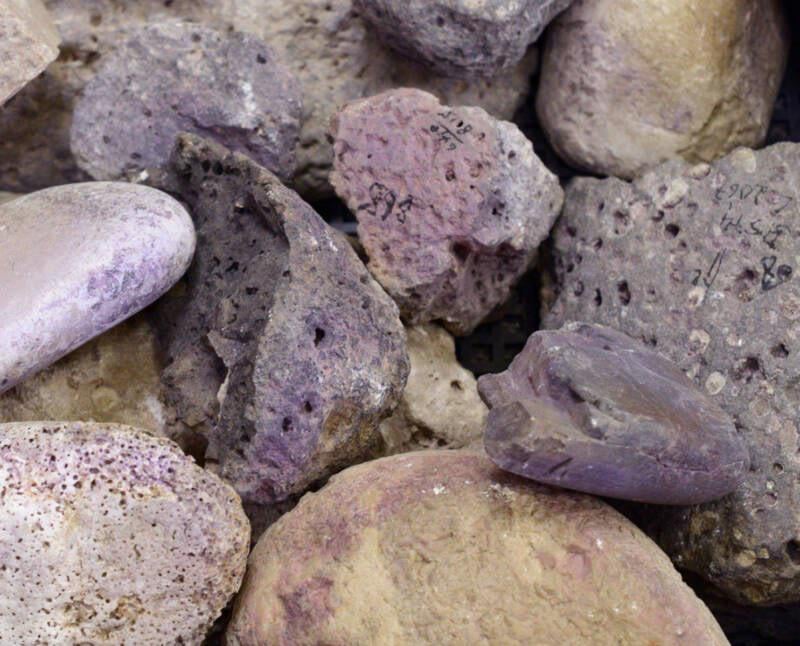
A 2,900-Year-Old Factory That Produced Tyrian Purple — The Most Prized Dye Of The Ancient World, at one point worth three times more than gold — Has Been Found In Tel Shiqmona, Israel [800×646]
by Remote_Finish_9429

A 2,900-Year-Old Factory That Produced Tyrian Purple — The Most Prized Dye Of The Ancient World, at one point worth three times more than gold — Has Been Found In Tel Shiqmona, Israel [800×646]
by Remote_Finish_9429
3 Comments
[Source](https://allthatsinteresting.com/israel-tyrian-purple-factory)
The dye is made from sea snail (Hexaplex trunculus) mucus, and archaeologists discovered 400 sea snail shells at the site, as well as 100-gallon ceramic vats and a variety of stone tools. They realized that the dye factory at Tel Shiqmona was enormous — perhaps one of the largest of the ancient world.
The factory at Tel Shiqmona produced purple dye for some 500 years and, between roughly the 10th to early 7th century B.C.E., it was “the only site around the Mediterranean with clear evidence of significant-scale production. We therefore assume it was the main supplier of dyed wool for elite and royal weaving centers across the region — Philistia, Israel, Phoenicia, Moab, Edom, Damascus, Cyprus, etc,“ said study lead author Golan Shalvi. The site was probably a key economic hub for the Kingdom of Israel and later the Assyrian Empire, both of which ruled the area at different times. Its repeated destruction and subsequent rapid reconstruction suggest a strong motivation to keep it functioning.
This dye was highly coveted by those who could afford it — in the fourth century C.E. one pound of Tyrian purple was worth three times as much as gold — and it swiftly became the color of ancient elites. And the elites guarded their color with passion. Indeed, the Roman emperor Caligula grew so enraged when the king of Mauretania wore purple to meet with him that Caligula had the king killed.
There is also some evidence of purple production at Tel Dor, though not on anything like the same scale:
https://tekhelet.com/pdf/0987.pdf
This is a rad post.