
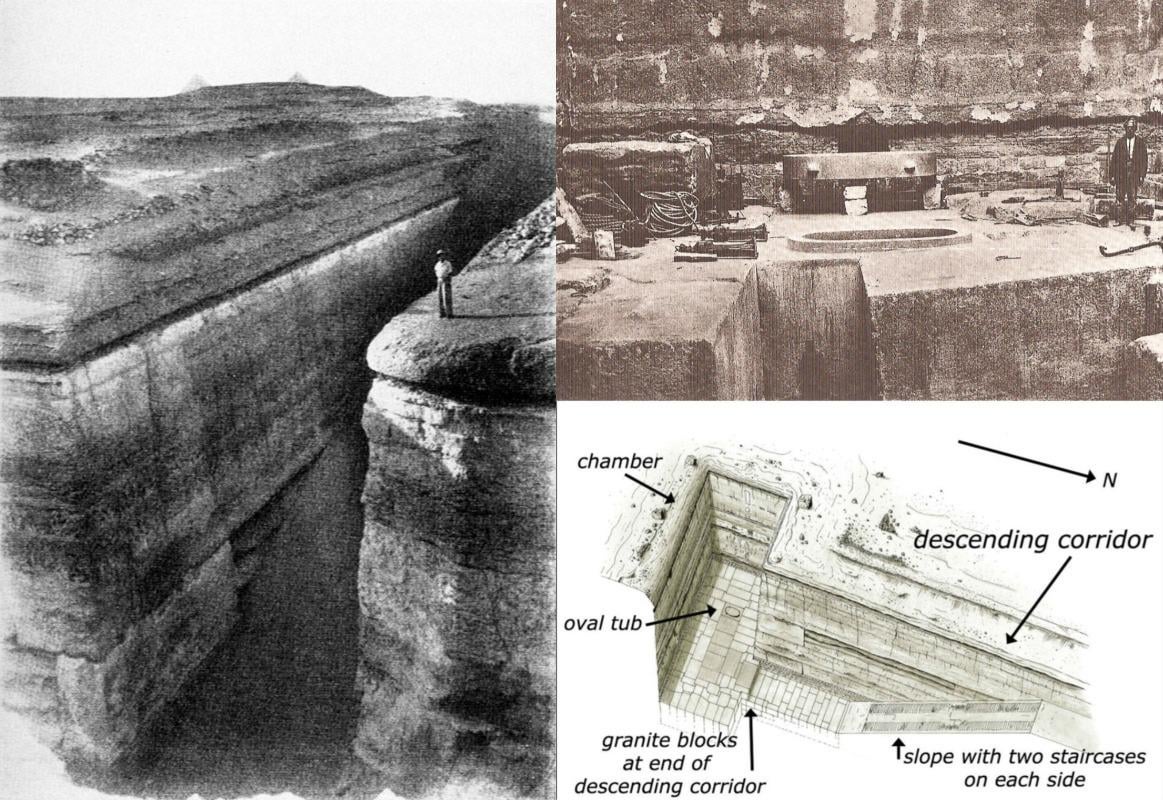
The Unfinished Northern Pyramid of Zawyet El Aryan, in Egypt, is a large shaft part of an unfinished pyramid that was probably built in the 26th century BCE. Discovered in 1842 and closed to researchers in 1964, today it is within a military restricted area and misused as a local dump [1163×800]
by Fuckoff555
2 Comments
> Superstructure
> Next to nothing is known about the superstructure of the pyramid as indeed only the square base, made of natural bedrock, was finished. It measures 200 m × 200 m (660 ft × 660 ft) and shows traces of a surrounding pedestal, preserved for the limestone covering. The exact planned size and slope cannot be evaluated because no covering blocks nor any pyramidion were ever found and pyramid pedestals were always larger than the base of the pyramid itself. Thus, it cannot be excluded that the planned size of the pyramid could have been noticeably smaller.
> Substructure
> The substructure consists of a T-shaped shaft, the corridor of which is on a South to North axis and the chamber on an East to West axis. The complete shaft has no remaining ceiling and it is possible that it never had any. A steep stairway leads down to the chamber. At half its length the stairway is interrupted by a horizontal surface of unknown purpose. The shaft walls are smooth but were never covered with stones and the chamber was never completed. Only the floor of the chamber was finished and covered with massive granite blocks, each being 4.5 m (15 ft) long and 2.5 m (8.2 ft) thick and weighing up to 9 tons each. Close to the Western end of the chamber an unusual vat was discovered. It has an oval shape and was embedded into one of the stone blocks constituting the chamber floor. It seems that the vat was brought into the chamber some time during the construction of the foundations since it is too big to fit through the passageway leading to the chamber. The vat is 3.15 m (10.3 ft) long, 2.22 m (7.3 ft) broad and 1.5 m (4.9 ft) deep. The oval lid was found in situ, indicating that the vat was found sealed. According to Barsanti, small traces of a substance were found inside the vat, but unfortunately they were never examined closer and today they are lost. Furthermore, Barsanti claims to have found a damaged dedication tablet with the name of king Djedefre on it.
[https://en.m.wikipedia.org/wiki/Unfinished_Northern_Pyramid_of_Zawyet_El_Aryan](https://en.m.wikipedia.org/wiki/Unfinished_Northern_Pyramid_of_Zawyet_El_Aryan)
How does this align to what we understand about the pyramids at Giza? Is this observed already in their “known” design details?