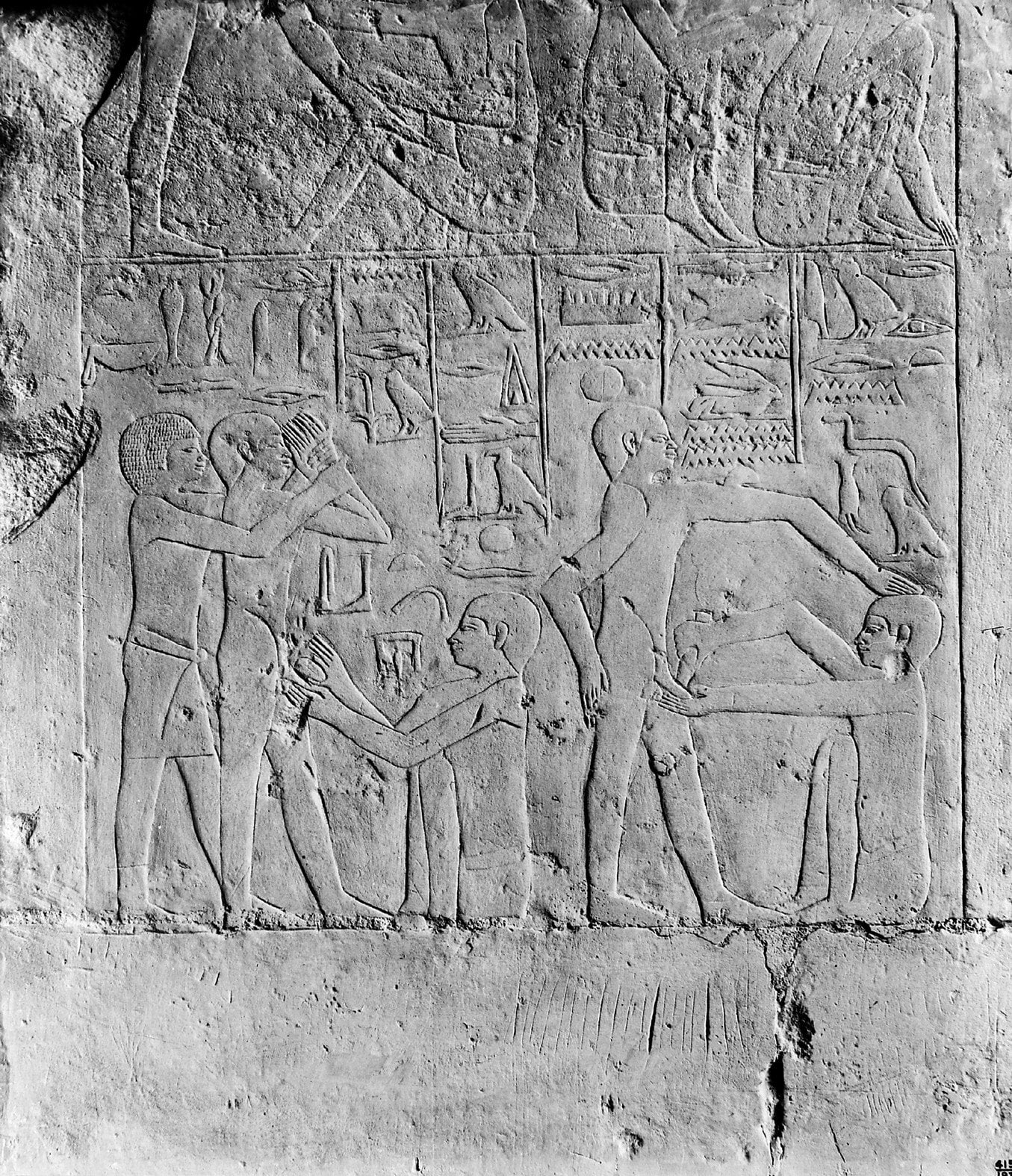
Egyptian circumcision, in the tomb of the Vizier Ankhmahor and his wife Mereruka. Old Kingdom, ca. 2400 BC, Sakkara. Oriental Institute in Chicago, Illinois. Conversational inscription in comments [1355×1575]
by Remote_Finish_9429

Egyptian circumcision, in the tomb of the Vizier Ankhmahor and his wife Mereruka. Old Kingdom, ca. 2400 BC, Sakkara. Oriental Institute in Chicago, Illinois. Conversational inscription in comments [1355×1575]
by Remote_Finish_9429
1 Comment
Original relief line-art of an ancient Egyptian stela from Ankhmahor’s tomb dating to Dynasty 6 and reign of King Teti (2355-2343 BCE) which appears on the east thickness of a doorway in the tomb in the pyramid complex of Teti now on display at the Oriental Institute in Chicago, Illinois. Depicting two men being circumcised, the scene has been interpreted in different ways however the nude male at right is surmounted by an inscription in which he says: sin wnnt r mnx (“Sever, indeed, thoroughly”) and the man kneeling before him, identifed as a Hm-kA, mortuary priest, says: iw(.i) r irt r nDm (“I will proceed carefully”). Finally the man doing the restraining is saying: nDr sw m rdi dbA.f (“Hold him fast. Do not let him faint”) whilst the restrainer says: iri.i r Hst.k (“I will do as you wish”). The Greek historian Herodotus, writing in the mid fifth century BCE, stated the Egyptians “practise circumcision for the sake of cleanliness, considering it better to be cleanly than comely.”