
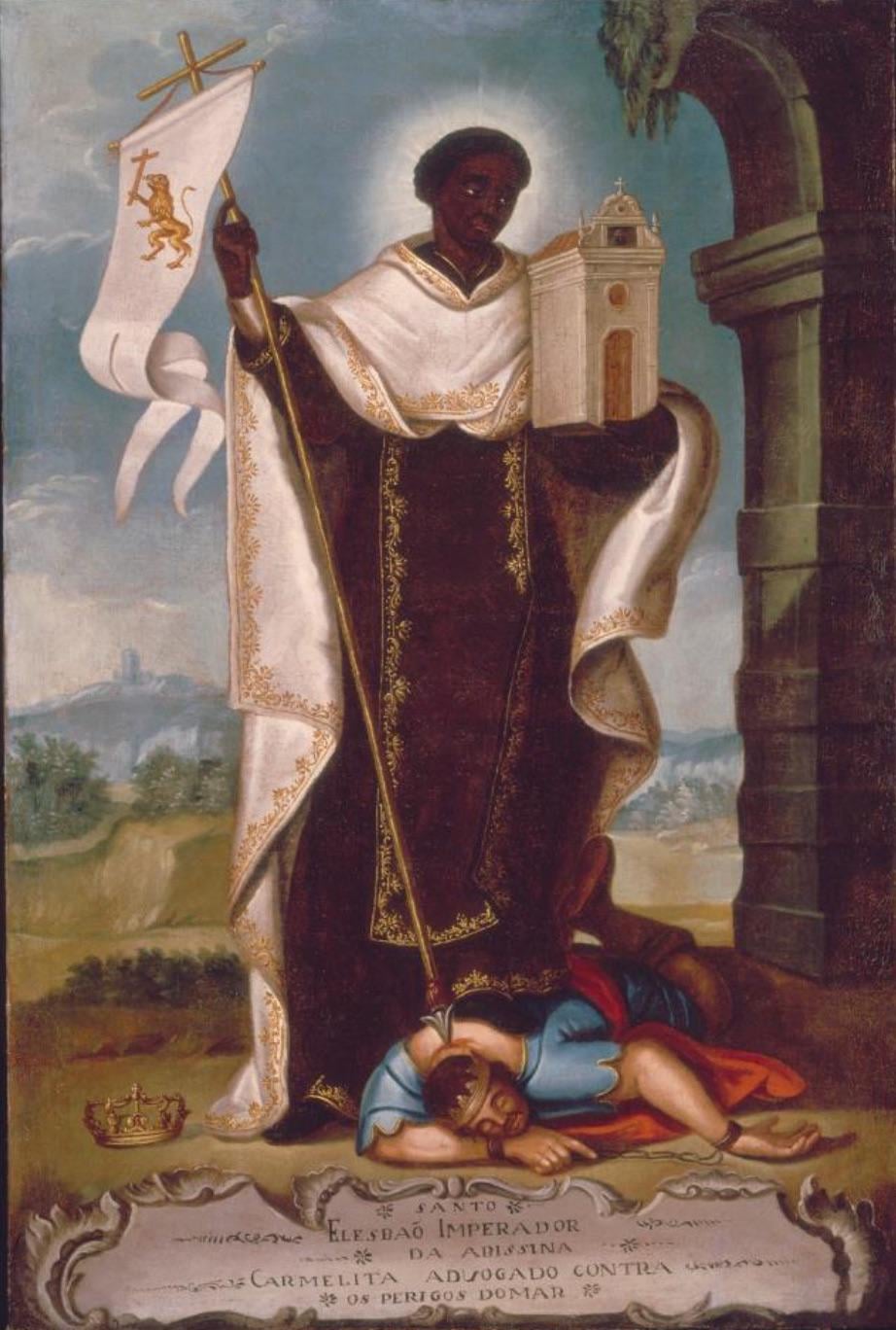
Anonymous 18th century painting from Portugal, captioned “Saint Elesbaan having slaughtered Evil.” It depicts the Amhara King Kaleb of Aksum, Ethiopia during his vengeful crusade against the Jewish Kingdom of Himyar, c. 520 AD [922×1368].
by Electronic-Tiger5809
4 Comments
The Christian community in 6th century Yemen was fairly diverse. The inhabitants of Zafar were mostly Aksumites. Those of Najran came from all over the Christian world—Greece, Egypt, Syria, and so forth.
As retribution for the violence against these Christians by the Jewish King Dunaan (AKA Joseph dhu Nuwas), King Kaleb carried out a large slaughter of the non-Christian population of Yemen. He forced surviving Jews to tattoo the cross on their bodies as a sign of their new faith.
After several months of personally occupying Himyar, King Kaleb appointed a loyal, local Christian vassal to rule on his behalf and returned to Ethiopia. Upon reaching Aksum, the king constructed and consecrated the Church of Mariam Tsion (Zion).
It is one of the oldest churches in Ethiopia and Africa more broadly, and is visited by tens of thousands of Christians for the annual feast day of St. Mary.
For an archaeological study of important pre-Aksumite, Aksumite, and post-Aksumite artefacts, check out “Colonialism, Collapse, Continuity,” [available here](https://ebnemelek.substack.com/p/colonialism-collapse-continuity). Chapter one is presented in [video format here](https://www.reddit.com/r/EbneMelek/s/h31geY97sI).
For more info on the crusade specifically, check out “The Throne of Adulis” by Bowersock.
This painting has such a unique charm! The details in the clothing and the expression on the subject’s face really pull you in.
I want this on my wall NGL
King Kaleb was born in Axum (which is in modern day Tigray) in the 6th century AD.
Why call him an “Amhara King”? Earliest references to any sort of Amhara identity aren’t even recorded until 12th/13th century.
Based on your previous posts it’s clear you’re on a mission to the claim history of other groups (in particular Tigrayans) as Amhara. The Amharas have a proud and noble history, this deliberate erasure of Tigrayan history and identity gives Amhara’s a bad name and unfortunately fulfils a stereotype many people have about Amharas. Do better – for your own people’s reputation if nothing else.