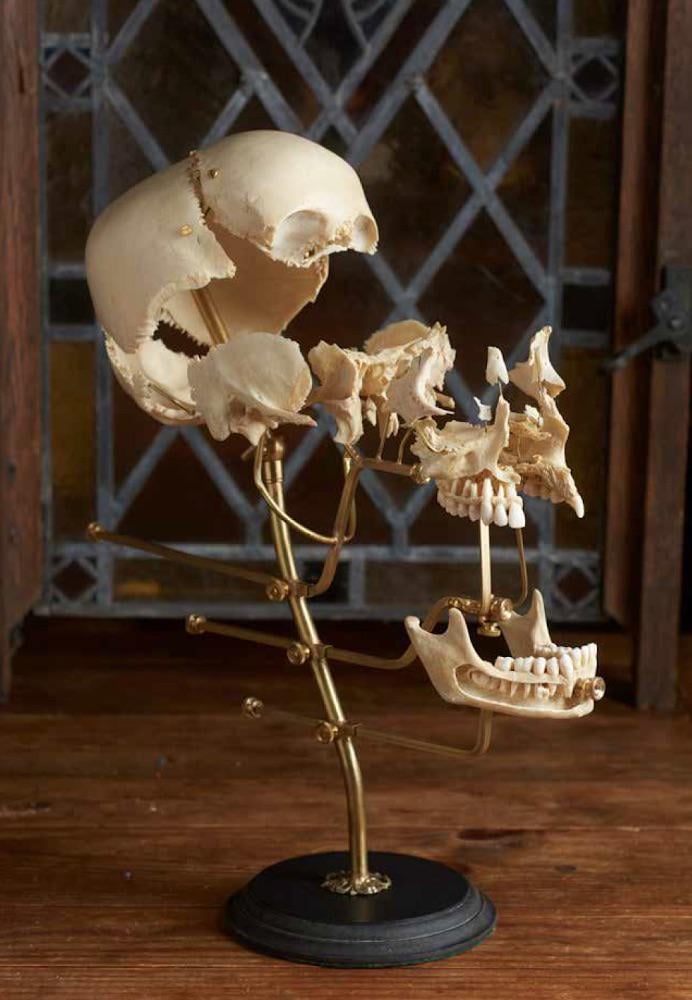
Beauchêne (or Exploded) Skull of a 14-year-old French girl whe died in the late nineteenth century. Featured in the book “Skulls: Portraits of the Dead and the Stories They Tell” [692 x 1000]
by bozofire123

Beauchêne (or Exploded) Skull of a 14-year-old French girl whe died in the late nineteenth century. Featured in the book “Skulls: Portraits of the Dead and the Stories They Tell” [692 x 1000]
by bozofire123
2 Comments
😭 why do that to her
A skull prepared using the Beauchêne method, also known as an exploded skull, is a meticulously dissected anatomical specimen in which the individual bones are separated and mounted in their natural positions but slightly spaced apart. This technique provides a detailed view of the skull’s structural components, including the cranial bones, sinuses, and intricate pathways for nerves and blood vessels, particularly those related to the teeth and jaw.
The method is named after French anatomist Claude Beauchêne, who pioneered this approach to better illustrate the complexity of cranial anatomy. Traditionally used in medical and dental studies, Beauchêne-prepared skulls allow students and researchers to examine the articulation of the skull’s many bones—especially the temporal, maxillary, and sphenoid bones—in a way that would otherwise be obscured in a fully intact specimen.
Today, these specimens are valued not only in medical education but also as striking displays in museums, private collections, and cabinets of curiosity. The intricate craftsmanship required to create an exploded skull makes each piece a remarkable
Source: Skulls: Portraits of the Dead and the Stories They Tell” by Paul Gambino