
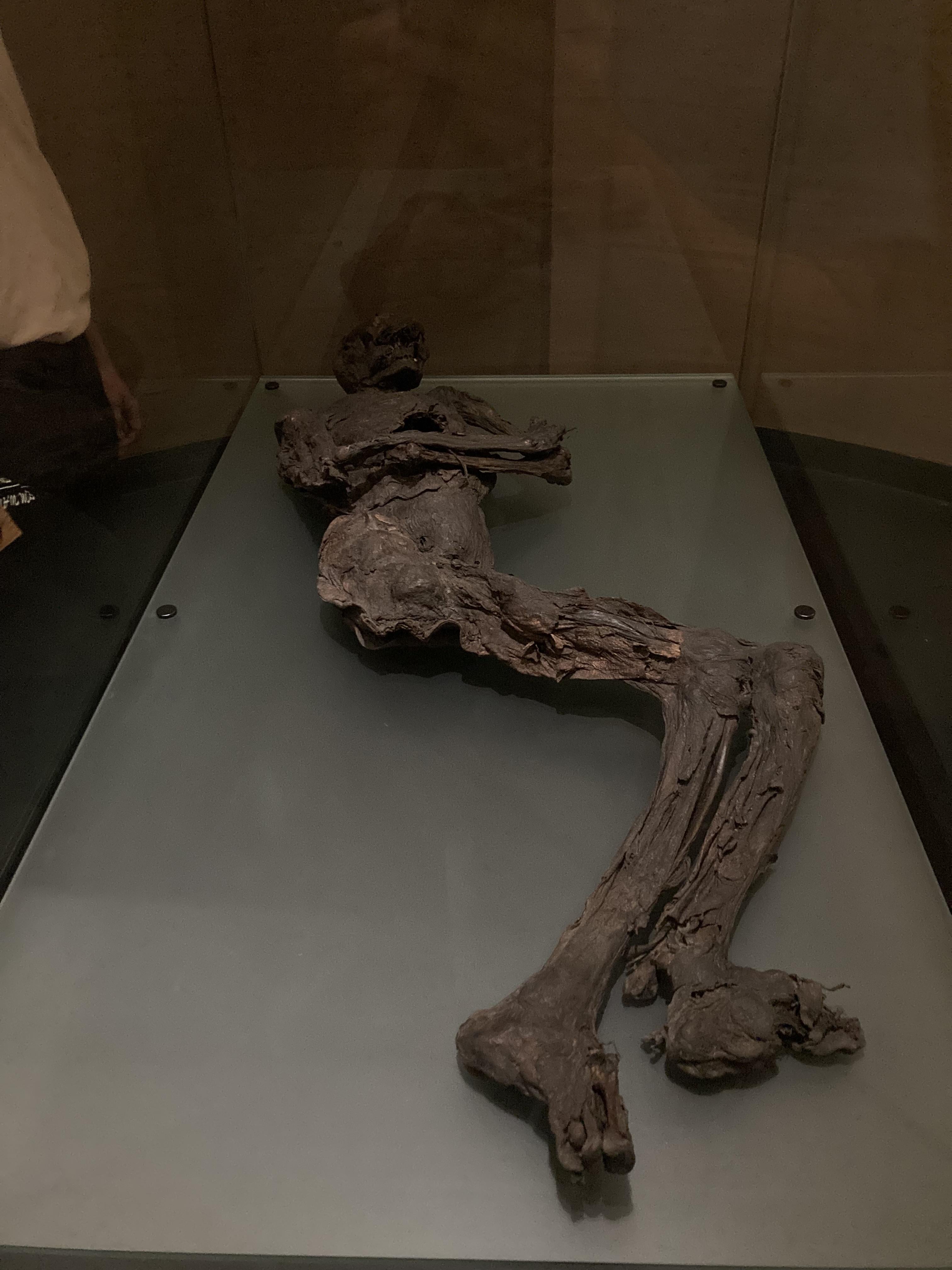
Gallagh Man is estimated to have lived sometime between 470BC and 120BC. At the time of his death, he was about 25 years old, and was healthy, standing about 6 feet tall, with red hair. He was killed by being strangled with a rope made of twisted willow twigs, the remains of which were still around his throat upon discovery. Perhaps he was murdered or executed for having committed a crime; it is, however, widely believed that, as was probably the case with most bog bodies, he was ritually sacrificed. He was buried in a 10-foot-deep grave, and was pinned down with ropes tied to 2 wooden stakes, likely to prevent the body from rising to the surface in the marshy landscape.
For over 2 millennia, Gallagh Man lay undisturbed in his grave until in 1821 he was uncovered by laborers excavating peat. The bog’s high acidity, low temperature, and lack of oxygen had naturally mummified his body. Still cloaking his body was a deerskin cape; he was otherwise naked. The O’Kelly family, who then owned the land in which he was discovered, unceremoniously turned him into an attraction, by charging visitors a fee to “uncover” the body, after which the body was reburied for the next paying spectator. They also moved the body to different locations on their property. Unfortunately, all of this caused damage; the cloak was badly fragmented, while little today remains of the once full-head of hair and beard.
In 1829, Gallagh Man was bought by the Royal Irish Academy and brought to Dublin. Later, he was transferred to the National Museum of Ireland – Archaeology, where today visitors can examine his remains and imagine a life which ended abruptly more than 21 centuries ago.
by japanese_american