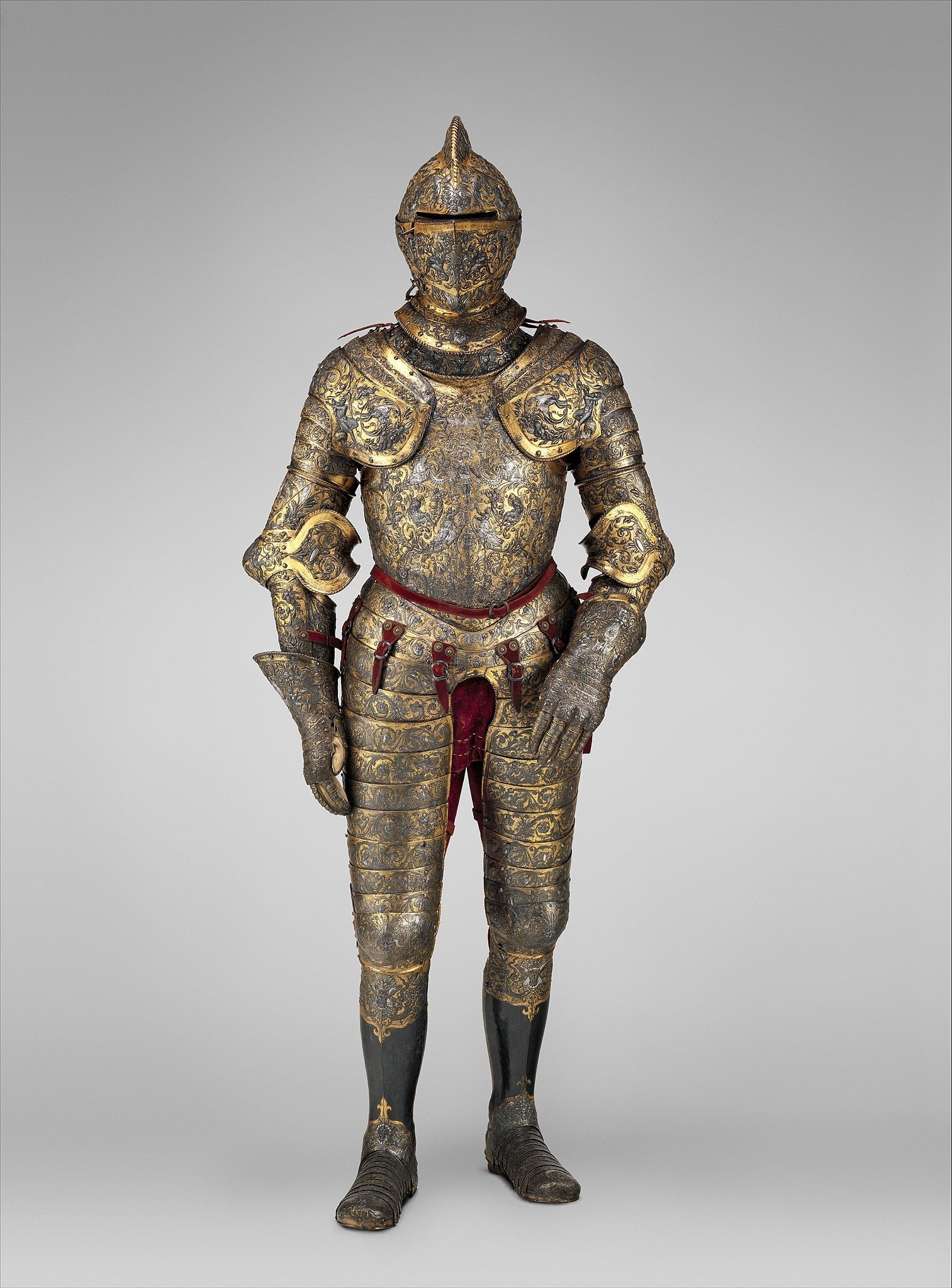
Armor of Henry II, King of France who reigned 1547–59. H. 74 in. (187.96 cm); Wt. 53 lb. 4 oz. (24.20 kg) MET [1513×2048]
by Remote_Finish_9429

Armor of Henry II, King of France who reigned 1547–59. H. 74 in. (187.96 cm); Wt. 53 lb. 4 oz. (24.20 kg) MET [1513×2048]
by Remote_Finish_9429
2 Comments
https://www.metmuseum.org/art/collection/search/24671
This is one of the most elaborate and complete French parade armors, and it retains much of its original coloring. The surfaces are covered by dense foliate scrolls inhabited by human figures and a variety of fabulous creatures that derive from the Italian grotesque. The decoration includes, at the center of the breast, a Roman warrior receiving tribute of arms from two kneeling females and, on the shoulders, Apollo chasing the nymph Daphne (front) and Apollo with the slain monster Python (back). The crescent moon, one of the badges of Henry II (reigned 1547–59), appears in several places.
He is famous for having died during a knightly tournament organized in a streetof Paris. His opponent stabbed him in the eye with a spear. Surgeons did the rest.