
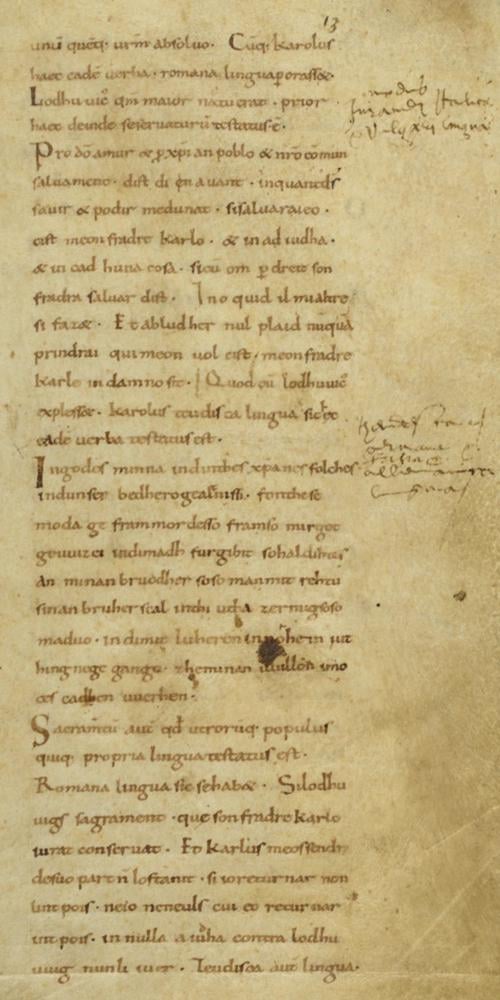
The Oath of Strasbourg, sworn on 14 February 842 by Louis the German and Charles to Bald to each other’s armies to create an alliance against Lothair I. The oath contains one of the earliest written texts of the French and German languages. Text and translation in comments. [500×1000]
by zhuquanzhong
2 Comments
Louis the German, king of East Francia (Germany), takes an oath before the West Francian (French) army in pre-Old French:
*Pro Deo amur et pro christian poblo et nostro commun saluament, d’ist di en auant, in quant Deus sauir et podir me dunat, si saluarai eo cist meon fradre Karlo, et in adiudha et in cadhuna cosa, si cum om per dreit son fradra saluar dift, in o quid il mi altresi fazet. Et ab Ludher nul plaid nunquam prindrai qui meon uol cist meon fradre Karle in damno sit.*
Translation: For the love of God and Christiandom and our joint salvation, from this day onward, to the best of my knowledge and abilities granted by God, I shall protect my brother Charles by any means possible, as one ought to protect one’s brother, insofar as he does the same for me, and I shall never willingly enter into a pact with Lothair against the interests of my brother Charles.
The army of West Francia replies:
*Si Lodhuvigs sagrament, que son fradre Karlo iurat conservat, et Karlus meos sendra de suo part non los tanit, si io returnar non l’int pois, ne io ne neuls, cui eo returnar int pois, in nulla aiudha contra Lodhuvig nun li iv er.*
Translation: If Louis keeps the oath which he has sworn to his brother Charles, and my lord Charles on the other hand breaks it, if I cannot dissuade him from it—neither I nor anyone else whom I could dissuade from it—then I shall render him no aid against Louis.
Charles the Bald, king of West Francia (France), takes an oath before the East Francian (German) army in Ripuarian Frankish High German:
*In Godes minna ind in thes christianes folches ind unser bedhero gealtnissi, fon thesemo dage frammordes, so fram so mir Got gewizci indi mahd furgibit, so hald ih tesan minan bruodher, soso man mit rehtu sinan bruodher scal, in thiu, thaz er mig sosoma duo; indi mit Ludheren in nohheiniu thing ne gegango, zhe minan willon imo ce scadhen werhen.*
(The translation is essentially the same as Louis’ oath)
The army of East Francia replies:
*Oba Karl then eid, then er sinemo bruodher Ludhuwige gesuor, geleistit, indi Ludhuwig min herro, then er imo gesuor, forbrihchit, ob ih inan es irwenden ne mag, noh ih noh thero nohhein, then ih es irwenden mag, widhar Karle imo ce follusti ne wirdit.*
(The translation is essentially the same as the West Francian army’s oath)
the French looks like bad Latin, but the German still looks kind of like german.