
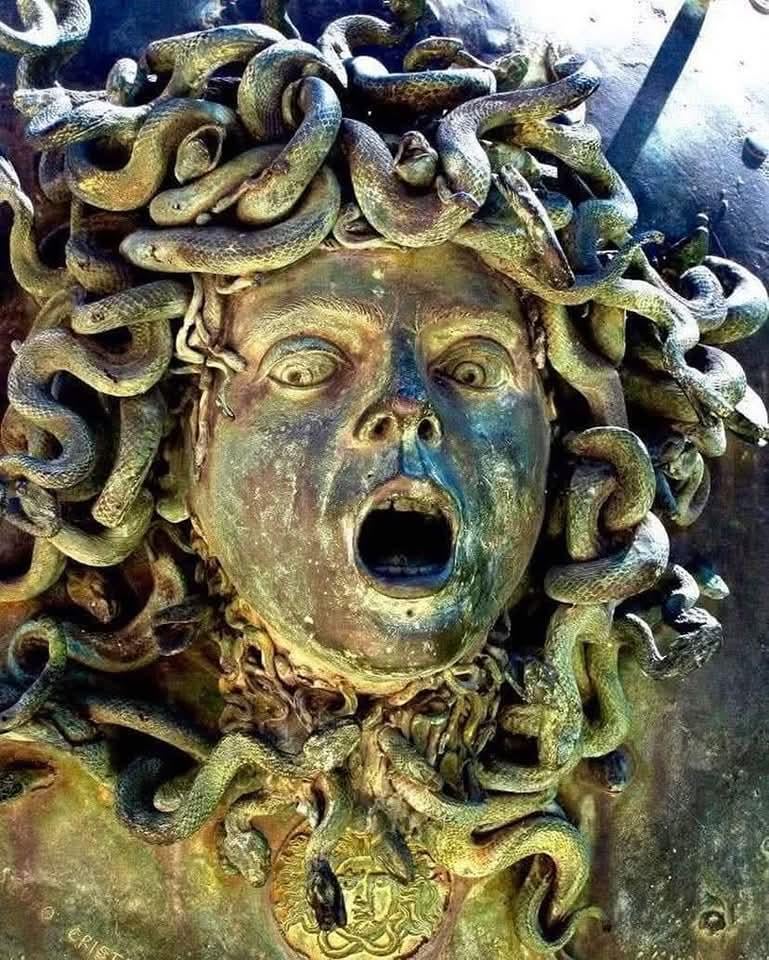
The Bronze Head of Medusa (120 AD), a remarkable artifact that exemplifies Roman art and mythology, unearthed at Hadrian’s Villa in Tivoli, Italy. Hadrian’s Villa was an extravagant retreat for Emperor Hadrian, showcasing the grandeur and opulence of the Roman elite. [769×960]
by Party_Judgment5780
1 Comment
The villa complex, now a UNESCO World Heritage Site, contains numerous structures, gardens, and pools, all designed to reflect Hadrian’s personal tastes and intellectual pursuits. The fusion of Greek, Egyptian, and Roman architectural elements within the villa underscores the emperor’s fascination with different cultures. The discovery of works such as the Bronze Head of Medusa provides a deeper understanding of the cultural and artistic expressions that flourished during Hadrian’s reign, highlighting the rich heritage of the Roman Empire.
The Bronze Head of Medusa, often linked to the mythological figure whose gaze turned people to stone, embodies the symbolic and artistic significance of such representations in Roman society. This artifact, along with other relics from Hadrian’s Villa, offers valuable insights into the spiritual and aesthetic beliefs that influenced Roman art. These discoveries shed light on the emperor’s vision for his villa—a space that merged personal and imperial grandeur, reflecting both the cultural diversity and artistic achievements of the Roman Empire.