
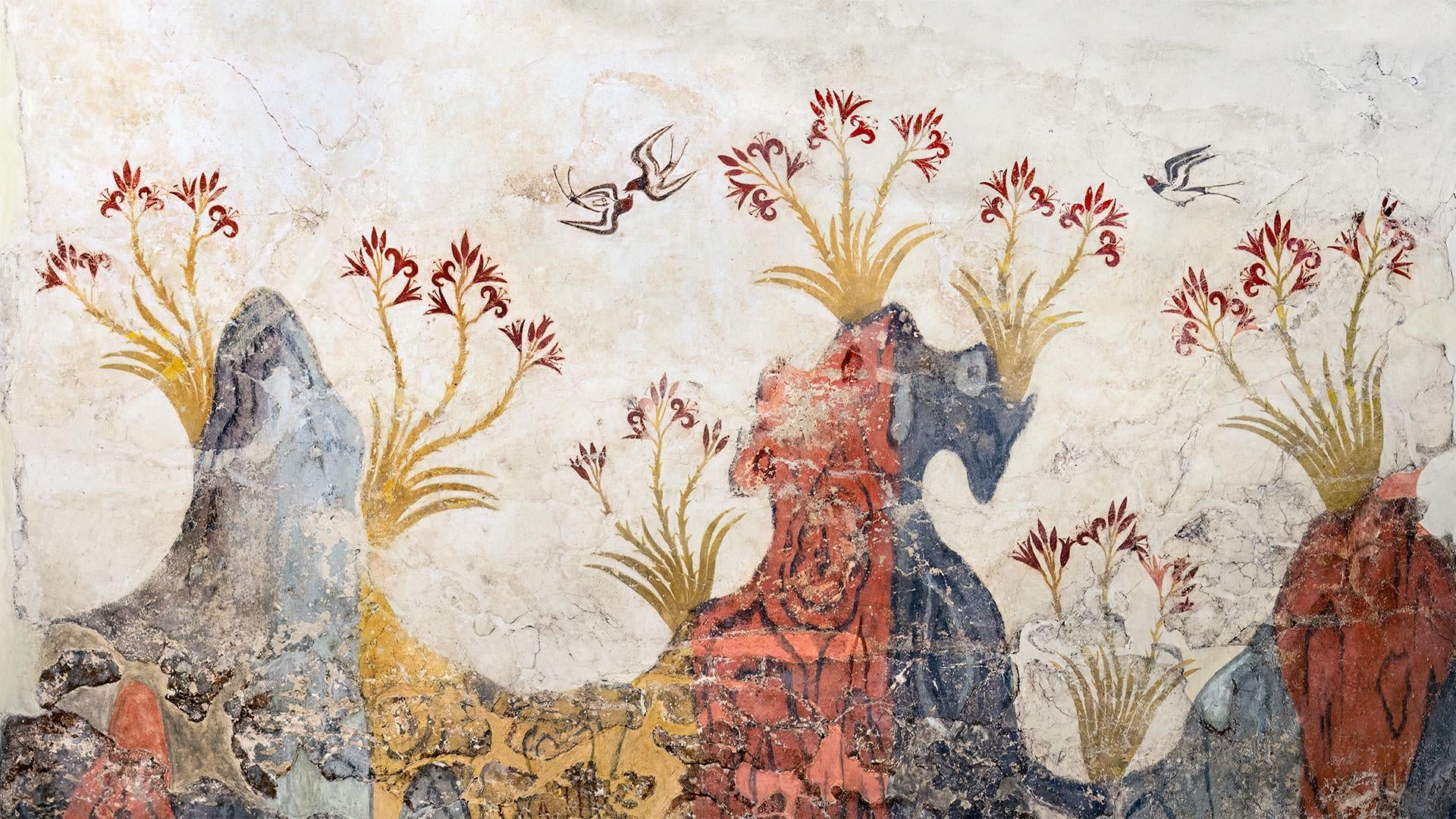
Spring Fresco, Akrotiri, Thera (Santorini), Greece, 1600 BC. The fresco depicts the brightly colored rocky landscape of the volcanic island dotted with blossoming lilies and flying swallows. It might be, some say, the first time an artist created art from the surrounding landscape…[1920×1080] [OC]
by WestonWestmoreland
1 Comment
..The Akrotiri Spring Fresco was discovered in 1967. It is one of the Wall Paintings of Thera and a leading example of Minoan/Cycladian painting. It dates back to the Bronze Age.
The blossoming lilies that dominate the composition help us to imagine the landscape of the island before the devastating Theran eruption.
Around 1600 BCE, a disastrous earthquake, followed by a volcanic eruption, covered the city of Akrotiri in the island of Thera in a thick layer of pumice and ash, which resulted in the remarkable conservation of frescoes from multiple buildings throughout the town.
To create such vibrant frescoes, a smooth lime plaster was applied to the walls and then painted over. It is impossible to know whether the match was a competitive one or simply a routine sport.
Thera is the best-known Minoan site outside Crete, likely homeland of the culture. The island was not known as Thera at this time. Only the southern tip of the large town of Akrotiri has been uncovered, yet it has revealed complexes of multi-level buildings, streets, and squares with remains of walls standing as high as eight metres, all entombed in the solidified ash of the famous eruption of Thera. The site was not a palace-complex as Knossos in Crete, nor was it a conglomeration of merchant warehousing. Its excellent masonry and fine wall-paintings reveal a complex community. A loom-workshop (as well as other frescoes depicting Theran women) suggests advanced and organized textile weaving for export. This Bronze Age civilization thrived between around 3000 and 1000 BC, reaching its peak in the period between 2000 and 1630 BC.
The volcanic eruption on the island of Thera, now known as Santorini, was one of the largest Plinian eruptions in the past 10,000 years, with a range of 30–40 cubic kilometres. An eruption of this size would have most likely generated a tsunami over 100 feet tall, travelling across the Aegean Sea and decimating populations in its path. The size of this eruption had far-reaching impacts on the environment and Civilization in the region, primarily the Minoans. The thick layer of pumice and ash from the volcano covered the island and preserved much of the alienation for thousands of years. As a result, several pieces of Minoan artwork, primarily the frescoes, were preserved as fragments in the rubble, and have been painstakingly reassembled by archaeologists. These frescoes provide modern society with invaluable insight into the daily lives of the Cycladic people.
Thera is regarded as part of the Minoan world, although the culture of Thera was somewhat different from that of Crete, and the political relationship between the two islands at the time is unclear.
The Minoan civilization was a Bronze Age Aegean civilization on the island of Crete and other Aegean Islands, flourishing from c. 2700 to c. 1450 BC until a late period of decline, finally ending around 1100 BC.
It represents the first advanced civilization in Europe, leaving behind massive building complexes, tools, stunning artwork, writing systems, and a massive network of trade. The name “Minoan” derives from the mythical King Minos and the identification of the site at Knossos with the labyrinth and the Minotaur…