
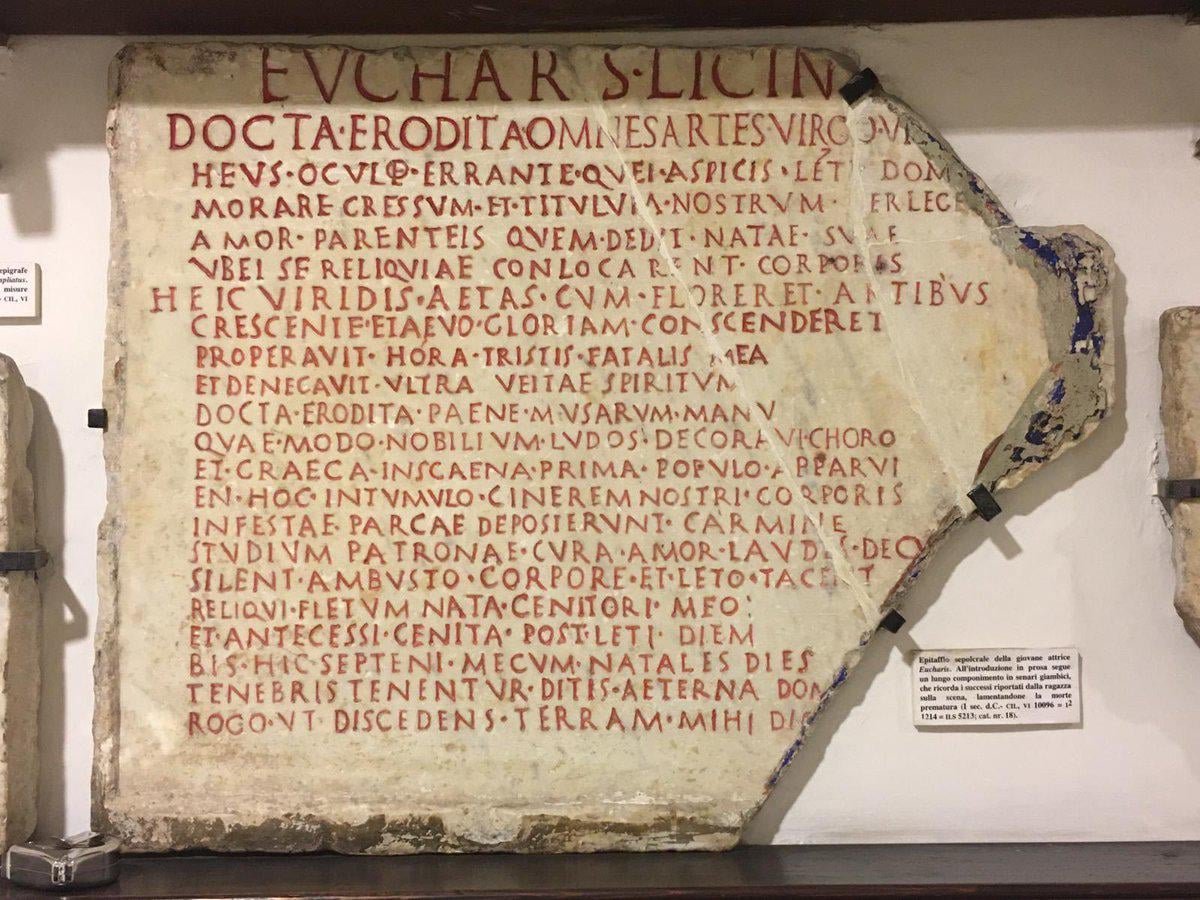
The epitaph of Licinia Eucharis, an ancient Roman stage actress who died at the age of 14. She is one of the few ancient actresses known to have achieved fame and respect in her profession during the Roman Republic. The 1st century BCE epitaph on her tomb was written by her father [1200×900]
by Fuckoff555
3 Comments
[https://en.m.wikipedia.org/wiki/Eucharis_(actress)](https://en.m.wikipedia.org/wiki/Eucharis_(actress))
[https://it.m.wikipedia.org/wiki/Eucaride](https://it.m.wikipedia.org/wiki/Eucaride)
Her epitaph is considered by some to be the “best composition of Latin poetry”. It reads:
> (Latin)
> «EUCHARIS LICINIAE L
DOCTA ERODITA OMNES ARTES VIRGO VIXIT AN XIIII.
HEVS OCVLO ERRANTE QVEI ASPICIS LETI DOMVM
MORARE GRESSVM ET TITVLUM NOSTRVM PERLEGERE
AMOR PARENTIS QVEM DEDIT NATAE SVAE
VBI SE RELIQVIAE CONLOCARENT CORPORIS.
HEI VIRIDIS AETAS CVM FLORERET ARTIBVS
CRESCENTE ET AEVO GLORIA CONSCENDERENT
PROPERAVIT HORA TRISTIS FATALIS MEA
ET DENEGAVIT VLTA VEITAE SPIRITVM.
DOCTA ERODITA PAENE MVSARVM MANV
QVAE MODO NOBILIUM LVDOS DECORAVIT CHORO
ET GRAECA IN SCAENA FIRST POPULO APPEARED
EN HOC ON TVMVLO CINEREM NOSTRI CORPORIS
INFESTAE PARCAE DEPOSIERVNT CARMINE
STVDIVM PATRONAE CVRA AMOR LAVEDS DECVS
SILENT AMBUSTO CORPORE ET LETO IACENT
RELIQVI FLETVM BORN PARENTS MEO
ET ANTECESSES GENITA POST LETI DIEM
BIS HIC SEPTENI MECVM NATALES DIES
TENEBRIS TENENTUR DITIS AETERNA DOMV
ROGO VT DISHENDENS TERRAM MIHI DICAS LEVEM.»
> «Eucaride, freedwoman of Licinia,
a young girl educated in every art who lived fourteen years.
O you, who turning your wandering eyes
see this inn of death, stop and read:
a father’s love has dedicated
this monument to the ashes of a daughter.
O God! While my youth flourished in the cultivation of the arts,
and my reputation grew with the years,
the fatal hour hastened to seize me
and took away my vital breath.
Skilled in music and led, so to speak, by the hand of the Muses,
she was the ornament of the chorus in the shows given by the nobles:
I had appeared for the first time in Rome on the Greek stage, when the cruel Parcae hurled my body
into a tomb . The affection of my mistress, her tender solicitude, her love, her applause, her graces, all are silent on my pyre, all are swallowed up by death. My fourteen years will remain with me in the darkness of Pluto’s eternal abode. As you depart from me, passenger, make vows, I beg you, that the earth may be light on my ashes.”
They were/needed to more mature at that time.
14 and acknowledged actress…impressive.
Women and girls were not allowed to perform in Ancient Greece, but in Ancient Rome they were allowed to perform as pantomime dancer-actresses, usually in less prestigious theaters. It was not regarded as a respectable profession, and therefore often performed by slaves or freedwomen.
Licinia was born a slave and became a freedwoman, likely due to her success in theater. According to the inscription she was so exceptional that she performed on the stage for Greek theater, i.e., the more prestigious theaters that usually banned female performers.
Her patron was probably her former owner who freed her, and may have paid for the expensive inscription as well. But the inscription suggests her father is the author, although we know nothing about him. We also don’t know how she died.