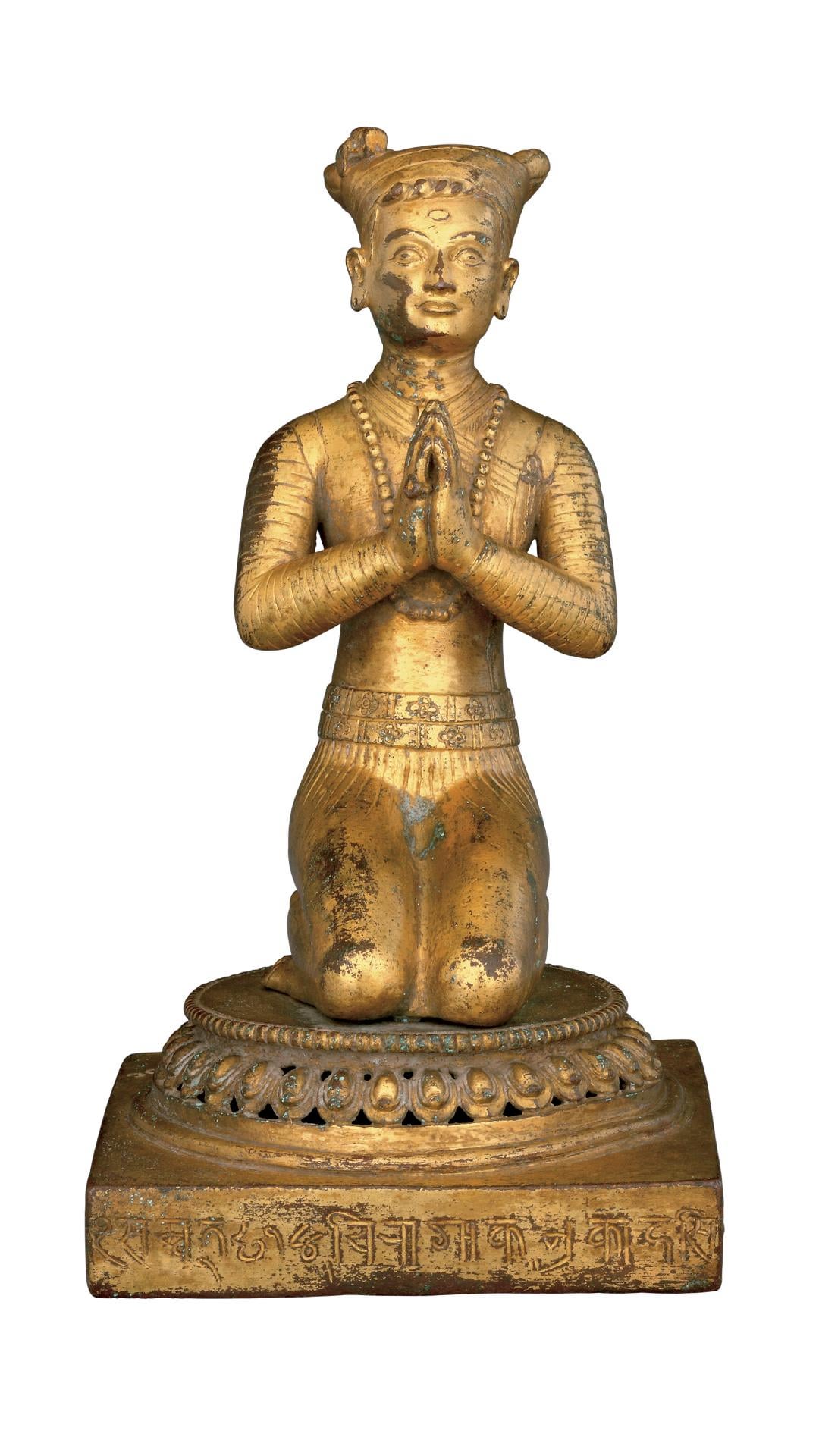
Commemorative Portrait of Ayurvriddhi. Gilt Bronze, 1694 CE, Nepal. Sir Ratan Tata Art Collection. On display at CSMVS museum, Mumbai, India.[1080×1920]
by Nice_Crew_449

Commemorative Portrait of Ayurvriddhi. Gilt Bronze, 1694 CE, Nepal. Sir Ratan Tata Art Collection. On display at CSMVS museum, Mumbai, India.[1080×1920]
by Nice_Crew_449
1 Comment
Idealised dedicatory portraits, especially of royalty, have been common in Nepal. Even their presentation has been in a standardized format. The male figures are shown in kneeling posture with hands folded in namaskara mudra. Our image of Ayurvriddhi, which too is a dedicatory and commemorative one, shows him in a similar posture. His robe, turban, necklace, and lotus seat suggest that he must have been a prominent person.
The square base on which the lotus seat is mounted bears an inscription running on all four sides. It reads: “On the eleventh day of the dark half of Phalgun (Newari Cira) month of Nepal Samvat 814 [1694 CE] Ayurvriddhi passed away. His sons Jasavriddhi, Dharmaraja, Ayamanandara, all these brothers commissioned the statue.”
[Museum](https://csmvs.in/collections/commemorative-portrait-of-ayurvriddhi/)