
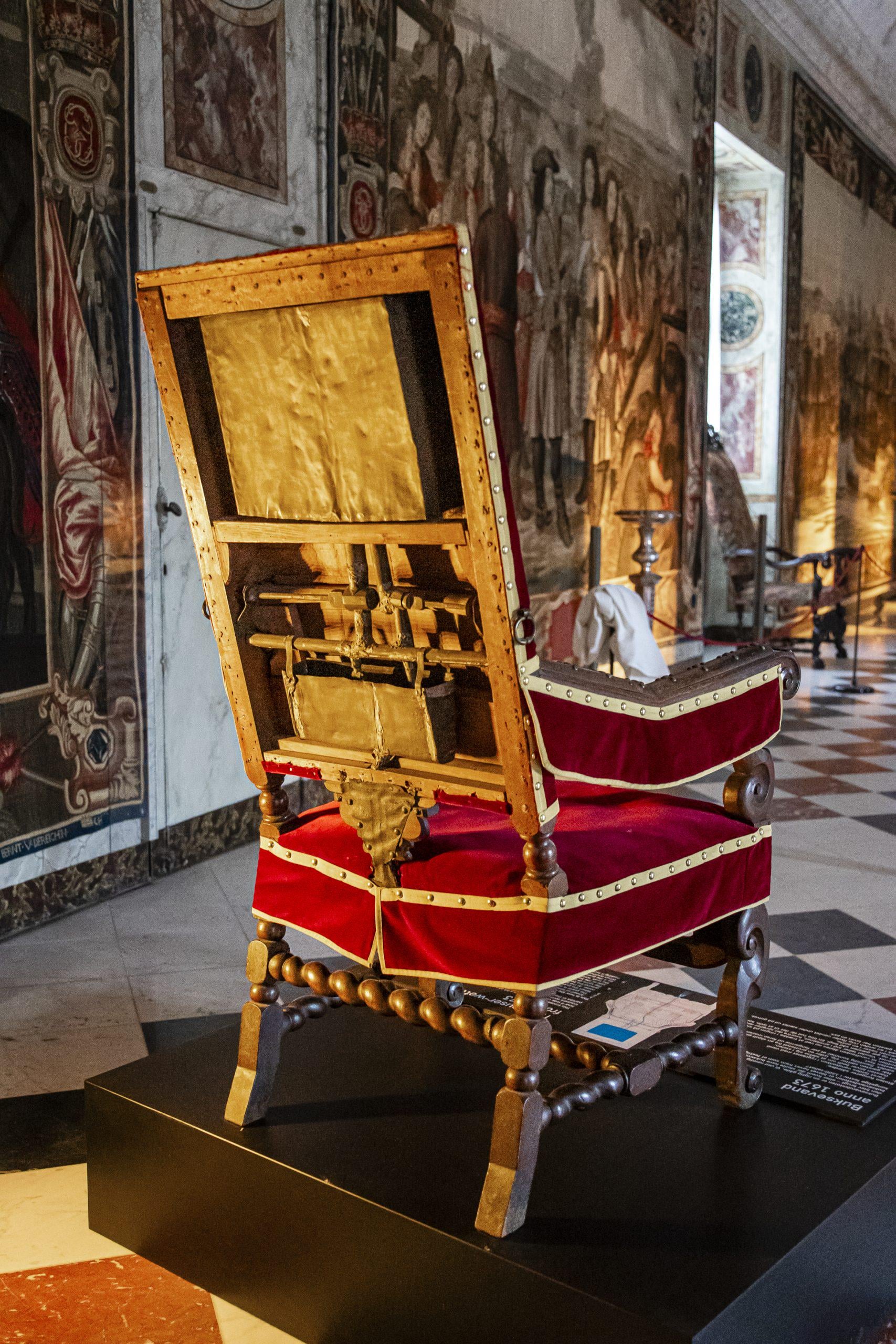
Chair from the court of Christian V of Denmark. The chair has trapping mechanisms in the arms, a bellow in the seat that acts as a whoopee cushion and a water tank in the back to emulate the sound of the sitter peeing their pants. Late 17th century. [1707×2560]
by house_of_ghosts
1 Comment
https://www.kongernessamling.dk/rosenborg/danmarks-aeldste-pruttepude/
https://via.ritzau.dk/pressemeddelelse/14265749/ny-forskning-afslorer-historien-bag-danmarks-aeldste-pruttepude
> **New research reveals the story behind Denmark’s oldest whoopee cushion**
>A very special royal chair from the late 17th century can both hold a person captive, make you wet your pants and has a hidden whoopee cushion in the seat. The chair can be experienced from February 18 at Rosenborg Castle in a new small exhibition, which is based on an award-winning research article about the chair’s use and history.
> The ‘Pants Wetting Chair’ at Rosenborg Castle has been around for about 350 years, but until now no one really knew its history and what it was actually used for at the Danish court. But two PhD students, an art historian and a historian from the University of Copenhagen, have changed that with new research.
> “At first glance, the Panty Chair looks like just a normal, old chair, but it has built-in farting and mischief. It has hidden trapping mechanisms in the armrests, a bellows in the seat that made farting sounds when you sat down and stood up from the chair, and a water container in the backrest that could provide pants wetting sounds. We got to know it when we were student assistants at Rosenborg Castle and showed guests around. We wondered why no one really knew anything about its original use. That’s why we decided to take a look at it to find out what untold story might be hidden here,” says Casper Thorhauge Briggs-Mønsted, PhD student at the Department of Art and Cultural Studies at the University of Copenhagen.
> “The design of the chair and its way into the Royal Art Chamber in the 18th century indicate that it originated in the court of Christian V. Although there have been very few sources available, we have found that its upholstery was so worn that it had to be replaced in 1752, when it entered the King’s Art Chamber, which tells us that it must have been used extensively. Unfortunately, the sources do not say anything about who was exposed to the chair’s mechanics and in what context this happened. We also found another fantastic source from 1775, which describes it as ‘a Lehne-Stol, which creaks when you sit in it, just like letting a wind blow’. The chair’s sound mechanism has therefore been perceived as a kind of fart cushion in the contemporary world,” explains Louise Kjærgaard Depner, PhD student at the SAXO Institute at the University of Copenhagen.
> “Christian V was an absolute monarch and he staged himself as the center of a complex network of strict rules for how one should behave at his court. However, in the sources we can also see that there was a great culture of pleasure at his court. On special occasions, the rules and hierarchies of everyday life were set aside for a little while in small breathing spaces. For example, at Shrove Tuesday, one could pretend to be someone else. And in connection with royal hunting, Christian V could punish hunting participants as a teasing humiliation to the great amusement of the rest of the court. The hidden mechanics of the trouser water chair would have fit perfectly into such an environment,” say Casper Thorhauge Briggs-Mønsted and Louise Kjærgaard Depner.
> The Buksevandstolen is unusually complex
In their research to learn more about the Danish Buksevandstolen, the two researchers came across other European mechanical chairs from the 16th and 17th centuries. Until now, these have never been connected.
> “We found that the Buksevandstolen is not the only mechanical chair in Europe from that time, but our research has revealed that it is quite advanced for its time. In addition to the Buksevandstolen at Rosenborg, there is a mechanical fang chair at the National Museum and another at Schloss Ambras in Austria. In addition, we have found descriptions of other chairs that no longer exist. The Buksevandstolen is the only one of all the mechanical chairs that has both a trapping mechanism, a water mechanism and a sound mechanism,” says Louise Kjærgaard Depner.
> Casper Thorhauge Briggs-Mønsted and Louise Kjærgaard Depner’s research has recently received The Society for Court Studies’ annual essay prize. The article about the trouser water chair and other mechanical chairs around Europe will be published in the international journal The Court Historian in spring 2025.
> And from February 18, you can experience it for yourself at Rosenborg Castle in the new mini-exhibition “The trouser water chair – royal teasing”, which is based on the history of the chair and the conclusions of the research. Here, you can, among other things, see the trouser water chair and hear what it must have sounded like when someone at court had trouser water.