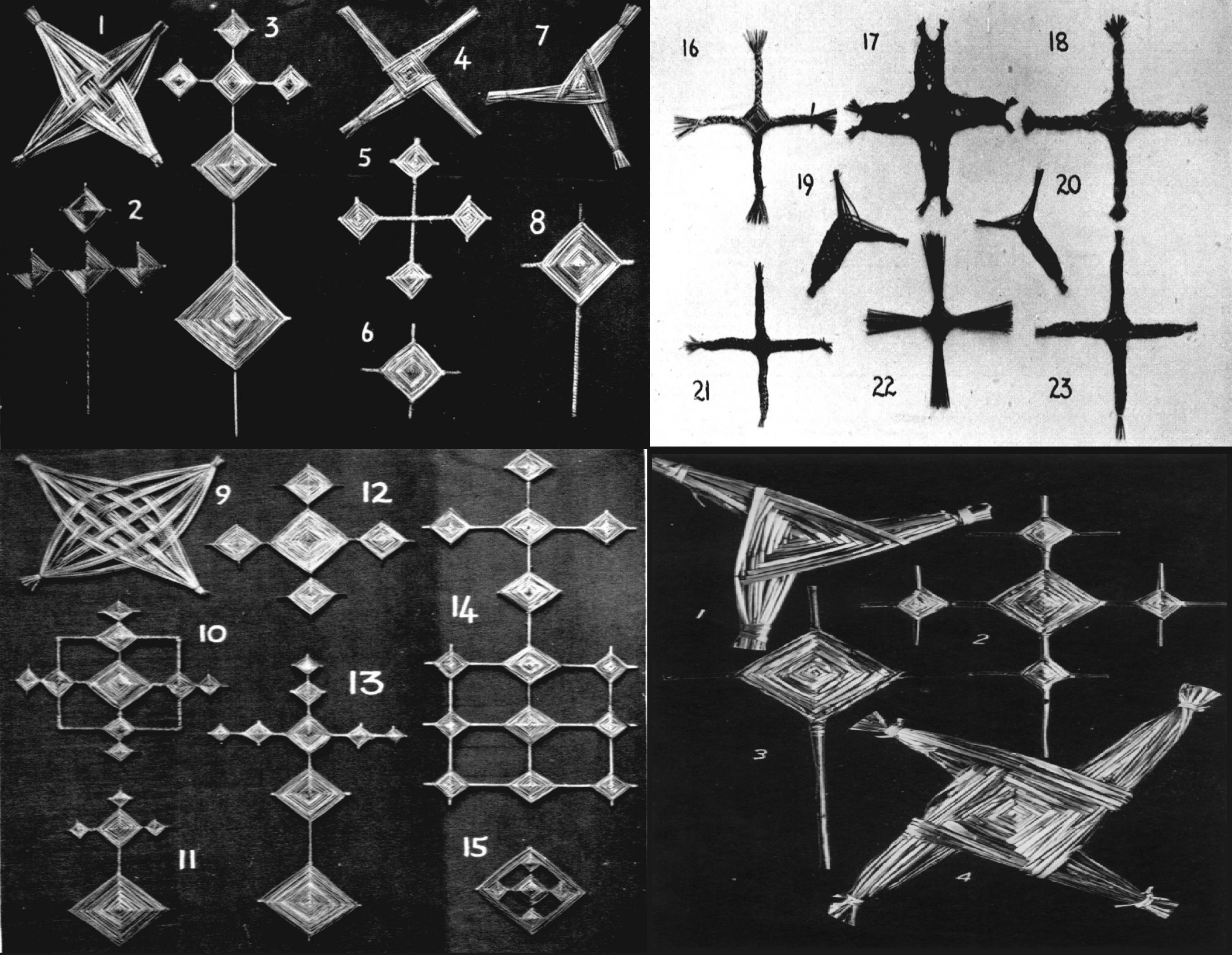
The tradition of hanging up woven crosses in one’s house is first attested in Ireland in the 1680s; apparently originally for Candlemas, before later becoming associated with St Brigid, whose feast day happens to fall on the day before Candlemas. The earliest designs were simple Greek or Latin t-shaped crosses, sometimes even made out of wood rather than woven, but nowadays the swastika shape seen in No. 4 are the most common. The swastika cross is quite a recent design, probably not attested before the early 20th century, but its distinctiveness has made it a popular choice for logo and graphic design since at least the 1950s, when it was adopted as the logo of Ireland’s fledgling Health Service, as well as national broadcaster RTÉ.
The diamond or lozenge-shaped crosses were apparently more common in the southern parts of Ireland and were known as ‘Brigid’s Shield’ or ‘Brigid’s Buckler’, which were intended to be worn as part of a folk procession where a young girl playing the part of Brigid would be adorned with her shield as well as a crown of reeds, and would carry a cross and lead the other girls of the village in prayer. Unfortunately, folk practices relating to St Brigid seem to have become increasingly unpopular after the turn of the 20th century for whatever reason, although the crosses have managed to endure.
These images are from T. G. F. Paterson’s 1945 article, ‘Brigid’s Crosses in County Armagh’, which you can read [here](https://www.jstor.org/stable/20566478?seq=1) if you have JSTOR access.

1 Comment
The tradition of hanging up woven crosses in one’s house is first attested in Ireland in the 1680s; apparently originally for Candlemas, before later becoming associated with St Brigid, whose feast day happens to fall on the day before Candlemas. The earliest designs were simple Greek or Latin t-shaped crosses, sometimes even made out of wood rather than woven, but nowadays the swastika shape seen in No. 4 are the most common. The swastika cross is quite a recent design, probably not attested before the early 20th century, but its distinctiveness has made it a popular choice for logo and graphic design since at least the 1950s, when it was adopted as the logo of Ireland’s fledgling Health Service, as well as national broadcaster RTÉ.
The diamond or lozenge-shaped crosses were apparently more common in the southern parts of Ireland and were known as ‘Brigid’s Shield’ or ‘Brigid’s Buckler’, which were intended to be worn as part of a folk procession where a young girl playing the part of Brigid would be adorned with her shield as well as a crown of reeds, and would carry a cross and lead the other girls of the village in prayer. Unfortunately, folk practices relating to St Brigid seem to have become increasingly unpopular after the turn of the 20th century for whatever reason, although the crosses have managed to endure.
These images are from T. G. F. Paterson’s 1945 article, ‘Brigid’s Crosses in County Armagh’, which you can read [here](https://www.jstor.org/stable/20566478?seq=1) if you have JSTOR access.