
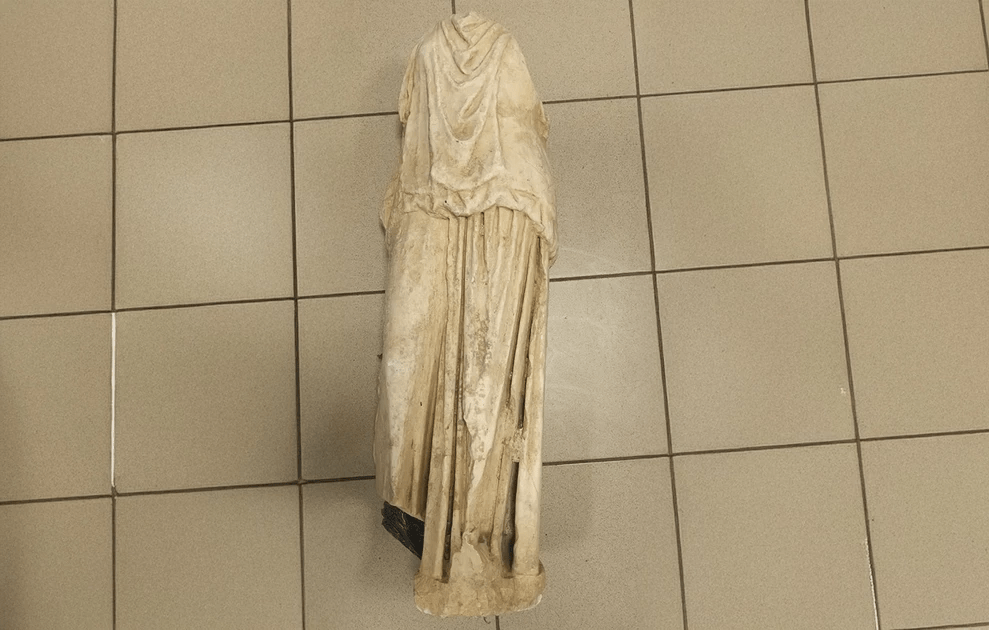
A man from Thessaloniki found an statue of a woman wrapped up inside a black plastic bag next to a trash bin. He informed the local authorities, just to find out that the statue dates back to 323–31 BC, spannig from the death of Alexander the Great to the Roman conquest of Ptolemaic Egypt. [989×630]
by Party_Judgment5780
5 Comments
Experts were brought in to examine the discarded artifact, and they eventually confirmed that it was ancient. How ancient? According to a statement issued by the Greek police, the statue dates back to the Hellenistic era, which covered the era from the death of Alexander the Great in 323 BC to around 31 BC. Presumably, the person who discarded the statue had no idea of its age, although there is really no way to know for sure why this individual decided to get rid of such a rare and unique item. Investigations are underway to learn more about the statue’s origins. The local police have transferred the artifact to investigators at Greece’s Cultural Heritage Protection Office, and it will soon undergo forensic analysis before being passed on to the local antiquities authority for safekeeping. Police have questioned one individual about the statue’s origins, but no charges have been filed.
The statue was found in Neoi Epivates, a suburb of Thessaloniki, Greece’s second-largest city. Standing just over 31 inches (80 cm) tall, it would not have been on display in some type of ancient public building. According to Bert Smith, a classical archaeologist at Oxford University, the marble statue was likely created for religious purposes. “The small size is typical for such marble votive offerings dedicated to deities in sanctuaries or temples,” Smith explained in an interview with the New York Times. In ancient Greece, “people would offer such dedications in gratitude for divine favor.”
Estelle Strazdins, a classicist from the Australian National University, told the Washington Post that the statue’s loose, flowing clothing and marble material means it likely represents a goddess. Statues of mortal women from this era were typically made of terra-cotta and portrayed in tighter, more modest clothing, further supporting the idea that this figure was meant to represent a deity. Strandings also believes the statue was likely a votive offering in a temple. Its small size, however, indicates it was not the central figure in the sanctuary. “It might be a gift someone offered to the god as thanks for a favor or in hopes of receiving a blessing,” she explained.
The figure on the statue is wearing what appears to be a peplos, a traditional wool garment worn by women in ancient Greece. However, the missing limbs and head do make it more difficult to identify the figure as a particular Greek deity. Bert Smith noted that the arms might have provided clues to the statue’s purpose or the attributes it was meant to represent. Missing limbs or heads are common with ancient statues since these parts are vulnerable to breakage when put under any kind of stress or pressure. This over-2,000-year-old statue will likely end up in a museum, no doubt accompanied by a plaque that will amuse visitors with the wild and crazy story of how it was recovered.
Sources:
[https://www.washingtonpost.com/world/2025/01/23/greek-statue-thessaloniki-trash/](https://www.washingtonpost.com/world/2025/01/23/greek-statue-thessaloniki-trash/)
[https://www.nytimes.com/2025/01/22/world/europe/ancient-greece-statue-trash-thessaloniki.html](https://www.nytimes.com/2025/01/22/world/europe/ancient-greece-statue-trash-thessaloniki.html)
[https://apnews.com/article/greece-ancient-statue-thessaloniki-ac751946c43686edc4fe6358aed10a5d](https://apnews.com/article/greece-ancient-statue-thessaloniki-ac751946c43686edc4fe6358aed10a5d)
the american mind cannot comprehend this
Don’t know if this is the case, but I’ve heard some people will deliberately hide or destroy artifacts they accidentally stumble on because they don’t want a swarm of archaeologist disturbing their land and/or business. I remember reading a story about a Greek fisherman who caught an Ancient Greek statue in his net and deliberately threw it back into the sea.
It’s not the best looking city as it’s been constantly destroyed and rebuilt throughout history but for whoever hasn’t already been there I can’t recommend enough Thessaloniki. Absolutely packed with history, get a guided tour and they’ll point out stuff you wouldn’t have noticed otherwise. Plus great food.
Intercepted a black market drop point?