
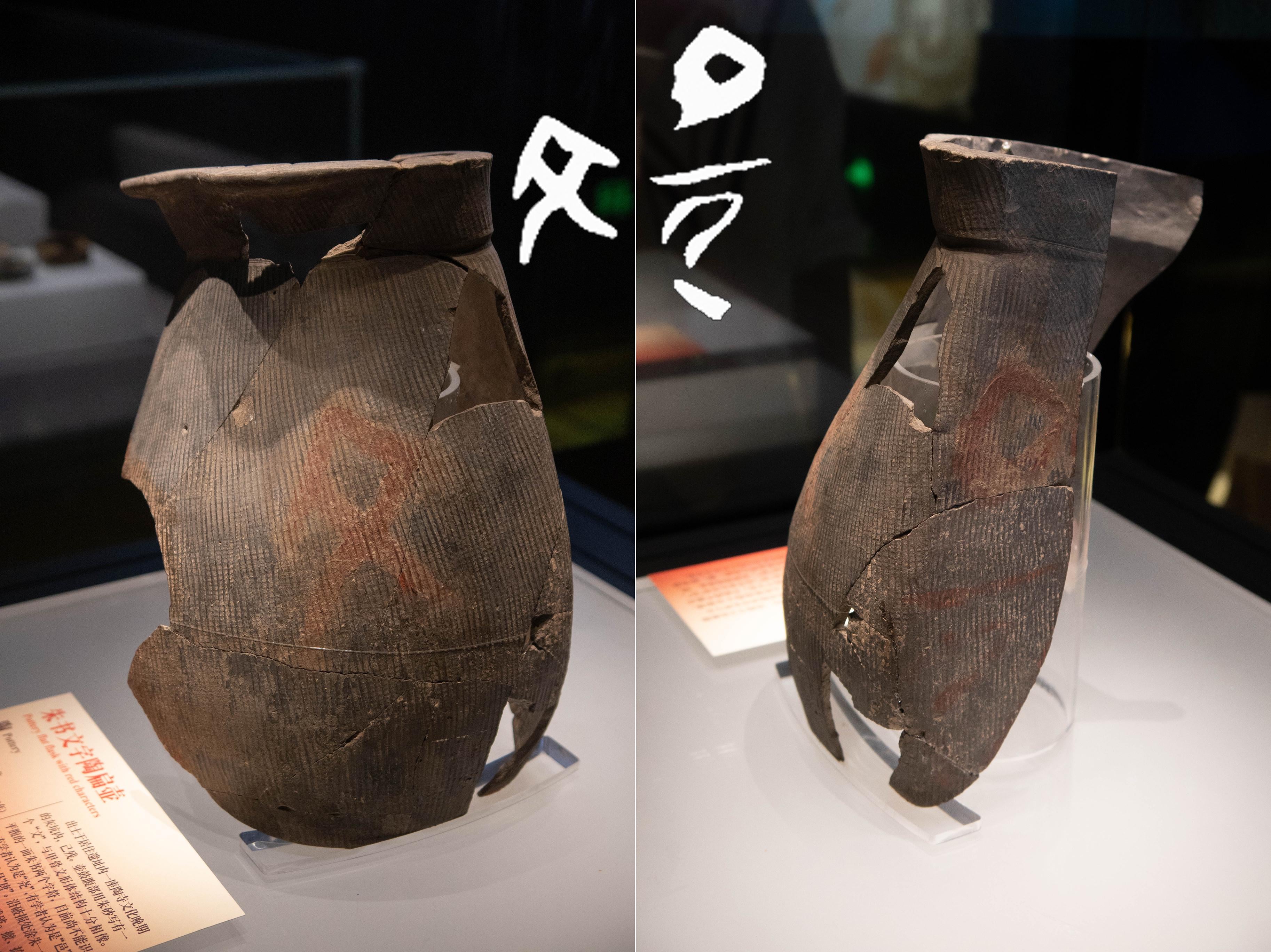
Red glyph flask, found at the Taosi archeological site, 2300-2000 BC, China. Two characters, either proto-writing or extremely early Chinese writing, are written on the flask, assisting in a tentative identification of the site to the legendary Emperor Yao. More details in comments. [3652×2736]
by zhuquanzhong
1 Comment
The [Taosi](https://en.wikipedia.org/wiki/Taosi) archeological site was an active civilization in China between 2300 and 1900 BC, and is associated with the late phase of the Longshan culture and directly precedes the Erlitou culture which some historians have, though not without controversy, associated with the Xia dynasty. The main site was a large city housing as many as 80,000 people at its peak.
A significant interest generated by the site is that it has been tentatively identified with the capital of Yao, an ancient Chinese emperor ruling in the 23rd century BC who is a part of the five emperors, five rulers traditionally recorded to precede even the Xia dynasty. Yao is considered by many to be a mythical or only semi-historical figure due to large corpuses of written Chinese only appearing a millennium after his supposed reign during the Shang dynasty. However, the Taosi site does correspond to the location Yao’s capital was said to be in Zhou era texts. In addition, an astronomical observatory was discovered at the site, and matches the description of Yao building the first Chinese observatory to establish a calendar as provided in the Classic of Yao from the Book of Documents. These are of course far from conclusive, but some other pieces of evidence have been found.
For example, this flask, which is the only marked flask found intact at the site, has two characters written on it. Both are almost certainly within the tradition that would eventually lead to the oracle bone script. The left character in the image is clearly 文, meaning “civilized” or “literate”. The right character is more controversial, but highly resembles the oracle bone script character 堯, which is emperor Yao’s regnal name meaning “lofty”. Due to the lack of an extensive corpus, whether this is proto writing or a fully developed writing system is unknown.
However, this has significant implications. Although it cannot conclusively establish Yao’s identity, it does point to the fact that a major and possibly literate civilization was present at the time. If verified with more evidence, it could push literate Chinese civilization forward by another millennium from the earliest oracle bone scripts of the 13th century BC, which themselves hint at an earlier system that we cannot yet find since the oracle bone script system shows signs of being a product of writing evolution and simplification.