
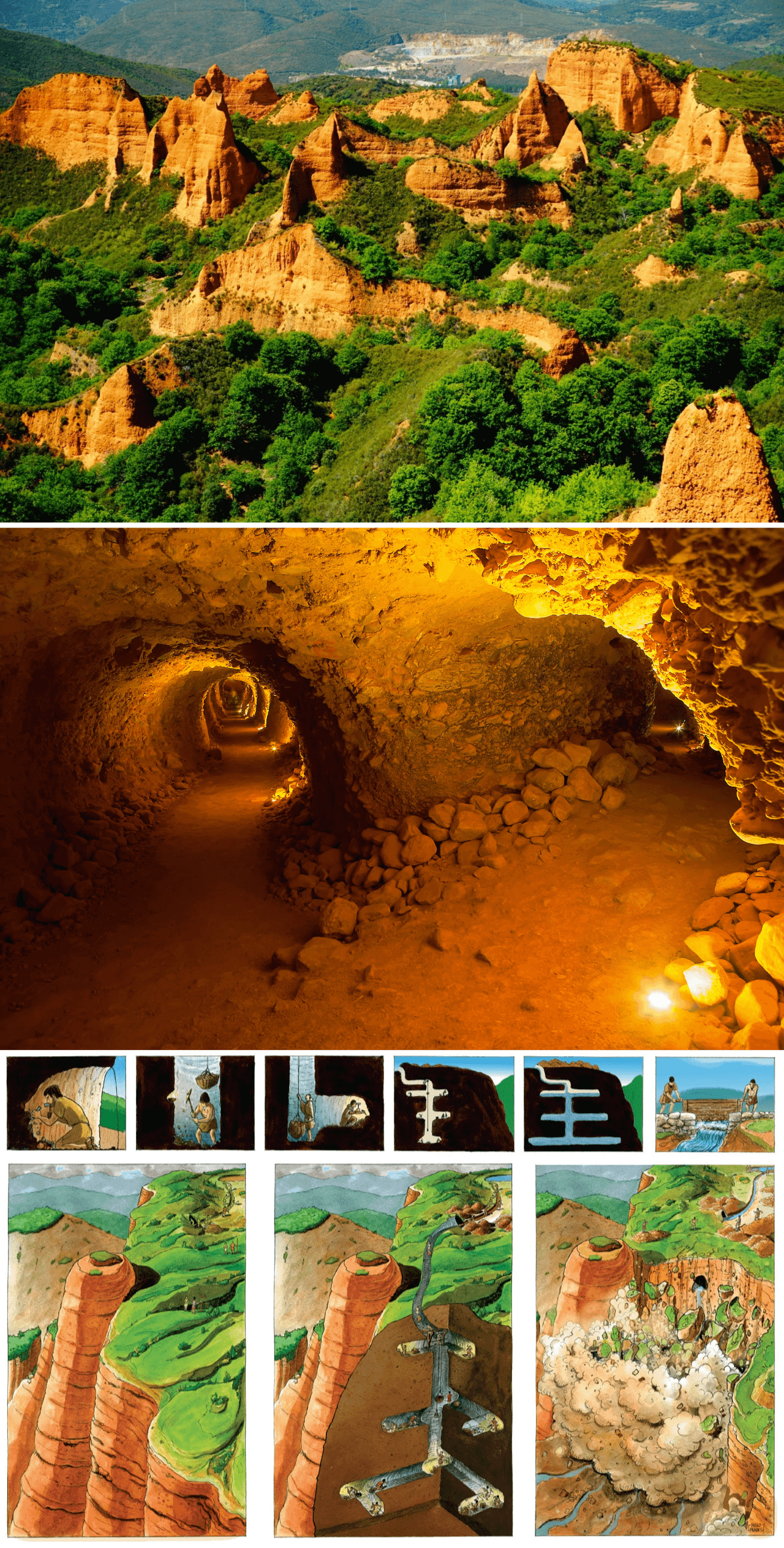
The Médulas is an outstanding Spanish landscape complex that came to be as a result of Roman gold mining works. The Romans mined the gold-rich soil with tunnels and shifts. Water was conducted through the tunnels acting as an explosive, resulting in the collapsing of the mountain [1280×2527]
by Fuckoff555
1 Comment
> Las Médulas is a historic gold-mining site near the town of Ponferrada in the comarca of El Bierzo (province of León, Castile and León, Spain). It was the most important gold mine, as well as the largest open-pit gold mine in the entire Roman Empire. Las Médulas Cultural Landscape is listed by UNESCO as a World Heritage Site. Advanced aerial surveys conducted in 2014 using LIDAR have confirmed the wide extent of the Roman-era works.
> The spectacular landscape of Las Médulas resulted from the ruina montium (wrecking of the mountains), a Roman mining technique described by Pliny the Elder in 77 AD. The technique employed was a type of hydraulic mining which involved undermining a mountain with large quantities of water. The water was supplied by interbasin transfer. At least seven long aqueducts tapped the streams of the La Cabrera district (where the rainfall in the mountains is relatively high) at a range of altitudes. The same aqueducts were used to wash the extensive alluvial gold deposits.
> The massive scale of mining at Las Médulas and other Roman sites had considerable environmental impact. Ice core data taken from Greenland suggest that mineral air pollution peaked during the Roman period in Spain. Levels of atmospheric lead from this period were not reached again until the Industrial Revolution some 1,700 years later.
[https://en.m.wikipedia.org/wiki/Las_M%C3%A9dulas](https://en.m.wikipedia.org/wiki/Las_M%C3%A9dulas)