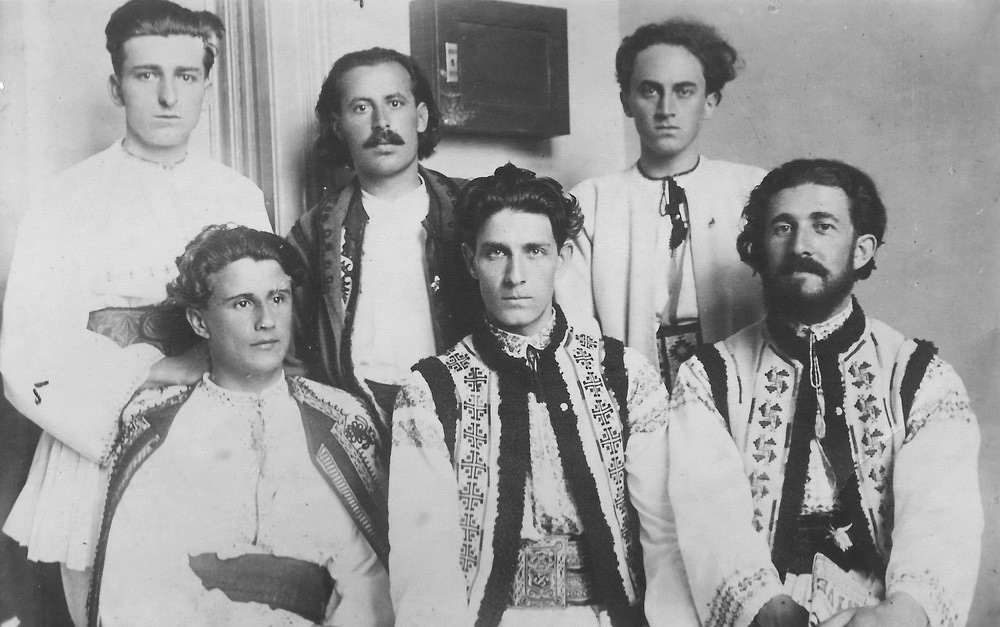
The founding members of the Iron Guard, fascist movement in Romania, pose for a group photo. The Iron Guard was founded in 1927, and would reach a membership of nearly 300,000 in the late 1930s [1000 x 627].
The founding members of the Iron Guard, fascist movement in Romania, pose for a group photo. The Iron Guard was founded in 1927, and would reach a membership of nearly 300,000 in the late 1930s [1000 x 627].
In late 1936, seven Legionnaires, Ion Mota, [Vasile Marin](https://en.wikipedia.org/wiki/Vasile_Marin), [Alexandru Cantacuzino](https://en.wikipedia.org/wiki/Alexandru_Cantacuzino_(militant)), [Gheorghe Clime](https://en.wikipedia.org/wiki/Gheorghe_Clime), the priest Ion Dumitrescu Borşa, Bănica Dobre, and Neculai Totu, volunteered to fight for the Nationalists in the Spanish Civil War. Their expedition went very badly. Just days after entering combat, Mota, 34, and Marin, 32, were both killed in action on January 13, 1937, after an artillery shell. The remaining Legionnaires returned home, and a [lavish funeral was thrown](https://en.wikipedia.org/wiki/Funerals_of_Ion_Mo%C8%9Ba_and_Vasile_Marin). In 1933, Prime Minister [Iron Duca](https://en.wikipedia.org/wiki/Ion_G._Duca) ordered the police to crack down on the Iron Guard. In response, the police became much more vicious against the Legionnaires, ultimately killing 18 of them. In December 1933, the Iron Guard, in response to the suppression of their movement and to Duca allowing more Jewish to immigrate to Romania, retaliated. On December 29, 1933, an [Iron Guard death squad](https://en.wikipedia.org/wiki/Iron_Guard_death_squads) assassinated Duca had allowed Jewish immigration to Romania and cracked down on the Iron Guard. The three murderers were Nicolae Constantinescu, Ion Caranica, and Doru Belimace. They were immediately arrested, found guilty of murder, and sentenced to life in prison with hard labor.
Nevertheless, the Iron Guard continued to grow in popularity. The government itself tried to form a fascist youth group, the Straja Tarii (Guards of the Fatherland). However, its artificiality made obtaining support almost impossible. By the first months of 1937, King Carol II started to realize that the efforts to replace Codreanu weren’t going to work. In the 1937 elections, the Iron Guard got nearly 400,000 votes. The National Liberal government of Prime Minister Gheorghe Tătărescu won the largest number of seats, but less than the 40% required to form a majority government in parliament. After assassinating Prime Minister Duca, the Iron Guard had been banned from participating in elections, but Codreanu got around this ban by creating his own political party as a front
. Later that month, Carol swore in the radical anti-Semitic poet Octavian Goga of the National Christian Party, which only won 9% of the vote, as Prime Minister. Carol’s reasons for appointing Goga were partly that he hoped Goga’s anti-Semitic policies would take support away from the Legionnaires. He also hoped that Goga’s incompetence would give him the excuse to use his emergency powers.
​
18 January 1938, less than a month after the elections, Goga asked Carol to dissolve Parliament. Carol granted the request, with a view toward holding fresh elections that winter. However, Carol became alarmed with overtures being made by the National Christian Party towards the Iron Guard,[7] and on 10 February 1938 he sacked Goga after only 45 days in office, suspended the constitution, cancelled the elections, and seized emergency powers. Later that year Carol pushed through a new constitution that concentrated all power in his hands, effectively codifying his emergency powers and turning his government into a royal dictatorship.

1 Comment
[The Iron Guard](https://en.wikipedia.org/wiki/Iron_Guard)
From left to right:
* Standing: [Corneliu Georgescu](https://ro.wikipedia.org/wiki/Corneliu_Georgescu), Teodosie Popescu, [Ion Mota](https://en.wikipedia.org/wiki/Ion_Mo%C8%9Ba) (deputy leader)
* Sitting: [Radu Mironovici](https://en.wikipedia.org/wiki/Radu_Mironovici), [Corneliu Zelea Codreanu](https://en.wikipedia.org/wiki/Corneliu_Zelea_Codreanu) (the chief founder), [Ilie Gârneață](https://en.wikipedia.org/wiki/Ilie_G%C3%A2rnea%C8%9B%C4%83)
In late 1936, seven Legionnaires, Ion Mota, [Vasile Marin](https://en.wikipedia.org/wiki/Vasile_Marin), [Alexandru Cantacuzino](https://en.wikipedia.org/wiki/Alexandru_Cantacuzino_(militant)), [Gheorghe Clime](https://en.wikipedia.org/wiki/Gheorghe_Clime), the priest Ion Dumitrescu Borşa, Bănica Dobre, and Neculai Totu, volunteered to fight for the Nationalists in the Spanish Civil War. Their expedition went very badly. Just days after entering combat, Mota, 34, and Marin, 32, were both killed in action on January 13, 1937, after an artillery shell. The remaining Legionnaires returned home, and a [lavish funeral was thrown](https://en.wikipedia.org/wiki/Funerals_of_Ion_Mo%C8%9Ba_and_Vasile_Marin). In 1933, Prime Minister [Iron Duca](https://en.wikipedia.org/wiki/Ion_G._Duca) ordered the police to crack down on the Iron Guard. In response, the police became much more vicious against the Legionnaires, ultimately killing 18 of them. In December 1933, the Iron Guard, in response to the suppression of their movement and to Duca allowing more Jewish to immigrate to Romania, retaliated. On December 29, 1933, an [Iron Guard death squad](https://en.wikipedia.org/wiki/Iron_Guard_death_squads) assassinated Duca had allowed Jewish immigration to Romania and cracked down on the Iron Guard. The three murderers were Nicolae Constantinescu, Ion Caranica, and Doru Belimace. They were immediately arrested, found guilty of murder, and sentenced to life in prison with hard labor.
Nevertheless, the Iron Guard continued to grow in popularity. The government itself tried to form a fascist youth group, the Straja Tarii (Guards of the Fatherland). However, its artificiality made obtaining support almost impossible. By the first months of 1937, King Carol II started to realize that the efforts to replace Codreanu weren’t going to work. In the 1937 elections, the Iron Guard got nearly 400,000 votes. The National Liberal government of Prime Minister Gheorghe Tătărescu won the largest number of seats, but less than the 40% required to form a majority government in parliament. After assassinating Prime Minister Duca, the Iron Guard had been banned from participating in elections, but Codreanu got around this ban by creating his own political party as a front
. Later that month, Carol swore in the radical anti-Semitic poet Octavian Goga of the National Christian Party, which only won 9% of the vote, as Prime Minister. Carol’s reasons for appointing Goga were partly that he hoped Goga’s anti-Semitic policies would take support away from the Legionnaires. He also hoped that Goga’s incompetence would give him the excuse to use his emergency powers.
​
18 January 1938, less than a month after the elections, Goga asked Carol to dissolve Parliament. Carol granted the request, with a view toward holding fresh elections that winter. However, Carol became alarmed with overtures being made by the National Christian Party towards the Iron Guard,[7] and on 10 February 1938 he sacked Goga after only 45 days in office, suspended the constitution, cancelled the elections, and seized emergency powers. Later that year Carol pushed through a new constitution that concentrated all power in his hands, effectively codifying his emergency powers and turning his government into a royal dictatorship.