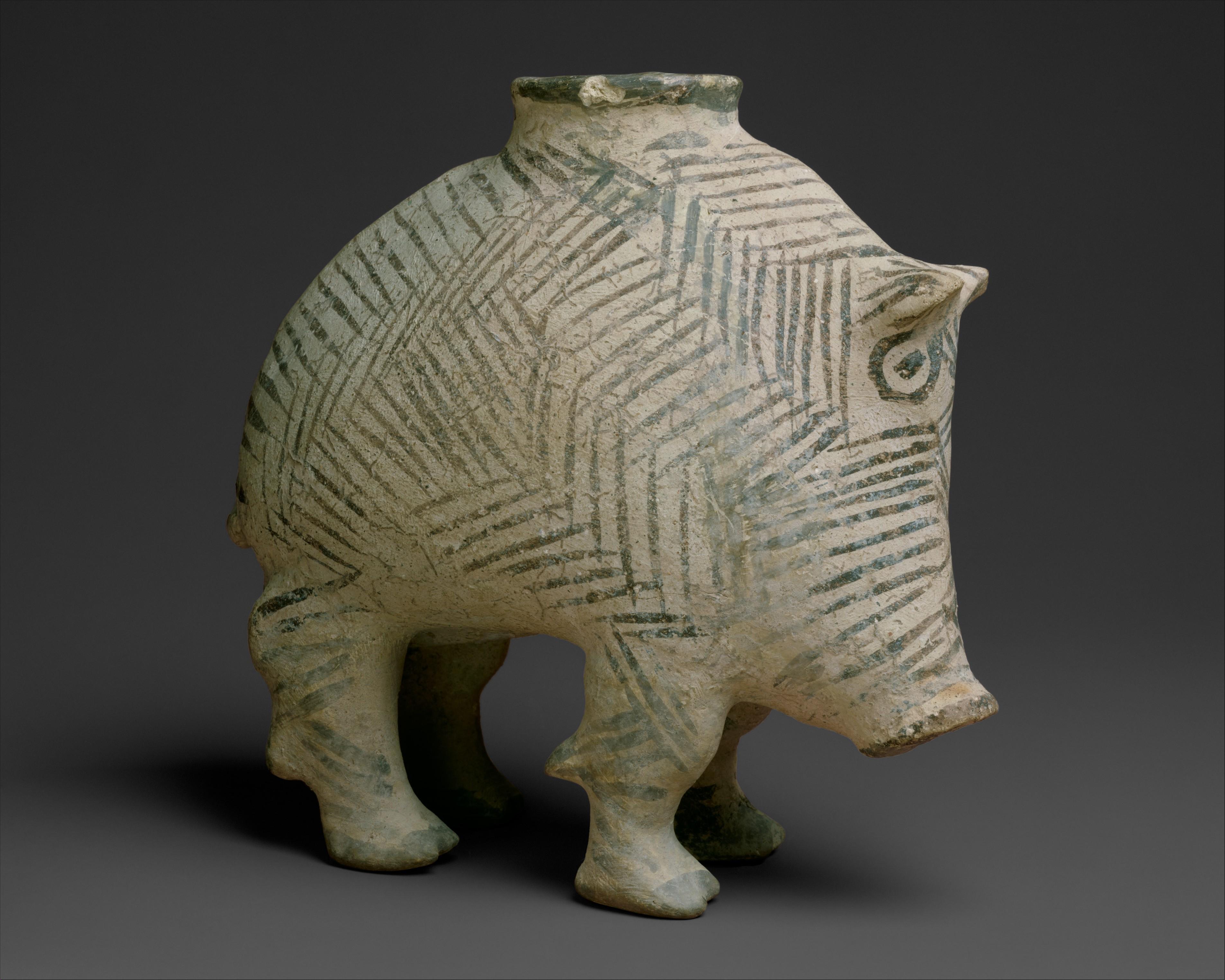
>This ceramic vessel takes the form of a standing wild boar. The body is hollow, serving as a container, with a small round rim atop the center of the back and a hole pierced through the snout. The vessel could have been filled through the larger hole in the back while the smaller hole in the snout was held closed with a thumb, allowing the liquid to flow out once the snout was uncovered. Made of fine clay with a smoothed surface, the vessel is decorated in dark brown paint on buff-colored ceramic. The sharply angled hatching covering the vessel evokes the boar’s bristly hide, especially along the spine, where it is arranged in a vertical row. The eyes are indicated by circles with a central dot, just below the small, alertly raised ears. The split hooves and fetlocks are modeled in clay. The boar’s hunched posture lends the vessel a sense of potentially explosive movement, and reminds the viewer that wild boars are fierce animals that pose dangers to crops in the field, and to the hunters pursuing them. Similar zoomorphic, or animal-shaped, vessels are especially characteristic of the Proto-Elamite period (3100-2900 B.C.) in southwestern Iran.
I found this using a site I’ve been building to explore artefacts from museums around the world – this one’s a ceramic vessel shaped like a wild boar, and you pour liquid out of its snout which I thought was kind of amazing.

3 Comments
>This ceramic vessel takes the form of a standing wild boar. The body is hollow, serving as a container, with a small round rim atop the center of the back and a hole pierced through the snout. The vessel could have been filled through the larger hole in the back while the smaller hole in the snout was held closed with a thumb, allowing the liquid to flow out once the snout was uncovered. Made of fine clay with a smoothed surface, the vessel is decorated in dark brown paint on buff-colored ceramic. The sharply angled hatching covering the vessel evokes the boar’s bristly hide, especially along the spine, where it is arranged in a vertical row. The eyes are indicated by circles with a central dot, just below the small, alertly raised ears. The split hooves and fetlocks are modeled in clay. The boar’s hunched posture lends the vessel a sense of potentially explosive movement, and reminds the viewer that wild boars are fierce animals that pose dangers to crops in the field, and to the hunters pursuing them. Similar zoomorphic, or animal-shaped, vessels are especially characteristic of the Proto-Elamite period (3100-2900 B.C.) in southwestern Iran.
Source: [Metropolitan Museum of Art](https://www.metmuseum.org/art/collection/search/326617)
I found this using a site I’ve been building to explore artefacts from museums around the world – this one’s a ceramic vessel shaped like a wild boar, and you pour liquid out of its snout which I thought was kind of amazing.
If you’re curious, you can see it here: [https://museumoftheweb.vercel.app/object/met-326617](https://museumoftheweb.vercel.app/object/met-326617) (best viewed on desktop atm!)
Would love any feedback if you end up browsing 🙂
Not even the most iconic boar vessel