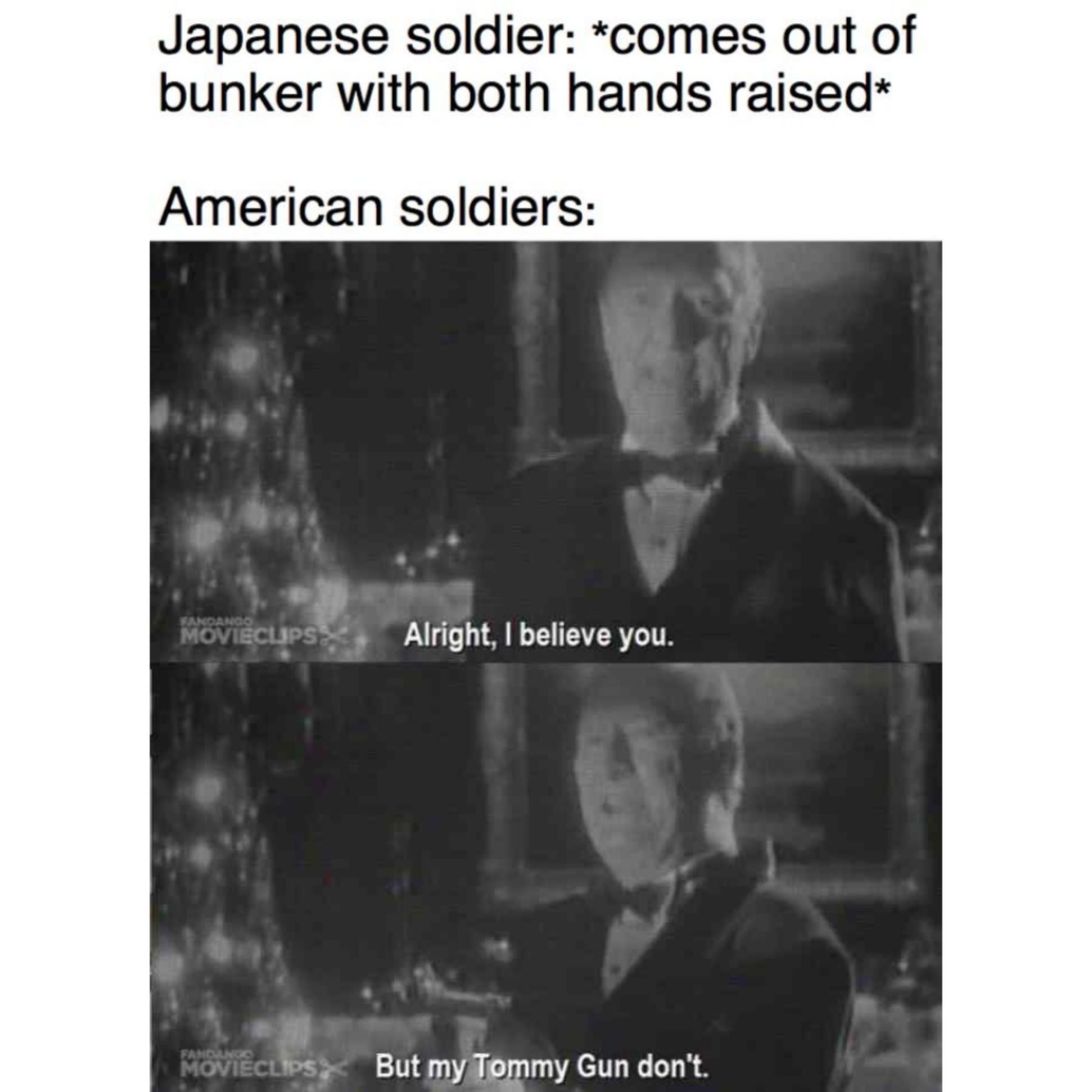
Encounters between U.S and Japanese forces in the Pacific War unfolded under conditions that made the recognition of surrender far less straightforward than abstract rules might suggest. Within the Imperial Japanese Army, surrender was institutionally discouraged through training, discipline, and ideological conditioning that framed capture as dishonorable.
This did not make surrender impossible, but it did make it comparatively rare and, more importantly, unpredictable in its form.
For troops serving in the U.S Army and the U.S Marine Corps, expectations were shaped not by formal doctrine alone but by repeated battlefield experience.
Engagements such as Guadalcanal, Saipan, and Okinawa frequently took place in dense jungle, fortified cave systems, or urbanized defensive positions, where visibility was limited and encounters occurred at close range. Under such circumstances, distinguishing between a genuine surrender, hesitation, or continued resistance was often difficult.
Communication further complicated these situations. Language barriers meant that verbal declarations could not always be understood, while gestures – raised hands, discarded weapons, slow approach – required interpretation in real time and under stress.
In an environment where seconds mattered, uncertainty carried immediate consequences.
Over time, such conditions encouraged a cautious approach to ambiguous encounters. This was less a matter of formal policy than of practical adaptation. Soldiers relied on prior experience to guide rapid decisions in situations where intent could not be verified with certainty.
The resulting behavior reflected an attempt to reconcile the theoretical norms of surrender with the realities of a theater of war in which those norms were not consistently observed or easily recognized.
Lord_Nyarlathotep on
The Pacific theater of WWII is a great case study in why false surrenders are a bad idea longterm and also a war crime
Natural_Jello_6050 on
Surrendering was tough for many reasons. One of them- fucking burden to troops. You have to feed, escort, give water, etc to surrender person. It was far easier to shoot them on the spot.
It goes both ways btw. At least U.S. Marines didn’t eat their POWs
CadenVanV on
You’re leaving out the whole false surrender with grenades or knives by Japanese soldiers that forced a doctrine of no mercy.
ConsulJuliusCaesar on
Interestingly enough they did get the rare POW. And Military Intelligence officers from all service found out all they had to do to get the Japanese to talk was feed them and not torture them. Often those POWs were only captured because they were too wounded to resist being captured. They actually expected allied soldiers to finish them off. And theb got better medical treatment than their own military could provide. Said Japanese soldiers after like an hour in a POW camp often found they were being treated better by their captors then there own military. So naturally they folded and spilled the beans giving away tactical and operational details that saved Allied lives and costed IJA lives. And then when transfered to camps in the US, Australia, and Europe alot of them procceeded to not return to Japan. This is the ulimate Liberal Democracy win in my opinion because the Japanese Empire’s whole thing was *we’re the best nation on the planet* and yet when their own soldiers were given literally the bare minimum required rights by Democracies their whole wall of fanaticism evaporated. Military intelligence then began strongly encouraging combat personnel to make efforts to capture more Japanese soldiers. 1. Because it was stupid easy to get them to flip. 2. The propaganda value is real obivous here. Every interaction went like this
“Wait you’re not going to beat me.”
“No want a candy bar?”
“Is this some kind of trick? Is the NCO going to pull it away last minute and beat the fuck out of me for considering it? Oh I know its filled with razor blades isn’t it.”
“Jesus Christ, it’s just a candy bar, bro who hurt you.”
“Alot of people.”
That said this is 100% a reason why all Nations should follow Geneva. And when people suggest we should just kill surrendering soldiers of an Authoritarian nation because they would do the same, I call said people extremely short sited. You can get the average person to flip by showing them just how much their government lied to and used them and if you can spread that information you can actually destroy the enemy resolve.
ZhenXiaoMing on
Everyone talking about “false surrender” and yet the Soviets captured over a million Japanese POW’s and the Chinese probably captured over 100,000.

6 Comments
Encounters between U.S and Japanese forces in the Pacific War unfolded under conditions that made the recognition of surrender far less straightforward than abstract rules might suggest. Within the Imperial Japanese Army, surrender was institutionally discouraged through training, discipline, and ideological conditioning that framed capture as dishonorable.
This did not make surrender impossible, but it did make it comparatively rare and, more importantly, unpredictable in its form.
For troops serving in the U.S Army and the U.S Marine Corps, expectations were shaped not by formal doctrine alone but by repeated battlefield experience.
Engagements such as Guadalcanal, Saipan, and Okinawa frequently took place in dense jungle, fortified cave systems, or urbanized defensive positions, where visibility was limited and encounters occurred at close range. Under such circumstances, distinguishing between a genuine surrender, hesitation, or continued resistance was often difficult.
Communication further complicated these situations. Language barriers meant that verbal declarations could not always be understood, while gestures – raised hands, discarded weapons, slow approach – required interpretation in real time and under stress.
In an environment where seconds mattered, uncertainty carried immediate consequences.
Over time, such conditions encouraged a cautious approach to ambiguous encounters. This was less a matter of formal policy than of practical adaptation. Soldiers relied on prior experience to guide rapid decisions in situations where intent could not be verified with certainty.
The resulting behavior reflected an attempt to reconcile the theoretical norms of surrender with the realities of a theater of war in which those norms were not consistently observed or easily recognized.
The Pacific theater of WWII is a great case study in why false surrenders are a bad idea longterm and also a war crime
Surrendering was tough for many reasons. One of them- fucking burden to troops. You have to feed, escort, give water, etc to surrender person. It was far easier to shoot them on the spot.
It goes both ways btw. At least U.S. Marines didn’t eat their POWs
You’re leaving out the whole false surrender with grenades or knives by Japanese soldiers that forced a doctrine of no mercy.
Interestingly enough they did get the rare POW. And Military Intelligence officers from all service found out all they had to do to get the Japanese to talk was feed them and not torture them. Often those POWs were only captured because they were too wounded to resist being captured. They actually expected allied soldiers to finish them off. And theb got better medical treatment than their own military could provide. Said Japanese soldiers after like an hour in a POW camp often found they were being treated better by their captors then there own military. So naturally they folded and spilled the beans giving away tactical and operational details that saved Allied lives and costed IJA lives. And then when transfered to camps in the US, Australia, and Europe alot of them procceeded to not return to Japan. This is the ulimate Liberal Democracy win in my opinion because the Japanese Empire’s whole thing was *we’re the best nation on the planet* and yet when their own soldiers were given literally the bare minimum required rights by Democracies their whole wall of fanaticism evaporated. Military intelligence then began strongly encouraging combat personnel to make efforts to capture more Japanese soldiers. 1. Because it was stupid easy to get them to flip. 2. The propaganda value is real obivous here. Every interaction went like this
“Wait you’re not going to beat me.”
“No want a candy bar?”
“Is this some kind of trick? Is the NCO going to pull it away last minute and beat the fuck out of me for considering it? Oh I know its filled with razor blades isn’t it.”
“Jesus Christ, it’s just a candy bar, bro who hurt you.”
“Alot of people.”
That said this is 100% a reason why all Nations should follow Geneva. And when people suggest we should just kill surrendering soldiers of an Authoritarian nation because they would do the same, I call said people extremely short sited. You can get the average person to flip by showing them just how much their government lied to and used them and if you can spread that information you can actually destroy the enemy resolve.
Everyone talking about “false surrender” and yet the Soviets captured over a million Japanese POW’s and the Chinese probably captured over 100,000.