
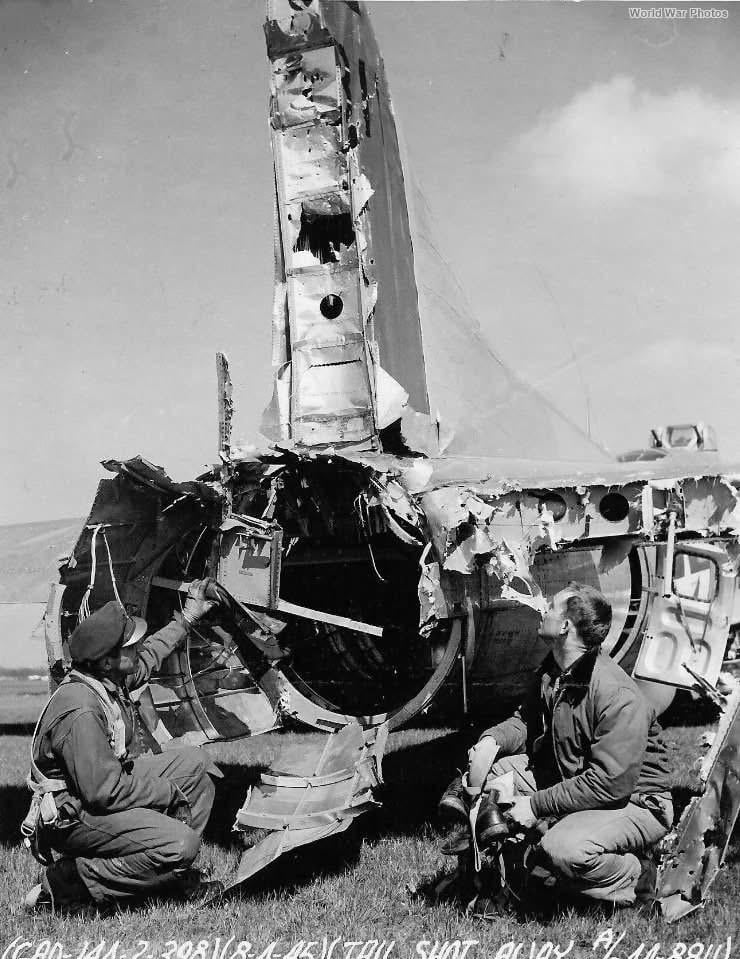
On 8 April 1945, the 398th Bomb Group launched a late-war Eighth Air Force mission against targets in central Germany, part of the sustained strategic campaign to cripple remaining transportation and industrial capacity as Allied forces closed in.
That day’s operation included attacks in the Halberstadt and Derben area, aimed at disrupting rail and military infrastructure supporting German defenses. By this stage of the war, German fighter opposition was diminished, but anti-aircraft fire remained intense and dangerous, particularly over defended targets.
Shortly after bombs away, B-17G S/N 44-8811, from the 600th Bomb Squadron, was struck by a direct burst of heavy flak. The explosion completely severed the tail, tearing away the entire tail-gun section, rudder and right elevator, leaving the aircraft without normal directional stability. The blast instantly killed the tail gunner, S/Sgt Wallace E. Kasch, who was carried away with the wreckage. Crew accounts describe a sudden rush of air through the fuselage and the shocking realization that “there wasn’t anything there but a large hole” where the tail had been.
Despite catastrophic damage, the pilots, Lt. Col. Edwin B. Dailey and 1st Lt. John L. Hahn, managed to keep the aircraft airborne using differential engine power to control direction. With no tail surfaces and minimal control authority, they carefully nursed the crippled bomber back across occupied Europe and the English Channel. The aircraft ultimately reached RAF Nuthampstead, where it made a survivable forced landing. The remaining nine crew members survived the ordeal.
by UrbanAchievers6371