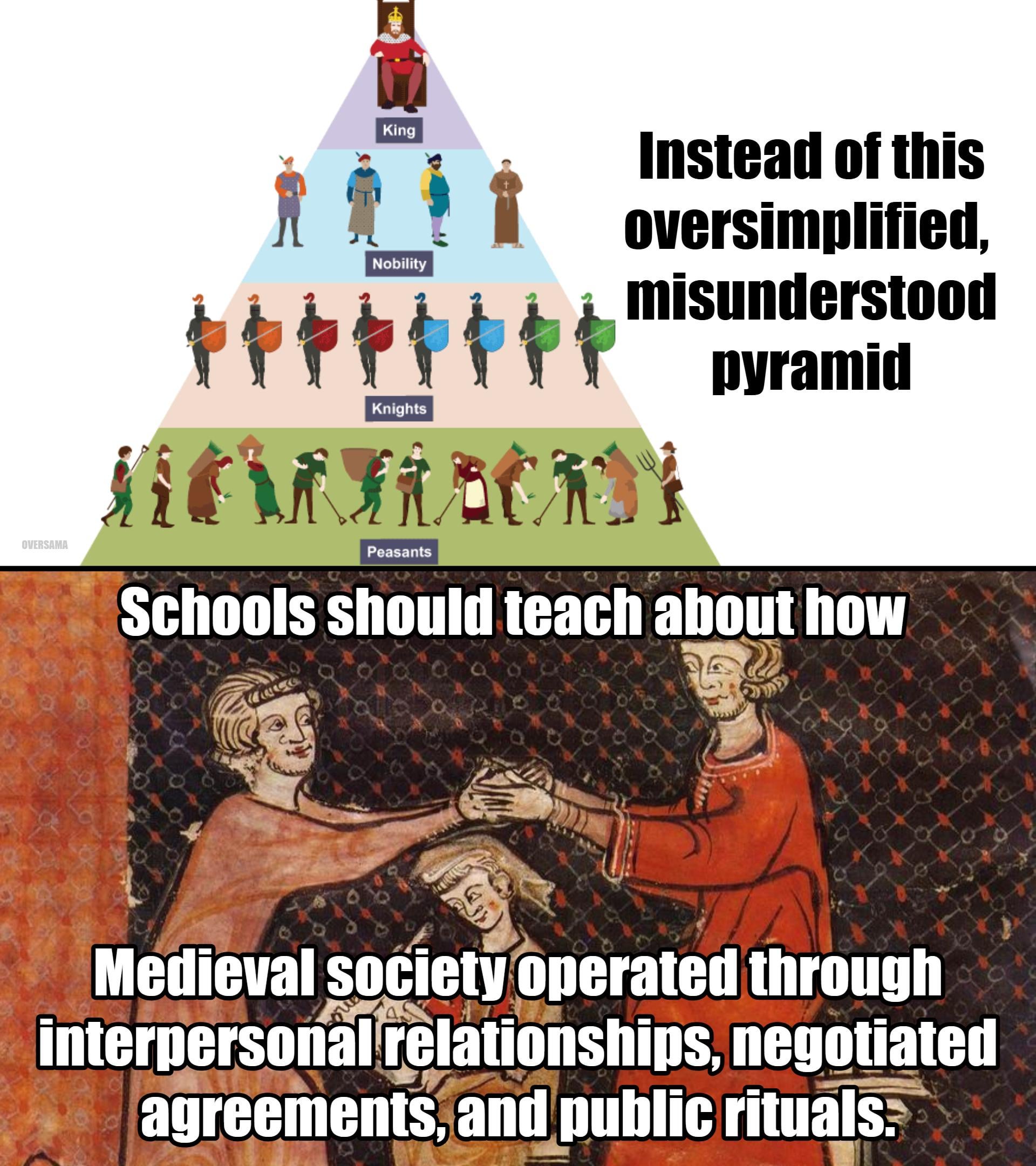
I agree schools make it seem like the feudal periods were unchanging and the hierarchy existed ever since the fall of Rome to the renaissance.
Im not a historian but I don’t think this structure simply stayed stagnant for 900-1000 years
mrhoofy on
Will never happen. Unless it’s about the dialectic and power imbalances education won’t care. Not in 2025.
abfgern_ on
Because it’s quite difficult for a seven year old to understand such a complex and vague system, and the layer view is a good first approximation
Quidplura on
History teacher here, you’re ofcourse correct about the bottom image describing the real situation. The reality for me is that I have about 90 minutes to teach a bunch of twelve year olds about the entirety of feudalism and I need to set it up in a way that the age of absolutisme and the ancien regime leading into the French Revolution make sense as well.
JohannMeino on
I am studying history didactics and while I agree with you in principle the realities of everyday teaching differs heavily.
In my country the middle ages are usually talked about in 7. grade (+/-1) a time in which most students haven’t even fully developed a sense for the historical other. Each and every didactics course talks about simplification as an essential part of teaching history. I don’t like it but alternatives are limited.
LeSygneNoir on
That’s…What they do? At the right level at least. It was definitely a big part of my medieval History lessons in the last years of high school (general school with literature options in France), while the “pyramid” is something I learned about in primary school pretty much.
The point is, you never study a period only once in school. You’re supposed to learn first the simplified version in primary school, then get back to it with a refined understanding in secondary school, then again with a yet more detailed look in high school, and then *again* in university if you so choose.
Those layers of understanding are supposed to build on each other, because it’s impossible for a school program to go from 0 to 100 on any given topic, not just in History but mathematics, science, etc. It would take an entire school year of just medieval History to reach the level you’re suggesting in one go. So you don’t teach anything *wrong* (the medieval pyramid is still largely valid at a glance), but you build an understanding year after year.
First, “it’s a basic social pyramid with nobility and clergy at the top”, second “nobility is at the top because it was created by force of arms”, third “the feudal system is based on interpersonal relationships that are guaranteed and balance by the force of arms”, etc.
Bring_Back_Feudalism on
They should teach that those both frames of understanding are true in different degrees for both old and *present* times, yes.
42stingray on
Just make it a part of the history curriculum to play through a campaign of CK3
El_Lanf on
The pyramid isn’t perfect but does a good job of representing societal stratification in a way that isn’t so relatable today, particularly in school. Meanwhile, the bottom text is basically applicable to about any period.
orangeminer on
I remember having a teacher who summarised the feudal system as a symbiotic relationship where “the knights were the protectors, the peasants grew the food and the clergy saved everybody’s souls”. I always thought that made a lot of sense.
boonatonnn on
The latter doesn’t exclude the former.
Someone describing our current economic and governmental system in the western world wouldn’t start by explaining what contracts are or how parties in government form coalitions or that some buisness do partnerships to improve their profits.
You would start by saying that people work for other people and get a wage. Or that the people vote for the government. Maybe you could say that people pay taxes and that the government provides services.
All of these things happen in every country in the west. Every country, of course does things differently but the generell economics and politics stay the same. We all live under capitalism and most of us in (more or less) democracies.
The same goes for feudalism and monarchies during the middle ages in Europe.
Simplifications are useful and needed to get the point across to as many people as possible.
Alaundo87 on
I try to do when I teach Middle Ages at age 13 (in Germany). We look at sources promoting a clear-cut society at different levels and then talk about why someone would write that when it simply was not true everywhere, trying to get a little into the intent of authors.
Distinct_Chef_2672 on
A cage is a cage, whether you have an interpersonal relationship with the jailer or the jailer is a faceless bureaucrat!
Lilfozzy on
The capitalist realist could never imagine the reality of the medieval peasant.
neefhuts on
This is not a meme
flashkiller01 on
It recalls me how confusing was feudal triangle when in the next damn paragraph guilds, knight orders, republics and free cities were mentioned 🙂
And a few years later I learned how extensive and prolofic were corruption, informal relations and unwritten rules in late medieval world.
And then Youtube recommended me some Eleanor Janega content 🙂 Now I’m disappointed in school programme, and I like Medieval much more, because ancestors were as fun and chill people as modern people do, just the different worldview and lifestyle.
CrystalFysh on
I was shocked to find out how many times peasants rioted against the nobility instead of simply taking the abuse like in stories.
nir109 on
Why do we teach kids that everything falls down at the same speed instead of starting with the theory of relativity, are we dumb?
tolgren on
The problem with everything like this is time. It takes a lot of time to accurately teach things and there’s not enough of it as is.
Mesolithic_Hunter on
Both are approximations of the truth.
TorudParis on
Yes, with army and eternal damnation on one side.
TheLordDuncan on
If it makes you feel any better, we didn’t cover that at all.
Hunkus1 on
I dont know where you went to school but I was taught the second image in school.

24 Comments
I agree schools make it seem like the feudal periods were unchanging and the hierarchy existed ever since the fall of Rome to the renaissance.
Im not a historian but I don’t think this structure simply stayed stagnant for 900-1000 years
Will never happen. Unless it’s about the dialectic and power imbalances education won’t care. Not in 2025.
Because it’s quite difficult for a seven year old to understand such a complex and vague system, and the layer view is a good first approximation
History teacher here, you’re ofcourse correct about the bottom image describing the real situation. The reality for me is that I have about 90 minutes to teach a bunch of twelve year olds about the entirety of feudalism and I need to set it up in a way that the age of absolutisme and the ancien regime leading into the French Revolution make sense as well.
I am studying history didactics and while I agree with you in principle the realities of everyday teaching differs heavily.
In my country the middle ages are usually talked about in 7. grade (+/-1) a time in which most students haven’t even fully developed a sense for the historical other. Each and every didactics course talks about simplification as an essential part of teaching history. I don’t like it but alternatives are limited.
That’s…What they do? At the right level at least. It was definitely a big part of my medieval History lessons in the last years of high school (general school with literature options in France), while the “pyramid” is something I learned about in primary school pretty much.
The point is, you never study a period only once in school. You’re supposed to learn first the simplified version in primary school, then get back to it with a refined understanding in secondary school, then again with a yet more detailed look in high school, and then *again* in university if you so choose.
Those layers of understanding are supposed to build on each other, because it’s impossible for a school program to go from 0 to 100 on any given topic, not just in History but mathematics, science, etc. It would take an entire school year of just medieval History to reach the level you’re suggesting in one go. So you don’t teach anything *wrong* (the medieval pyramid is still largely valid at a glance), but you build an understanding year after year.
First, “it’s a basic social pyramid with nobility and clergy at the top”, second “nobility is at the top because it was created by force of arms”, third “the feudal system is based on interpersonal relationships that are guaranteed and balance by the force of arms”, etc.
They should teach that those both frames of understanding are true in different degrees for both old and *present* times, yes.
Just make it a part of the history curriculum to play through a campaign of CK3
The pyramid isn’t perfect but does a good job of representing societal stratification in a way that isn’t so relatable today, particularly in school. Meanwhile, the bottom text is basically applicable to about any period.
I remember having a teacher who summarised the feudal system as a symbiotic relationship where “the knights were the protectors, the peasants grew the food and the clergy saved everybody’s souls”. I always thought that made a lot of sense.
The latter doesn’t exclude the former.
Someone describing our current economic and governmental system in the western world wouldn’t start by explaining what contracts are or how parties in government form coalitions or that some buisness do partnerships to improve their profits.
You would start by saying that people work for other people and get a wage. Or that the people vote for the government. Maybe you could say that people pay taxes and that the government provides services.
All of these things happen in every country in the west. Every country, of course does things differently but the generell economics and politics stay the same. We all live under capitalism and most of us in (more or less) democracies.
The same goes for feudalism and monarchies during the middle ages in Europe.
Simplifications are useful and needed to get the point across to as many people as possible.
I try to do when I teach Middle Ages at age 13 (in Germany). We look at sources promoting a clear-cut society at different levels and then talk about why someone would write that when it simply was not true everywhere, trying to get a little into the intent of authors.
A cage is a cage, whether you have an interpersonal relationship with the jailer or the jailer is a faceless bureaucrat!
The capitalist realist could never imagine the reality of the medieval peasant.
This is not a meme
It recalls me how confusing was feudal triangle when in the next damn paragraph guilds, knight orders, republics and free cities were mentioned 🙂
And a few years later I learned how extensive and prolofic were corruption, informal relations and unwritten rules in late medieval world.
And then Youtube recommended me some Eleanor Janega content 🙂 Now I’m disappointed in school programme, and I like Medieval much more, because ancestors were as fun and chill people as modern people do, just the different worldview and lifestyle.
I was shocked to find out how many times peasants rioted against the nobility instead of simply taking the abuse like in stories.
Why do we teach kids that everything falls down at the same speed instead of starting with the theory of relativity, are we dumb?
The problem with everything like this is time. It takes a lot of time to accurately teach things and there’s not enough of it as is.
Both are approximations of the truth.
Yes, with army and eternal damnation on one side.
If it makes you feel any better, we didn’t cover that at all.
I dont know where you went to school but I was taught the second image in school.
The should play crusader kings as homework