I imagine the number of *actual* games that aren’t just Unreal asset flips or porn slop is still very low.
grumd on
Now estimate the number of dollars Valve earns each year
sun_not_cold on
Wait, the counter-strike people are still around?
Ristrxtto on
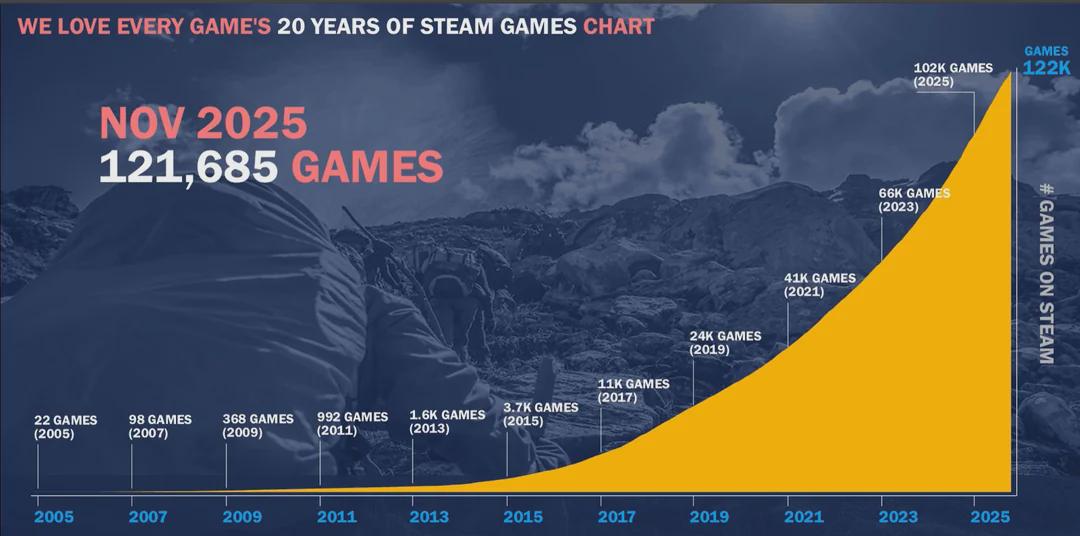
holy Jesus there were that few games in 2013? 🤯
god I’m getting old…
HippieInDisguise2_0 on
I was on Steam when it had less than 1000 games on it.
Jfc
boogieman117 on
I remember when Steam first started when Half Life 2. Everyone HATED it.
Preform_Perform on
Im around number 85,000 I reckon.
leonprimrose on
damn. I think my account is from before they had 100 games. I’ll have to check later
elfonzi37 on
My account is from ~100 games with orange box, I didn’t really start using it until I got a Dota 2 beta key arpund ~1,000 games.
Symbiotic_Tragedy on
I bought Deus Ex collection as my first purchase back in 2010. My how time flies.
iprocrastina on
It’s probably hard for PC gamers who weren’t in the hobby back in 2004 to think that people hated Steam when it released. If you wanted to play Half-Life 2 (and *everyone* did) you had to install Steam, even if you were installing from disc (which most people were). People did not like the idea of digital download and they loathed the idea of needing to go through an application every time they wanted to play a game. And for a long time (as shown by this graph) it was really just Valve games and a handful of other titles on Steam, so there wasn’t much incentive to use it. Back then Steam was effectively just HL2’s launcher.
When The Orange Box released in late 2007 it gave Steam a massive boost in user base because everyone and their dog wanted to play it and by that point Source engine games were no longer difficult to run. Valve then took advantage of their newly grown user base with the 2008 holiday steam sale that started the trend of doing massive, deep sales on big name titles, and *that’s* what catapulted them into becoming the dominant platform on PC and also what ended PC gamers’ resistance to digital distribution.
The steam sales haven’t been very noteworthy in a very long time, but from 2008-2015ish the sales were ridiculously good. Like months-old AAA games on sale for -50%, current gen games that were a couple years old would be on sale for -90%, you could build up a huge library of current AAA and AA games for the price of a single new game back then. And since people quickly amassed dozens or hundreds of games they were now invested in the Steam platform.
And this is why if you look at the graph you’ll notice Steam started really taking off around 2009, and not-coincidentally you’ll notice that the decline in Steam sale quality matches up with when the graph started going parabolic in 2015.
boot2skull on
Does this graph shape match the average number of never-played games in users’ libraries?

12 Comments
I imagine the number of *actual* games that aren’t just Unreal asset flips or porn slop is still very low.
Now estimate the number of dollars Valve earns each year
Wait, the counter-strike people are still around?
holy Jesus there were that few games in 2013? 🤯
god I’m getting old…
I was on Steam when it had less than 1000 games on it.
Jfc
I remember when Steam first started when Half Life 2. Everyone HATED it.
Im around number 85,000 I reckon.
damn. I think my account is from before they had 100 games. I’ll have to check later
My account is from ~100 games with orange box, I didn’t really start using it until I got a Dota 2 beta key arpund ~1,000 games.
I bought Deus Ex collection as my first purchase back in 2010. My how time flies.
It’s probably hard for PC gamers who weren’t in the hobby back in 2004 to think that people hated Steam when it released. If you wanted to play Half-Life 2 (and *everyone* did) you had to install Steam, even if you were installing from disc (which most people were). People did not like the idea of digital download and they loathed the idea of needing to go through an application every time they wanted to play a game. And for a long time (as shown by this graph) it was really just Valve games and a handful of other titles on Steam, so there wasn’t much incentive to use it. Back then Steam was effectively just HL2’s launcher.
When The Orange Box released in late 2007 it gave Steam a massive boost in user base because everyone and their dog wanted to play it and by that point Source engine games were no longer difficult to run. Valve then took advantage of their newly grown user base with the 2008 holiday steam sale that started the trend of doing massive, deep sales on big name titles, and *that’s* what catapulted them into becoming the dominant platform on PC and also what ended PC gamers’ resistance to digital distribution.
The steam sales haven’t been very noteworthy in a very long time, but from 2008-2015ish the sales were ridiculously good. Like months-old AAA games on sale for -50%, current gen games that were a couple years old would be on sale for -90%, you could build up a huge library of current AAA and AA games for the price of a single new game back then. And since people quickly amassed dozens or hundreds of games they were now invested in the Steam platform.
And this is why if you look at the graph you’ll notice Steam started really taking off around 2009, and not-coincidentally you’ll notice that the decline in Steam sale quality matches up with when the graph started going parabolic in 2015.
Does this graph shape match the average number of never-played games in users’ libraries?