
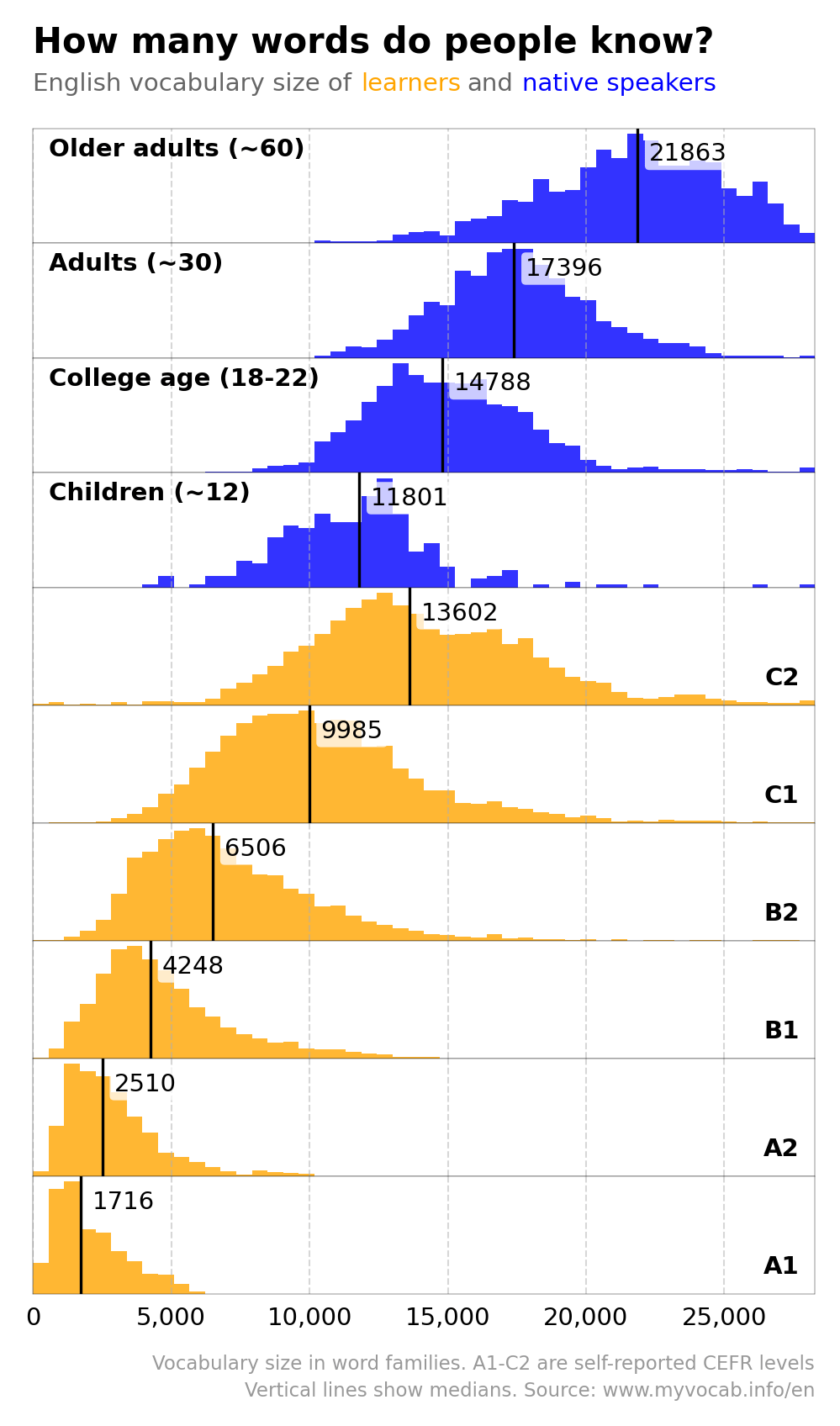
The data are based on 34,000 learners and native speakers who took the vocabulary test.
A1-C2 are CEFR levels, a common classification of proficiency among language learners. A1-A2 are beginners, B1-B2 — intermediate, C1 — advanced learners, and C2 is supposed to be a native-speaker level (and achieved by very few learners). The levels were self-reported.
The counting units are word families (so limit, limitless, unlimited are counted as a single unit). The full reference lexicon is 28k word families.
Based on the data, a C1 is below the average middle-schooler, and a C2 is at about the level of a college-age native speaker. This is only if we force them onto the same one-dimensional scale, of course, because in reality the composition of their vocabulary is quite different.
by RevolutionaryLove134
16 Comments
Cool test, fun to try. I landed exactly where I should (C2 14200 or 14800 words).
And very cool to see how those levels actually compare to native speakers 😎
I’m curious about those kids that showed up as the outliers with huge vocabularies. I’m guessing they’re book nerds.
I wonder how much of this is biased from the fact that more recent generations have a more limited vocabulary in general. In which case, it would be less about age and more about specific generation.
Seems accurate, I can say my dad has a D2 Spanish level 😂 he be like creating new words out of thin air HAHAH
6 classes from A1 to C2, and then there’s freakin’ Shashi Tharoor.
Interesting I feel as if my vocabulary has actually shrank since college… i went from trying to sound smart to trying to make everything as simple as possible for coworkers
That is an interesting and cool way to test. I got 18500 words with it as my second language which sounds plausible. I saw in the results afterwards that there were some fake words introduced in the test – I am impressed that they were well enough hidden that I can’t imagine which ones it would be.
Does this show that you learn more words as you grow up or does this show that the more literate you are the longer you live
Do people really expand their vocabulary much between ages 30 and 60? Hell, I feel even an increase between college age and 30 is surprising.
Or is it a generation issue?
Why do older people seem to have much bigger vocabularies? Older people tend to have less formal education.
I suspect there’s some kind of selection bias at work here. I suppose if you are taking a voluntary vocab test in the first place, you’re more likely to be the kind of person who has a large vocabulary, ie someone who loves reading. Which you can do better if you’re more likely to be retired.
So I can struggle & grind my way up to C2, only to be on par with a child?
Interesting. 19000 words; non native English speaker.
Took the test and landed C2. Seemed to me there were a few too many “science” words that you’ll never ever use in a conversation.
Like yes it’s part of the vocab but it really should be limited to conversational words not specific career disciplines. Drawing from my own experience, I’ll never be talking to someone and expect them to know what Martensite and Austenite are.
I’m quite curious how the natives would stack up against immigrants who came as late children/early teens. Technical not native but immersed in the same environment with native speakers since school age.
C2 with 20k words. I’m in my 40s. English is my 4th language. Nonetheless, it’s the one I’m most proficient in. I’m not even at the 50th percentile relative to 60 year old native speakers?
Yeah I feel like the non-native population is heavily biased, like you would only end-up on this website if you frequent the anglosphere, so your level is generally far above the “general population” of non-natives.