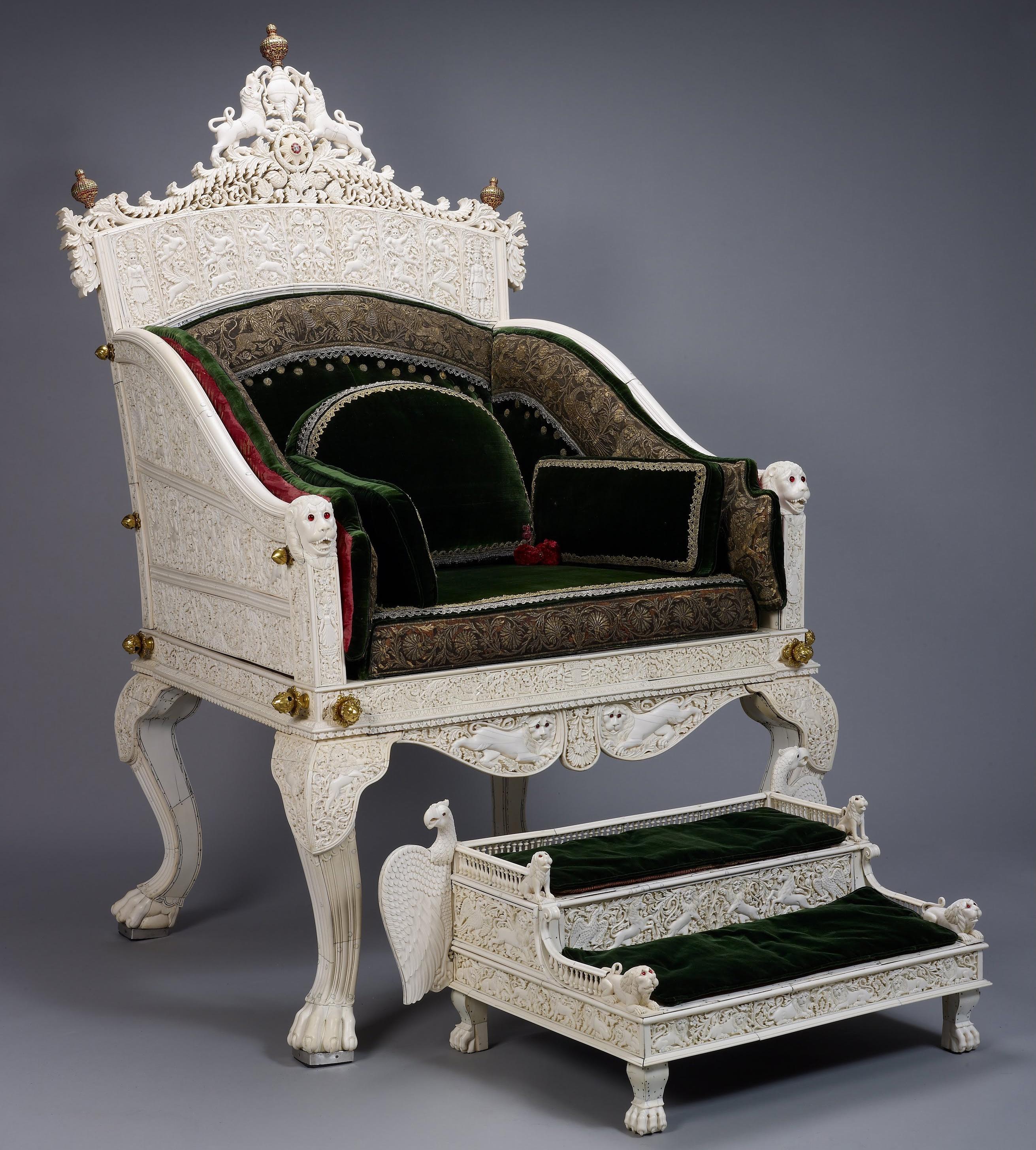
Ivory throne and footstool, carved with elephants. Presented to Queen Victoria at the Great Exhibition of 1851. Travancore, India, 1840-1850 [2622×2910]
Ivory throne and footstool, carved with elephants. Presented to Queen Victoria at the Great Exhibition of 1851. Travancore, India, 1840-1850 [2622×2910]
[Museum](https://www.rct.uk/collection/1561/throne-and-footstool). This spectacular throne, the centrepiece of the Indian section in the Great Exhibition of 1851, was presented to Queen Victoria in part to advertise the carving skills of Travancore in southern India. The densely-carved elephant-ivory plaques incorporate Indian and European motifs, and the conch-shell emblem of Travancore forms the cresting.
Travancore was widely regarded in India as one of the leading centres of ivory carving, and successive rulers in the nineteenth century, including Maharajah Martanda Varma (ruled 1847-60), were keen to promote and support this industry. The throne arrived in time to be lent by the Queen to the Great Exhibition, where it occupied the centre of the tented and richly hung Indian section. The Queen particularly noted her ‘magnificent chair, carved in ivory’ on a visit to the Exhibition with King Leopold of the Belgians on 24 June; and at the closing ceremony in October the throne was prominently placed on the dais at the centre of the Nave for Prince Albert’s use. When the Queen became Empress of India in 1876, she chose to be shown seated on the throne at Windsor for her official photograph.
DaneAlaskaCruz on
So much elephant ivory tusks in these two pieces of furniture.
Glad that there has been a ban on elephant ivory for a long time now.
There’s so much wood out there that is a better material to work with for carving than ivory.

2 Comments
[Museum](https://www.rct.uk/collection/1561/throne-and-footstool). This spectacular throne, the centrepiece of the Indian section in the Great Exhibition of 1851, was presented to Queen Victoria in part to advertise the carving skills of Travancore in southern India. The densely-carved elephant-ivory plaques incorporate Indian and European motifs, and the conch-shell emblem of Travancore forms the cresting.
Travancore was widely regarded in India as one of the leading centres of ivory carving, and successive rulers in the nineteenth century, including Maharajah Martanda Varma (ruled 1847-60), were keen to promote and support this industry. The throne arrived in time to be lent by the Queen to the Great Exhibition, where it occupied the centre of the tented and richly hung Indian section. The Queen particularly noted her ‘magnificent chair, carved in ivory’ on a visit to the Exhibition with King Leopold of the Belgians on 24 June; and at the closing ceremony in October the throne was prominently placed on the dais at the centre of the Nave for Prince Albert’s use. When the Queen became Empress of India in 1876, she chose to be shown seated on the throne at Windsor for her official photograph.
So much elephant ivory tusks in these two pieces of furniture.
Glad that there has been a ban on elephant ivory for a long time now.
There’s so much wood out there that is a better material to work with for carving than ivory.