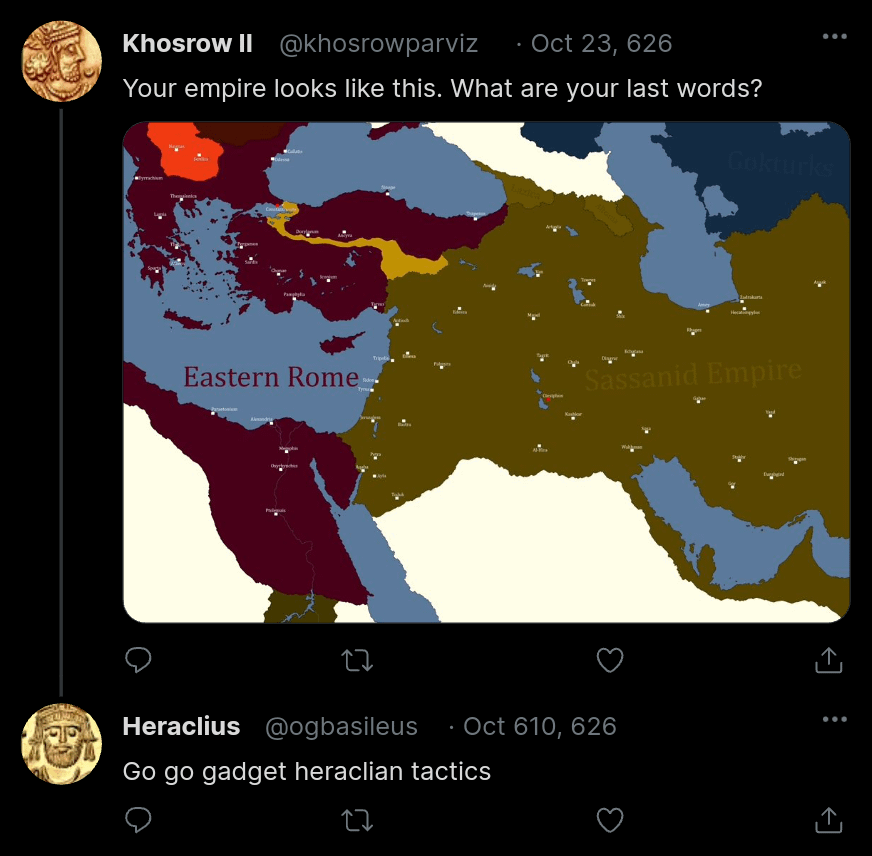
In October 626, Khosrow II’s Sassanid Empire was at its absolute territorial zenith. Egypt, Syria, Palestine, much of Anatolia, and the Caucasus were under Persian control following two decades of total Byzantine collapse after Phocas’s coup in 602.
Khosrow had even installed a Persian governor in Alexandria and was coordinating with the Avar Khagan for the joint siege of Constantinople itself (June-July 626, though the meme dates it October for dramatic effect).
Roman emperor Heraclius (who had seized the throne in 610 after a civil war of his own) was not in Constantinople during the siege. He had already left in 624 on his insane deep-strike campaign through Armenia into the Persian heartland, deliberately abandoning his rear like a man with nothing left to lose.
The Sassanids didn’t expect Heraclius to lock in like this. He treated the entire war like a Byzantine *Strategikon* on steroids: scorched-earth raids, divide-and-conquer against three separate Persian armies in 625, and the single most audacious winter invasion of Mesopotamia in recorded history.
This ended up with a civil war in Ctesiphon, Khosrow murdered, Kavad II signing a humiliating peace, and Heraclius restores the True Cross to Jerusalem in 630 wearing the same purple he left in.
Then both empires were so bankrupt and depopulated that the Rashidun Caliphate almost conquered the entire map in under 20 years.
rosyvibexz on
Khosrow II: ‘I have your cross, your capital is besieged, and your empire is gone. Any last words?’ Heraclius: ‘Actually, I’m about to do what’s called a pro-gamer move’.
MasterpieceVirtual66 on
Ave Imperator Caesar Flavius Heraclius Augustus! Πιστός εν Χριστώ τω Θεώ Βασιλεύς και Αυτοκράτωρ!
BasedAustralhungary on
Heraclius casually posting from October 610 shouldn’t have made me laugh as much as it did
NondescriptNorbert on
The silly little tribal merchants down south that have just had a spiritual awakening: “It’s adorable either of you feel in charge.”
autisticsatanist on
He had such bad luck to be regning during the muslim conquests.
GCN_09 on
I studied Heraclius’s counteroffensive campaign when I was in training to be a officer of the Brazilian Air Force. What baffled me and my fellow officer candidates is that this campaign really shouldn’t have worked.
Heraclius marched an army the size of two modern divisions across the Caucasus in winter, sacked the spiritual heart of Zoroastrianism, won a decisive field battle at Nineveh without besieging Ctesiphon, and forced a dynastic collapse.
Contemporary Persian sources (what little survive) even describe the panic in the Sassanid royal court when Heraclius appeared in the Iranian plateau like a ghost army.
Khosrow’s execution in 628 was carried out by his own nobles because they realized the war was lost the moment the Romans decided to stop playing defense.

7 Comments
In October 626, Khosrow II’s Sassanid Empire was at its absolute territorial zenith. Egypt, Syria, Palestine, much of Anatolia, and the Caucasus were under Persian control following two decades of total Byzantine collapse after Phocas’s coup in 602.
Khosrow had even installed a Persian governor in Alexandria and was coordinating with the Avar Khagan for the joint siege of Constantinople itself (June-July 626, though the meme dates it October for dramatic effect).
Roman emperor Heraclius (who had seized the throne in 610 after a civil war of his own) was not in Constantinople during the siege. He had already left in 624 on his insane deep-strike campaign through Armenia into the Persian heartland, deliberately abandoning his rear like a man with nothing left to lose.
The Sassanids didn’t expect Heraclius to lock in like this. He treated the entire war like a Byzantine *Strategikon* on steroids: scorched-earth raids, divide-and-conquer against three separate Persian armies in 625, and the single most audacious winter invasion of Mesopotamia in recorded history.
This ended up with a civil war in Ctesiphon, Khosrow murdered, Kavad II signing a humiliating peace, and Heraclius restores the True Cross to Jerusalem in 630 wearing the same purple he left in.
Then both empires were so bankrupt and depopulated that the Rashidun Caliphate almost conquered the entire map in under 20 years.
Khosrow II: ‘I have your cross, your capital is besieged, and your empire is gone. Any last words?’ Heraclius: ‘Actually, I’m about to do what’s called a pro-gamer move’.
Ave Imperator Caesar Flavius Heraclius Augustus! Πιστός εν Χριστώ τω Θεώ Βασιλεύς και Αυτοκράτωρ!
Heraclius casually posting from October 610 shouldn’t have made me laugh as much as it did
The silly little tribal merchants down south that have just had a spiritual awakening: “It’s adorable either of you feel in charge.”
He had such bad luck to be regning during the muslim conquests.
I studied Heraclius’s counteroffensive campaign when I was in training to be a officer of the Brazilian Air Force. What baffled me and my fellow officer candidates is that this campaign really shouldn’t have worked.
Heraclius marched an army the size of two modern divisions across the Caucasus in winter, sacked the spiritual heart of Zoroastrianism, won a decisive field battle at Nineveh without besieging Ctesiphon, and forced a dynastic collapse.
Contemporary Persian sources (what little survive) even describe the panic in the Sassanid royal court when Heraclius appeared in the Iranian plateau like a ghost army.
Khosrow’s execution in 628 was carried out by his own nobles because they realized the war was lost the moment the Romans decided to stop playing defense.