
Over 20 million electric cars were sold globally in 2025 — some for as little as $10,000. Even just two decades ago, that would have been impossible.
The reason it's possible now? Batteries have gotten much cheaper.
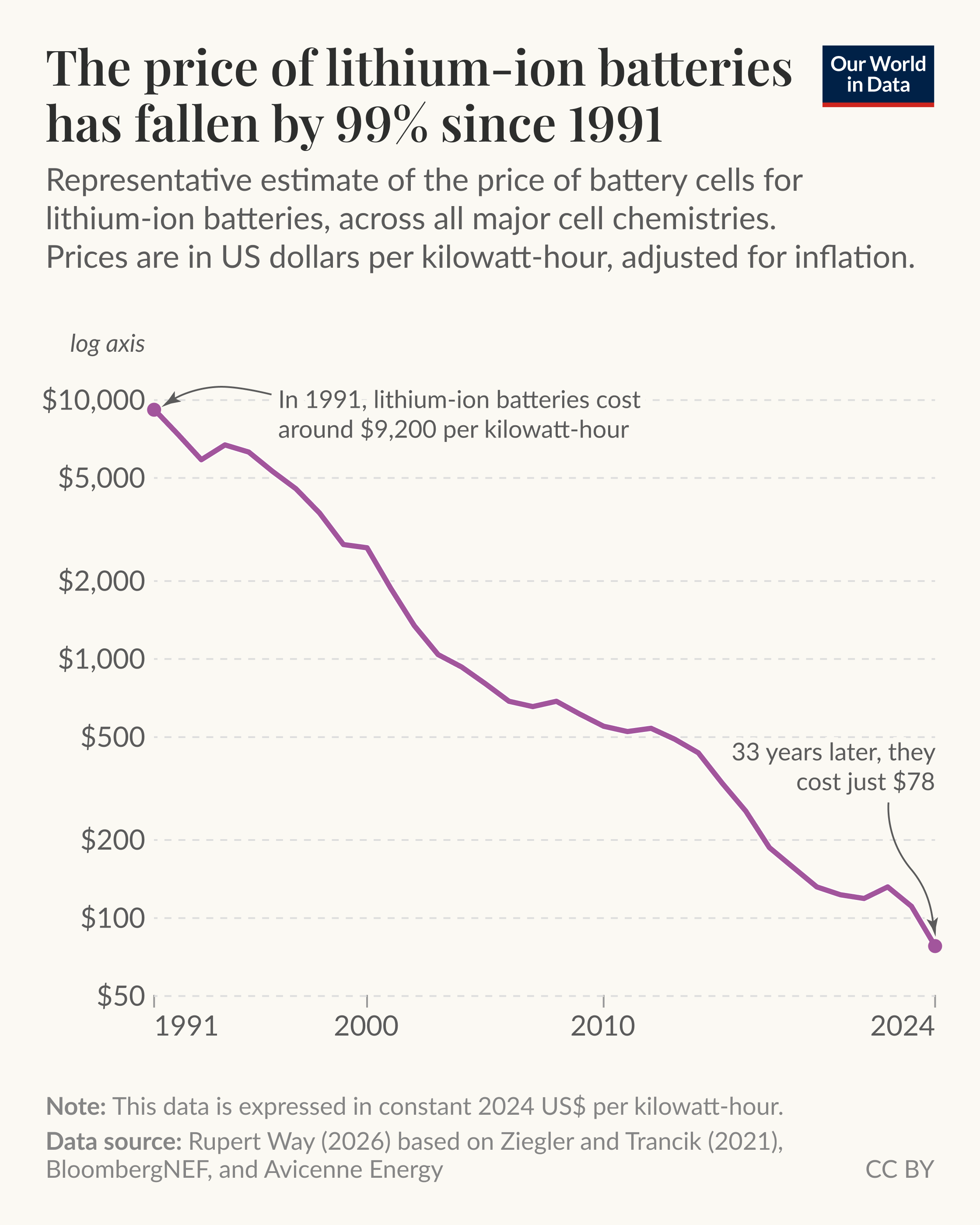
In 1991, lithium-ion battery cells cost around $9,200 per kilowatt-hour. By 2024, that had fallen to just $78 — a decline of more than 99%. You can see this in the chart.
To put that in perspective: the battery cells in a standard electric car today cost around $5,000. In 1991, those same cells would have cost nearly $600,000.
There was no single breakthrough behind this. Batteries follow a “learning curve”: as cumulative production grows, thousands of small improvements in chemistry, manufacturing, and supply chains drive prices down.
Since 1998, every time global cumulative battery production doubled, the price dropped by roughly 19%.
Early progress was driven by consumer electronics — phones and laptops — before the technology became viable for cars, buses, and larger energy storage.
Energy density has also more than tripled since the 1990s, meaning batteries can now store far more energy for their volume.
Read more and see more charts (including an interactive version of the chart here) in our recent article by Hannah Ritchie.
by ourworldindata
14 Comments
**Data source:** [Rupert Way (2026)](https://www.smithschool.ox.ac.uk/person/rupert-way) based on Ziegler and Trancik (2021), BloombergNEF, and Avicenne Energy
**Tools used:** the OWID-Grapher with finishing in Figma
I was around in the early days of this sub when the data was beautiful.
Half of it is just line graphs screenclipped from websites now 🙁
Let the “batteries are lagging behind” crowd see this. Smartphones could have kept a good battery life, but businesses chose to squeeze out every bit of flashiness because it sells. It’s a marvel that Li-ion batteries have kept up as well as they have.
This is why there are disposable vapes nowadays. It wouldn’t have made sense a few years back.
The sad part is that the ecological impact of trashing lithium ion battery is 100% the same.
The children in the lithium mines being like
https://preview.redd.it/97k9jrr1grsg1.jpeg?width=750&format=pjpg&auto=webp&s=7fb79e148df5f85a0a96f73c18f6b6fb370bc280
Can somebody pls go and tell this to Makita?
so basically, we shouldn’t expect any that much cheaper batteries by now, at least of Li-pol type
Logarithmic scale really makes a difference here
Batteries are still the biggest cost of EVs. They have only come down ~15% in the past decade that they’ve been viable.
I have a home solar install.
Every time I buy an LiFePO4 battery – the same capacity, type from the same manufacturer – they are cheaper.
Same for solar panels.
It’s about the only thing that’s NOT following inflation.
12V 100Ah LiFePO4:
– £299.99 28/09/2023
– £279.99 28/10/2023
– £239.99 31/5/2024
– £209.99 31/7/2024
– ….
They are currently… let me check….
£179.99
And now they come with bluetooth by default (which the others didn’t).
And even RAM prices look similar.
“There was no single breakthrough behind this. Batteries follow a “learning curve”: as cumulative production grows, thousands of small improvements in chemistry, manufacturing, and supply chains drive prices down.”
In other words: we could have gotten here way sooner if the fossil fuel lobby didn’t actively resist this development from happening. Such a shame really.
This graph be like China LiFePO4 battery development progress from 1991 to 2024
you know what would be great. To chart other battery technologies like that and have a lookup table for what kind of capacity, charging speed and energy retention is needed for which application.