
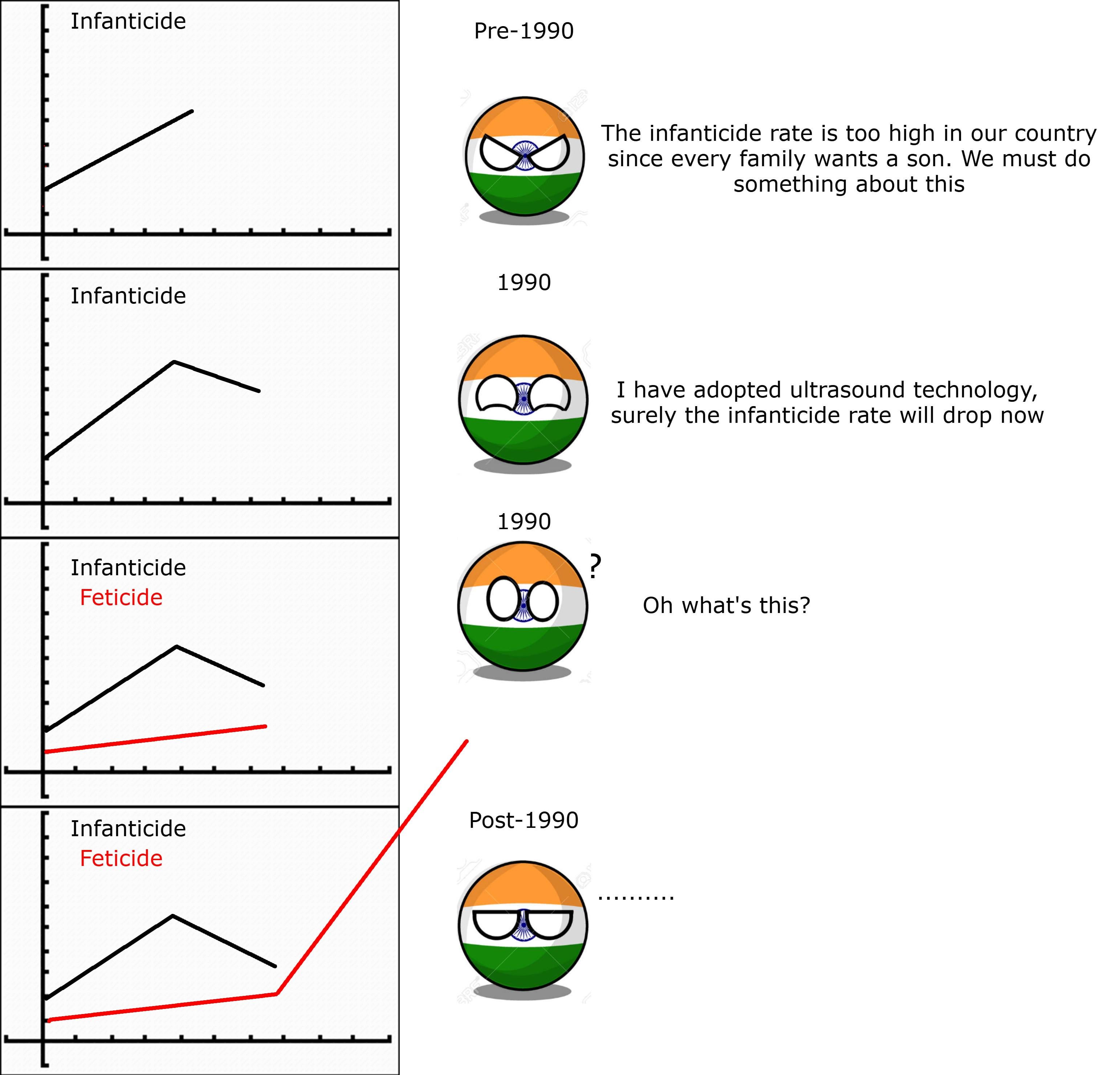
In India like in most cultures it was considered preferable to have a son, however in India, having a daughter meant a heavy financial burden for the family since it is a custom to give a dowry (goods or lump sum of money) to the husband of the daughter when she got married
This lead to many poor families to simply kill their infant daughters if they had any since the family did not want to commit to a hefty dowry.
Ultrasound Technology became first available in the 1980s in India and then became widespread in the 1990s which slightly curbed the infanticide problem. However, ultrasound technology now caused a massive increase in Feticide (removal of fetus) since now parents could use ultrasounds to find out if their unborn child was male or female, and if it was the latter, the fetus would be removed
This prompted the Indian government to ban the usage of ultrasound technologies for the purpose of finding out the sex of the fetus in 1996 because their demographic shifted massively with there being more men then women
Sources
by PrinzEugen_Azur_Lane
13 Comments
The classic Cobra Effect. Trying to solve a horrific problem with technology only to realize human nature just finds a more efficient way to be horrific
Never understood why Indian culture does dowry this way. Southern African cultures has something similar called a lobola, but it is paid to the family of the bride.
It has ended up helping the liberation of women, because an educated bride commands a larger lobola.
And it hasn’t lead to any gender imbalance, because the son still carries the family name.
Eh, better than killing kids.
If you have something to pass on as inheritance, then having sons is deemed preferable to keep the family fortunes. Those families may be poor but not dirt poor. If you have absolutely nothing, then investing in your daughter with all your resources, however paltry, is your gateway to escape. The gateway may or may not be marriages but it often beats raising another dirt poor son who can’t get married anyway.
Eh, why worry. A fetus is not a living being anyway /s
My mum was a nurse in India who had the whole “It is illegal to reveal the sex of a baby” thing drilled into her, so you can imagine her surprise when, after marrying my dad and immigrating out of there, her obgyn was like “Hey you wanna know if it’s a boy or a girl?” while she was pregnant with me.
Positive News:
It has improved a lot in recent years. India’s sex ratio measured as females per 1,000 males has went from 927 in 1991 to 943 in 2011. While census is yet to conducted, recent data (NFHS-5, 2019-21 survey) shows an increase to 1,020 females per 1,000 males although data is yet to completely verified.
* Southern states and North East achieved balance by 00s.
* Even Eastern states like Bengal, Bihar, Odisha, MP and Western states like Maharashtra have mostly balanced out or are close to it
* Only region with terrible sex ratio still is upper North particularly Punjab, Haryana.
Note- Having more female than male is fine for society as female tend to live few years more.
For clarifications, when you’re talking about feticide, are you talking about the crime of unlawful killing of a fœtus by a person other than the mother, or abortions?
Very healthy and normal society.
Being a women in India does not sound like a fun experience
Should have started earlier with the role of international NGOs in creating this problem: [https://indianexpress.com/article/opinion/columns/international-ngos-and-the-perils-of-outsourcing-development-9612752/](https://indianexpress.com/article/opinion/columns/international-ngos-and-the-perils-of-outsourcing-development-9612752/)
I feel that using the term “feticide” is a little misleading, considering it could just mean abortion.
pro-choicers in a bit of a confusion in the comments section . let me clarify – In india , legally , feticide is unlawful killing of a fœtus by a person other than the mother, AND abortions (MTP) .
moral problem , isnt it ?