Did you know: The SR-71 Blackbird had over 4,000+ documented attempted missile firings during its operational career and none of them managed to successfully shoot it down, engineering at its peak!
Did you know: The SR-71 Blackbird had over 4,000+ documented attempted missile firings during its operational career and none of them managed to successfully shoot it down, engineering at its peak!
Engineering at its peak except when it leaked gass all over the runway lmao.
Great engineering for its time.
Satellite technology made the need for these high-speed spy planes nonexistent but if they did try again today they would probably end up with a better design.
MelodiousPun on
To be fair, with X-Men onboard for added defense, it wasn’t much of a contest.
o_MrBombastic_o on
It was also built with help from the Soviets, we got the Titanium used to build it from the USSR
yaxir on
a tool for imperialism
techman710 on
I still wonder how many UFO sightings in the late 60’s and early 70’s were people seeing this amazing jet. Skunkworks does some incredible work. Remember they did this with slide rules and hand drawn blueprints.
Percolator2020 on
Yeah, though I walk through the valley of the shadow of death I shall fear no evil for I am at 80,000 feet and climbing.
Rickshmitt on
I had this as a micro machine
ThreadCountHigh on
Well yes. It would have been more vulnerable to anti-satellite weapons than it ever was to surface-to-air weapons in its time.
LikeWhattttlol on
In cod I always try to shoot it down 😂😂😂😂 even tho I could never find it duh!!!
shamrock01 on
source for the “missile firings” claim?
rawtrap on
When they made this plane it operated at altitudes and speeds that missiles couldn’t reach, truly impressive for the time, now hypersonic flight on missiles is a real threat for almost every plane so I’m really curious to see how they manage to work around it (aside from obviously using stealth as the primary tool), drones must play an important role in this matter
-SuperTrooper- on
# “America is all about speed. Hot, nasty, bad-ass speed.” – Eleanor Roosevelt
Sea_Perspective6891 on
There was one incident I remember from this one documentary where they talked about how they were almost hit while over Russia. A missile came very close to the back but the Blackbird outran it just long enough till the middle exploded in mid flight. They actually felt the shockwave from the explosion when the whole plane shook.
rogueslayer1138 on
It’s also built from titanium that was sourced from the Soviet Union (using a network of shell companies to hide the true buyer). The Soviets thought the titanium was being used in “pizza ovens”.
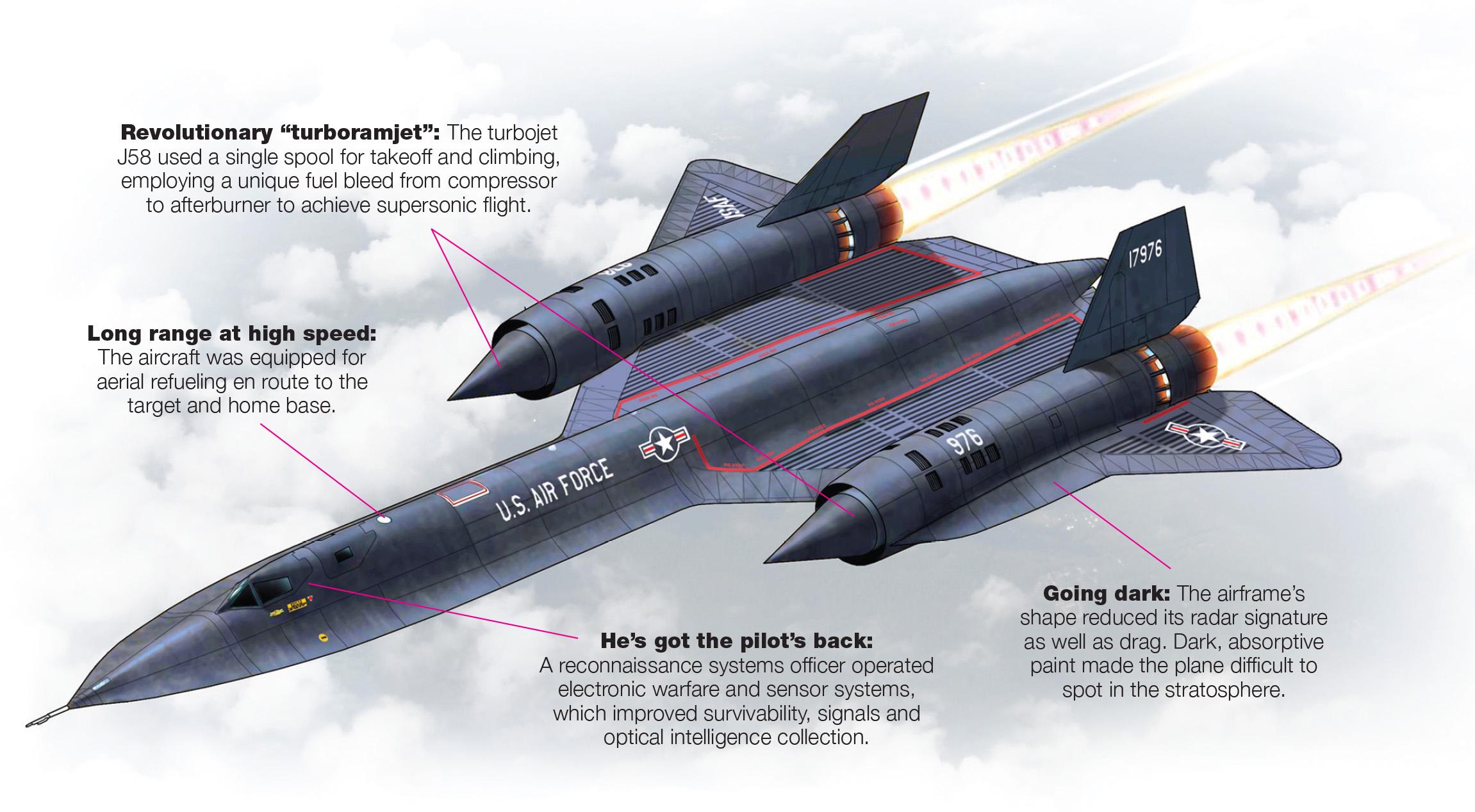
The turbo-ramjet misinformation again… ugh it just won’t die! The engine wasn’t a turbo- ramjet, not even close! It’s genius is being able to work at pressures and temperatures a normal engine would straight up blow itself apart at. It was fed subsonic air like all jet engines do.
algypan on
One of these is at Duxford on display where you can get close to it. It’s an incredible piece of engineering.
Rocangus on
I must be early. No sign of the groundspeed story yet.
alfred_hedgehog on
rather engineering at it’s low, since soviets were unable to shot it. modern AA missiles are able to intercept ballistic missiles which are several times faster.
mbjanak on
This aircraft was built over 60 years ago and it still looks like it’s from the future. Amazing stuff.
Gabriel_Conroy on
Nobody has posted it yet so here it is. Enjoy
“There were a lot of things we couldn’t do in an SR-71, but we were the fastest guys on the block and loved reminding our fellow aviators of this fact. People often asked us if, because of this fact, it was fun to fly the jet. Fun would not be the first word I would use to describe flying this plane. Intense, maybe. Even cerebral. But there was one day in our Sled experience when we would have to say that it was pure fun to be the fastest guys out there, at least for a moment.
It occurred when Walt and I were flying our final training sortie. We needed 100 hours in the jet to complete our training and attain Mission Ready status. Somewhere over Colorado we had passed the century mark. We had made the turn in Arizona and the jet was performing flawlessly. My gauges were wired in the front seat and we were starting to feel pretty good about ourselves, not only because we would soon be flying real missions but because we had gained a great deal of confidence in the plane in the past ten months. Ripping across the barren deserts 80,000 feet below us, I could already see the coast of California from the Arizona border. I was, finally, after many humbling months of simulators and study, ahead of the jet. I was beginning to feel a bit sorry for Walter in the back seat. There he was, with no really good view of the incredible sights before us, tasked with monitoring four different radios. This was good practice for him for when we began flying real missions, when a priority transmission from headquarters could be vital. It had been difficult, too, for me to relinquish control of the radios, as during my entire flying career I had controlled my own transmissions. But it was part of the division of duties in this plane and I had adjusted to it. I still insisted on talking on the radio while we were on the ground, however. Walt was so good at many things, but he couldn’t match my expertise at sounding smooth on the radios, a skill that had been honed sharply with years in fighter squadrons where the slightest radio miscue was grounds for beheading. He understood that and allowed me that luxury.
Just to get a sense of what Walt had to contend with, I pulled the radio toggle switches and monitored the frequencies along with him. The predominant radio chatter was from Los Angeles Center, far below us, controlling daily traffic in their sector. While they had us on their scope (albeit briefly), we were in uncontrolled airspace and normally would not talk to them unless we needed to descend into their airspace. We listened as the shaky voice of a lone Cessna pilot asked Center for a readout of his ground speed. Center replied: “November Charlie 175, I’m showing you at ninety knots on the ground.”
Now the thing to understand about Center controllers, was that whether they were talking to a rookie pilot in a Cessna, or to Air Force One, they always spoke in the exact same, calm, deep, professional, tone that made one feel important. I referred to it as the ” Houston Center voice.” I have always felt that after years of seeing documentaries on this country’s space program and listening to the calm and distinct voice of the Houston controllers, that all other controllers since then wanted to sound like that, and that they basically did. And it didn’t matter what sector of the country we would be flying in, it always seemed like the same guy was talking. Over the years that tone of voice had become somewhat of a comforting sound to pilots everywhere. Conversely, over the years, pilots always wanted to ensure that, when transmitting, they sounded like Chuck Yeager, or at least like John Wayne. Better to die than sound bad on the radios.
Just moments after the Cessna’s inquiry, a Twin Beech piped up on frequency, in a rather superior tone, asking for his ground speed. “I have you at one hundred and twenty-five knots of ground speed.” Boy, I thought, the Beechcraft really must think he is dazzling his Cessna brethren. Then out of the blue, a navy F-18 pilot out of NAS Lemoore came up on frequency. You knew right away it was a Navy jock because he sounded very cool on the radios. “Center, Dusty 52 ground speed check”. Before Center could reply, I’m thinking to myself, hey, Dusty 52 has a ground speed indicator in that million-dollar cockpit, so why is he asking Center for a readout? Then I got it, ol’ Dusty here is making sure that every bug smasher from Mount Whitney to the Mojave knows what true speed is. He’s the fastest dude in the valley today, and he just wants everyone to know how much fun he is having in his new Hornet. And the reply, always with that same, calm, voice, with more distinct alliteration than emotion: “Dusty 52, Center, we have you at 620 on the ground.”
And I thought to myself, is this a ripe situation, or what? As my hand instinctively reached for the mic button, I had to remind myself that Walt was in control of the radios. Still, I thought, it must be done – in mere seconds we’ll be out of the sector and the opportunity will be lost. That Hornet must die, and die now. I thought about all of our Sim training and how important it was that we developed well as a crew and knew that to jump in on the radios now would destroy the integrity of all that we had worked toward becoming. I was torn.
Somewhere, 13 miles above Arizona, there was a pilot screaming inside his space helmet. Then, I heard it. The click of the mic button from the back seat. That was the very moment that I knew Walter and I had become a crew. Very professionally, and with no emotion, Walter spoke: “Los Angeles Center, Aspen 20, can you give us a ground speed check?” There was no hesitation, and the replay came as if was an everyday request. “Aspen 20, I show you at one thousand eight hundred and forty-two knots, across the ground.”
I think it was the forty-two knots that I liked the best, so accurate and proud was Center to deliver that information without hesitation, and you just knew he was smiling. But the precise point at which I knew that Walt and I were going to be really good friends for a long time was when he keyed the mic once again to say, in his most fighter-pilot-like voice: “Ah, Center, much thanks, we’re showing closer to nineteen hundred on the money.”
For a moment Walter was a god. And we finally heard a little crack in the armor of the Houston Center voice, when L.A.came back with, “Roger that Aspen, Your equipment is probably more accurate than ours. You boys have a good one.” It all had lasted for just moments, but in that short, memorable sprint across the southwest, the Navy had been flamed, all mortal airplanes on freq were forced to bow before the King of Speed, and more importantly, Walter and I had crossed the threshold of being a crew. A fine day’s work. We never heard another transmission on that frequency all the way to the coast. For just one day, it truly was fun being the fastest guys out there.”
As told by Maj. Brian Shul, USAF
kayl_the_red on
The SR-71 holds gravity in sheer contempt, why should it care about a missile?
the-watch-dog on
Did you know: i went years without seeing and hearing so much about war machines and magically “everyone” finds death machines nifty all of a sudden. Weird huh
tdkimber on
my goat
markstar99 on
We have to take into account, if it was just because of it’s speed, it would have been shot down more than once, 50% of the fantastic job it did was because of it’s fantastic electronic warfare abilities to trick missiles into missing the plane, otherwise it would have been shot down rather soon.
OCDAVO on
Who needs 4,000 SAM missiles? All the enemy has to do is wait until we park it on the ramp withing drone/missile range of Iran, and “poof”.
RRoadRollerDaa on
Also make out of Soviet Titanium to spy on Soviet lol
supercharger619 on
It’s my understanding that the frame was the limiting factor in the plane going faster not the engines, please correct me if that’s not right
Fascinating story about the development of the U2, SR-71, and F-117.
kroghman on
Are there any stories from USSR, or other, pilots who were trying to shoot it down?
BlueReaper0013 on
The Lockheed SR-71 Blackbird. An advanced long-range strategic reconnaissance aircraft capable of Mach 3 at an altitude of 85,000 feet.
fearswe on
The Swedish Saab 37 Viggen is the only plane that has managed to repeatedly get acknowledged radar lock on though. Had they actually fired missiles, it probably would’ve hit.
They achieved it by feeding the airplanes with targeting data from the groundradars, and they were also in-front of the SR-71 so they were flying towards each other which would’ve meant the SR-71 couldn’t just famously speed away.
Recommend the Boeing museum in Seattle to see this beast and the big block V8 on a cart they used to start it. Must have been incredibly loud. I love these planes would leak fuel on the ground as there were gaps in the skin to allow for expansion at speed
Amazing engineering indeed, but oh so very expensive to operate!
Morty
APoisonousMushroom on
One of the most interesting things about the SR-71 was that it was literally too fast for a missile’s explosion to catch it. There’s a famous story from pilot Brian Shul (who wrote Sled Driver) about a mission over Libya in ’86 where they were being hunted by SA-2s and SA-4s. His standard “evasive maneuver” was basically just to floor it. He pushed the jet to Mach 3.5, and because those missiles had to burn so much energy just to climb to 80,000 feet, they didn’t have enough gas left to close the gap.
The coolest part I think is the physics of the blast. Since the Blackbird is screaming along at over three times the speed of sound, a missile exploding behind it literally can’t hit it with a pressure wave. A shockwave moves through the air at the speed of sound, but the SR-71 is moving away from that air three times faster. Shul described seeing the missiles detonate in the heat of his engines like “implosions” in the distance because by the time the blast even happened, he was already miles down range.
ArchitectofExperienc on
Proof that with enough speed, it may actually be possible to outrun your problems
PrimoBachs on
My favorite jet in history
freshapepper on
I djed a wedding under the wing of one of these at the Kalamazoo air zoo.
growerdan on
Is that like 3 of the US fighter jets being shot down over Iran by “friendly fire” and we’ve never lost one of those jets to enemy fire. 🙄
AdventureMan247 on
Doctrine and Logistics are a major part of this record
Synap-6 on
Wish i had kept my GI Joe Blackbird from the 80s-90s
Gene-Hackmans_Dog on
Shooting down an airplane is normally difficult anyways. You have to put your missile where the aircraft will be. And if your target is Mach 3 at 80,000 feet, they could just take a small 10 degree turn and now your aim point is miles off and missile is defeated.

46 Comments
8 kill streak 👐
Engineering at its peak except when it leaked gass all over the runway lmao.
Great engineering for its time.
Satellite technology made the need for these high-speed spy planes nonexistent but if they did try again today they would probably end up with a better design.
To be fair, with X-Men onboard for added defense, it wasn’t much of a contest.
It was also built with help from the Soviets, we got the Titanium used to build it from the USSR
a tool for imperialism
I still wonder how many UFO sightings in the late 60’s and early 70’s were people seeing this amazing jet. Skunkworks does some incredible work. Remember they did this with slide rules and hand drawn blueprints.
Yeah, though I walk through the valley of the shadow of death I shall fear no evil for I am at 80,000 feet and climbing.
I had this as a micro machine
Well yes. It would have been more vulnerable to anti-satellite weapons than it ever was to surface-to-air weapons in its time.
In cod I always try to shoot it down 😂😂😂😂 even tho I could never find it duh!!!
source for the “missile firings” claim?
When they made this plane it operated at altitudes and speeds that missiles couldn’t reach, truly impressive for the time, now hypersonic flight on missiles is a real threat for almost every plane so I’m really curious to see how they manage to work around it (aside from obviously using stealth as the primary tool), drones must play an important role in this matter
# “America is all about speed. Hot, nasty, bad-ass speed.” – Eleanor Roosevelt
There was one incident I remember from this one documentary where they talked about how they were almost hit while over Russia. A missile came very close to the back but the Blackbird outran it just long enough till the middle exploded in mid flight. They actually felt the shockwave from the explosion when the whole plane shook.
It’s also built from titanium that was sourced from the Soviet Union (using a network of shell companies to hide the true buyer). The Soviets thought the titanium was being used in “pizza ovens”.
https://nationalinterest.org/blog/buzz/titanium-russia-was-secret-ingredient-sr-71-blackbird-207691
The turbo-ramjet misinformation again… ugh it just won’t die! The engine wasn’t a turbo- ramjet, not even close! It’s genius is being able to work at pressures and temperatures a normal engine would straight up blow itself apart at. It was fed subsonic air like all jet engines do.
One of these is at Duxford on display where you can get close to it. It’s an incredible piece of engineering.
I must be early. No sign of the groundspeed story yet.
rather engineering at it’s low, since soviets were unable to shot it. modern AA missiles are able to intercept ballistic missiles which are several times faster.
This aircraft was built over 60 years ago and it still looks like it’s from the future. Amazing stuff.
Nobody has posted it yet so here it is. Enjoy
“There were a lot of things we couldn’t do in an SR-71, but we were the fastest guys on the block and loved reminding our fellow aviators of this fact. People often asked us if, because of this fact, it was fun to fly the jet. Fun would not be the first word I would use to describe flying this plane. Intense, maybe. Even cerebral. But there was one day in our Sled experience when we would have to say that it was pure fun to be the fastest guys out there, at least for a moment.
It occurred when Walt and I were flying our final training sortie. We needed 100 hours in the jet to complete our training and attain Mission Ready status. Somewhere over Colorado we had passed the century mark. We had made the turn in Arizona and the jet was performing flawlessly. My gauges were wired in the front seat and we were starting to feel pretty good about ourselves, not only because we would soon be flying real missions but because we had gained a great deal of confidence in the plane in the past ten months. Ripping across the barren deserts 80,000 feet below us, I could already see the coast of California from the Arizona border. I was, finally, after many humbling months of simulators and study, ahead of the jet. I was beginning to feel a bit sorry for Walter in the back seat. There he was, with no really good view of the incredible sights before us, tasked with monitoring four different radios. This was good practice for him for when we began flying real missions, when a priority transmission from headquarters could be vital. It had been difficult, too, for me to relinquish control of the radios, as during my entire flying career I had controlled my own transmissions. But it was part of the division of duties in this plane and I had adjusted to it. I still insisted on talking on the radio while we were on the ground, however. Walt was so good at many things, but he couldn’t match my expertise at sounding smooth on the radios, a skill that had been honed sharply with years in fighter squadrons where the slightest radio miscue was grounds for beheading. He understood that and allowed me that luxury.
Just to get a sense of what Walt had to contend with, I pulled the radio toggle switches and monitored the frequencies along with him. The predominant radio chatter was from Los Angeles Center, far below us, controlling daily traffic in their sector. While they had us on their scope (albeit briefly), we were in uncontrolled airspace and normally would not talk to them unless we needed to descend into their airspace. We listened as the shaky voice of a lone Cessna pilot asked Center for a readout of his ground speed. Center replied: “November Charlie 175, I’m showing you at ninety knots on the ground.”
Now the thing to understand about Center controllers, was that whether they were talking to a rookie pilot in a Cessna, or to Air Force One, they always spoke in the exact same, calm, deep, professional, tone that made one feel important. I referred to it as the ” Houston Center voice.” I have always felt that after years of seeing documentaries on this country’s space program and listening to the calm and distinct voice of the Houston controllers, that all other controllers since then wanted to sound like that, and that they basically did. And it didn’t matter what sector of the country we would be flying in, it always seemed like the same guy was talking. Over the years that tone of voice had become somewhat of a comforting sound to pilots everywhere. Conversely, over the years, pilots always wanted to ensure that, when transmitting, they sounded like Chuck Yeager, or at least like John Wayne. Better to die than sound bad on the radios.
Just moments after the Cessna’s inquiry, a Twin Beech piped up on frequency, in a rather superior tone, asking for his ground speed. “I have you at one hundred and twenty-five knots of ground speed.” Boy, I thought, the Beechcraft really must think he is dazzling his Cessna brethren. Then out of the blue, a navy F-18 pilot out of NAS Lemoore came up on frequency. You knew right away it was a Navy jock because he sounded very cool on the radios. “Center, Dusty 52 ground speed check”. Before Center could reply, I’m thinking to myself, hey, Dusty 52 has a ground speed indicator in that million-dollar cockpit, so why is he asking Center for a readout? Then I got it, ol’ Dusty here is making sure that every bug smasher from Mount Whitney to the Mojave knows what true speed is. He’s the fastest dude in the valley today, and he just wants everyone to know how much fun he is having in his new Hornet. And the reply, always with that same, calm, voice, with more distinct alliteration than emotion: “Dusty 52, Center, we have you at 620 on the ground.”
And I thought to myself, is this a ripe situation, or what? As my hand instinctively reached for the mic button, I had to remind myself that Walt was in control of the radios. Still, I thought, it must be done – in mere seconds we’ll be out of the sector and the opportunity will be lost. That Hornet must die, and die now. I thought about all of our Sim training and how important it was that we developed well as a crew and knew that to jump in on the radios now would destroy the integrity of all that we had worked toward becoming. I was torn.
Somewhere, 13 miles above Arizona, there was a pilot screaming inside his space helmet. Then, I heard it. The click of the mic button from the back seat. That was the very moment that I knew Walter and I had become a crew. Very professionally, and with no emotion, Walter spoke: “Los Angeles Center, Aspen 20, can you give us a ground speed check?” There was no hesitation, and the replay came as if was an everyday request. “Aspen 20, I show you at one thousand eight hundred and forty-two knots, across the ground.”
I think it was the forty-two knots that I liked the best, so accurate and proud was Center to deliver that information without hesitation, and you just knew he was smiling. But the precise point at which I knew that Walt and I were going to be really good friends for a long time was when he keyed the mic once again to say, in his most fighter-pilot-like voice: “Ah, Center, much thanks, we’re showing closer to nineteen hundred on the money.”
For a moment Walter was a god. And we finally heard a little crack in the armor of the Houston Center voice, when L.A.came back with, “Roger that Aspen, Your equipment is probably more accurate than ours. You boys have a good one.” It all had lasted for just moments, but in that short, memorable sprint across the southwest, the Navy had been flamed, all mortal airplanes on freq were forced to bow before the King of Speed, and more importantly, Walter and I had crossed the threshold of being a crew. A fine day’s work. We never heard another transmission on that frequency all the way to the coast. For just one day, it truly was fun being the fastest guys out there.”
As told by Maj. Brian Shul, USAF
The SR-71 holds gravity in sheer contempt, why should it care about a missile?
Did you know: i went years without seeing and hearing so much about war machines and magically “everyone” finds death machines nifty all of a sudden. Weird huh
my goat
We have to take into account, if it was just because of it’s speed, it would have been shot down more than once, 50% of the fantastic job it did was because of it’s fantastic electronic warfare abilities to trick missiles into missing the plane, otherwise it would have been shot down rather soon.
Who needs 4,000 SAM missiles? All the enemy has to do is wait until we park it on the ramp withing drone/missile range of Iran, and “poof”.
Also make out of Soviet Titanium to spy on Soviet lol
It’s my understanding that the frame was the limiting factor in the plane going faster not the engines, please correct me if that’s not right
The evasive maneuver is full throttle.
Give this a read some time: [Skunk Works: A Personal Memoir of My Years at Lockheed](https://www.goodreads.com/book/show/101438.Skunk_Works)
Fascinating story about the development of the U2, SR-71, and F-117.
Are there any stories from USSR, or other, pilots who were trying to shoot it down?
The Lockheed SR-71 Blackbird. An advanced long-range strategic reconnaissance aircraft capable of Mach 3 at an altitude of 85,000 feet.
The Swedish Saab 37 Viggen is the only plane that has managed to repeatedly get acknowledged radar lock on though. Had they actually fired missiles, it probably would’ve hit.
They achieved it by feeding the airplanes with targeting data from the groundradars, and they were also in-front of the SR-71 so they were flying towards each other which would’ve meant the SR-71 couldn’t just famously speed away.
[https://en.wikipedia.org/wiki/Saab_37_Viggen#Operational_history](https://en.wikipedia.org/wiki/Saab_37_Viggen#Operational_history)
Recommend the Boeing museum in Seattle to see this beast and the big block V8 on a cart they used to start it. Must have been incredibly loud. I love these planes would leak fuel on the ground as there were gaps in the skin to allow for expansion at speed
Maj. Brian Shul passed on in 2023. RIP
https://preview.redd.it/o4p88e9jl2sg1.png?width=720&format=png&auto=webp&s=994b4e6c86f9c52609c1d4de389df18951efad81
Amazing engineering indeed, but oh so very expensive to operate!
Morty
One of the most interesting things about the SR-71 was that it was literally too fast for a missile’s explosion to catch it. There’s a famous story from pilot Brian Shul (who wrote Sled Driver) about a mission over Libya in ’86 where they were being hunted by SA-2s and SA-4s. His standard “evasive maneuver” was basically just to floor it. He pushed the jet to Mach 3.5, and because those missiles had to burn so much energy just to climb to 80,000 feet, they didn’t have enough gas left to close the gap.
The coolest part I think is the physics of the blast. Since the Blackbird is screaming along at over three times the speed of sound, a missile exploding behind it literally can’t hit it with a pressure wave. A shockwave moves through the air at the speed of sound, but the SR-71 is moving away from that air three times faster. Shul described seeing the missiles detonate in the heat of his engines like “implosions” in the distance because by the time the blast even happened, he was already miles down range.
Proof that with enough speed, it may actually be possible to outrun your problems
My favorite jet in history
I djed a wedding under the wing of one of these at the Kalamazoo air zoo.
Is that like 3 of the US fighter jets being shot down over Iran by “friendly fire” and we’ve never lost one of those jets to enemy fire. 🙄
Doctrine and Logistics are a major part of this record
Wish i had kept my GI Joe Blackbird from the 80s-90s
Shooting down an airplane is normally difficult anyways. You have to put your missile where the aircraft will be. And if your target is Mach 3 at 80,000 feet, they could just take a small 10 degree turn and now your aim point is miles off and missile is defeated.
“Accelerate and gain altitude”