
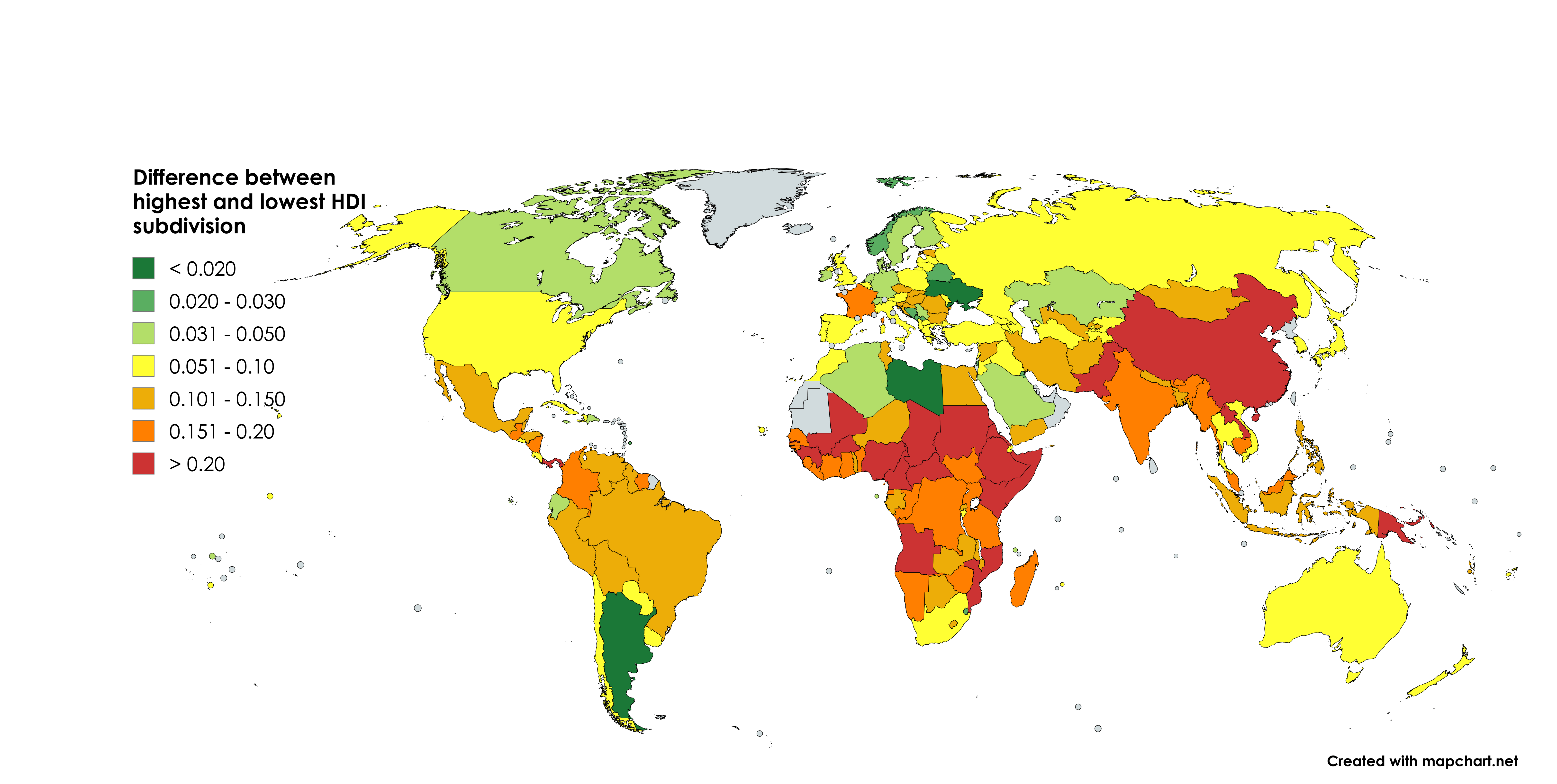
This is a visualisation of the world's subdivisions, comparing the highest HDI subdivision in that country, with the lowest. Countries/regions that have not been coloured in do not have data regarding this topic. Almost all subdivisions have the latest (2023) HDI subdivision data, but for others (e.g. Syria, Kosovo), I had to settle for 2022.
Note: Some countries do things like group together multiple subdivisions when calculating HDI (e.g. Japan, Algeria). There are also countries that use different subdivisions altogether from the standard 1st-level subdivisions (e.g. UK, Argentina). Furthermore, this map is not an endorsement of the HDI methodology being foolproof or 100% accurate.
by BlorfagusDornkle
5 Comments
[[Source]](https://en.wikipedia.org/wiki/List_of_subnational_entities_by_Human_Development_Index)
I wonder if you could turn this into like a 3 by 3 index that rates countries by both how equal they are across subdivisions and also how high their HDI actually is
Like there is a big difference between the relatively low inter division HDI of Switzerland vs Kazakhstan as an example
Still useful data anyway outside of a few outliers like France with French Guyana
I was surprised at France but it’s true they have Mayotte and Guyana
Thanks for sharing
“Subdivision inequality” is a somewhat confusing title. Why not call it “Regional inequality” or “Inequality between regions”?
I am actually surprised that Germany isnt yellow. I would have expected the gap between eastern German counties and highly developed western German cities to be larger.