
Greetings, all. Hoping that this is within the rules/guidelines of the community.
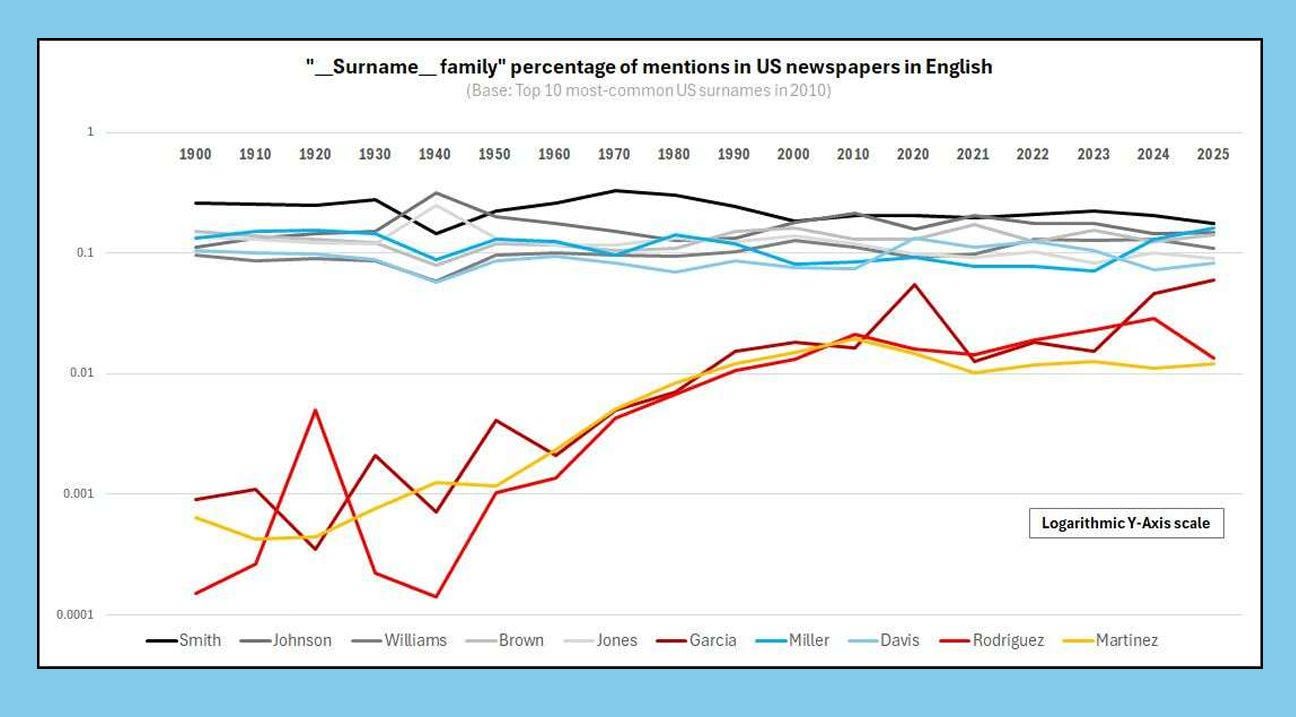
As a proof-of-concept exercise, our firm ran an analysis across decades of Census data, along with corresponding peeks at surnames appearing in newspapers over the past 125 years. What we found:
Three Hispanic surnames have surged in frequency in the United States, but their corresponding frequency in mentions in newspapers is generally weak — substantially so.
You can check out the 5-page slide deck here: 2026_03_21_Surname-PDF.pdf
— — —
The Methodology:
Source for the surnames was a US Census website page, "Frequently Occurring Surnames from the 2010 Census".
To keep the newspaper data clean, we had to get creative. Searching for a name like "Brown" on the Ancestry/Newspapers website might pull up "brown sugar" or "brown the meat". We also noticed that searching for "Mr. [Surname]" (which also retrieves "Mrs. [Surname]") showed a big decline across the board after the year 2000 — likely because modern journalism has moved away from using titles of address to identify people.
We shifted the search phrase to "[Surname] family". This helped ensure the capture of mentions of people.
What the Charts Show:
Share of Voice — we calculated the "percentage of the sample" for each surname per decade to see how their relative share of news mentions has shifted over time. On the logarithmic scale, you more easily can see the exponential growth in mentions of surnames like Garcia, Rodriguez, and Martinez starting in the later-20th century. Interestingly, there is a clear gap between actual Census population percentages in 2010 and newspaper coverage in 2010 for certain surnames — downward for each of the Latino ones.
by ResearchBiz_Biz
4 Comments
Sources:
[https://www.census.gov/topics/population/genealogy/data/2010_surnames.html](https://www.census.gov/topics/population/genealogy/data/2010_surnames.html)
[https://www.newspapers.com/search/](https://www.newspapers.com/search/)
Tool:
Microsoft Excel
missed opportunity to make brown brown
I feel like this was produced with an agenda but whatever, it’s likely accurate enough and the log scale doesn’t negatively mislead. The nuance missed here though is that the first assumptions many people will make is that 1. Illegal hispanics must be flooding into the country and that’s why the numbers are going up. Or 2. Hispanics are more often criminal and that is why their names in newspapers have increased so much so fast.
The problem with 1. Is that as the data shows those names started increasing in the 1930s so this isn’t the new circumstance many folks like to pretend. Why the 1930s? For a couple reasons, first because similar to now there was a lot of economic hardship in the 1920s and 1930s that racists blamed on hispanics and forced millions out of the US. Many of these people were originally native to lands in Texas, Arizona, New Mexico, and California and had lived there when the US annexed the areas, so when the racist policies died down they just moved back to their native lands.
Also thanks to WW2 and other political policies of the US vs Latin america there have been a large number of people not just immigrating but even gaining automatic citizenship, such as Cuba, Puerto Rico, etc where these surnames are very common. Point being that it isn’t just Mexico or illegal immigration.
These immigrant population also tend to be more poor than the average US population, and the poorer a population the higher it’s family sizes, so for a generation or 2 Hispanic immigrants have outsized family sizes compared to established American households which further increases their comparative population.
The problem with 2. would just be a bias and bad assumption, while it may be true that many newspaper mentions would be due to crime, increased population leads to that increase without attributing further traits that isn’t shown in the data.
Just some food for thought as data without context tends to reinforce biases instead of challenge them or provoke useful thought.
Nice research. Which tool did you use to create it?