
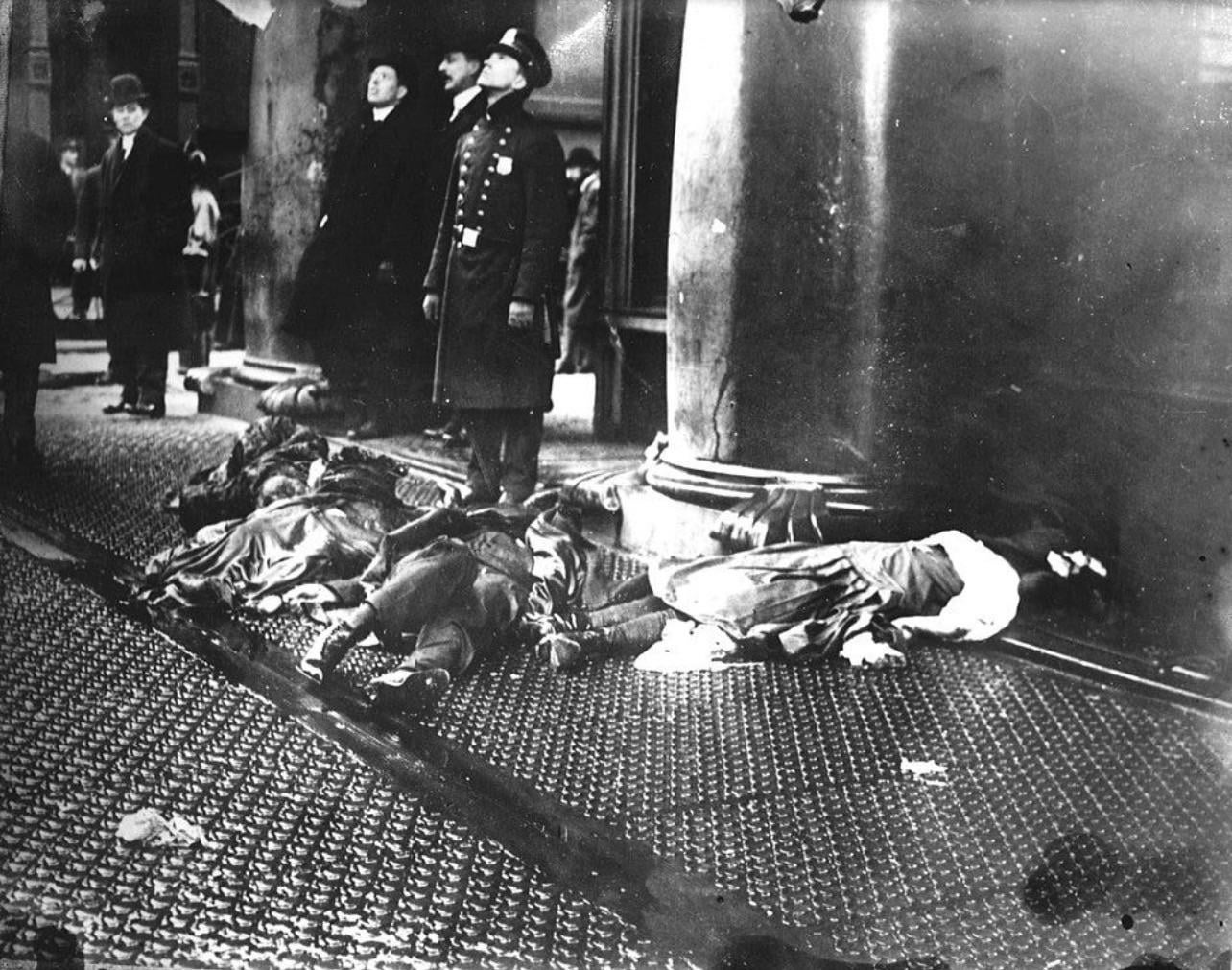
On March 25, 1911, at around 4:40 p.m., a fire broke out in a rag bin on the 8th floor of the Asch Building, home to the Triangle Shirtwaist Factory.
The company, run by Russian-born immigrants Isaac Harris and Max Blanck, had become wildly successful, producing over 1,000 shirtwaists a day and earning the nickname “Shirtwaist Kings.” That success rested on the labor of about 500 workers, mostly young Jewish and Italian immigrant women, who worked long hours in crowded, dust-filled rooms, paid by the piece for just $6–$12 a week.
Conditions were harsh and tightly controlled. To prevent theft, doors were often locked, and workers were constantly monitored. Many had already gone on strike during the 1909 Uprising of the 20,000, winning some concessions, but key safety measures, like sprinklers, were ignored.
When the fire started, a manager tried to use a hose, but its valve had rusted shut.
Within minutes, flames tore through the factory. Workers on the 8th floor escaped via stairs and elevators, as operators Joseph Zito and Gaspar Mortillaro made repeated trips to save as many as they could. The 10th floor was warned and fled to the roof.
But the 9th floor had no warning. The doors remained locked.
Firefighters arrived quickly, but their ladders only reached the 7th floor, and their hoses lacked the pressure to fight the blaze. The elevators eventually failed. Trapped workers were left with a choice: burn or jump. Many jumped.
Journalist William Gunn Shepherd later wrote:
“I learned a new sound that day… the thud of a speeding living body on a stone sidewalk.”
In total, 146 people died, 123 women and 23 men.
The disaster led to major reforms. An investigatory committee headed by Frances Perkins helped pass dozens of new labor laws in New York, improving workplace safety standards.
But the story isn’t that clean. Many similar laws had existed before and many new laws too were ignored. Harris and Blanck were acquitted, and ultimately profited from insurance payouts.
If you’re interested, I go deeper into the Triangle Shirtwaist Factory Fire here: https://open.substack.com/pub/aid2000/p/hare-brained-history-vol-79-the-triangle?r=4mmzre&utm\_medium=ios
by aid2000iscool
7 Comments
Jesus Christ that’s horrible
I’ve read before that the doors were locked to keep union organizers out as well as to keep workers in and prevent them from “stealing time” through taking breaks or just quitting midday in view of the other workers.
Quitting mid-shift was a tactic of organizers as it was very visual and it was easy for them to say at least ONE reasons why a union was needed.
[https://nationalpartnership.org/113-years-later-we-remember-the-triangle-shirtwaist-factory-fire/](https://nationalpartnership.org/113-years-later-we-remember-the-triangle-shirtwaist-factory-fire/)
The weirdest part about all this pics is how casual people are when there are corpses next to them
They seemed to be way more confronted to death than we are, as a society
Whenever I’m reminded of this story, I think of all the people who left for work that day not knowing they’d be jumping off a building within a few hours. It’s just incomprehensibly tragic.
Pictures like these enrage me. People murdered out of nothing more than pure greed.
Knowing the owners just walked away richer from this disaster makes it so much worse.
I work at FedEx, and our facility has controlled access (badge into a turnstile sorta thing) right next to the turnstile is a man door, only openable from the inside.
Management complained that people were letting people in with it and to stop, it’s a security issue etc. All valid points imo.
Well one day, after a fire drill, saying if a fire happens to leave out the man door and/or the turnstile, they padlocked the man door.
So I reported it to OSHA and the fire department and it was sawed off the next day
Interesting it made me consider 9/11. We have videos of people jumping, but I don’t think pictures like this exist and I’m glad