Oh no. Dont let the great replacement idiots get ahold of this.
BrettHullsBurner on
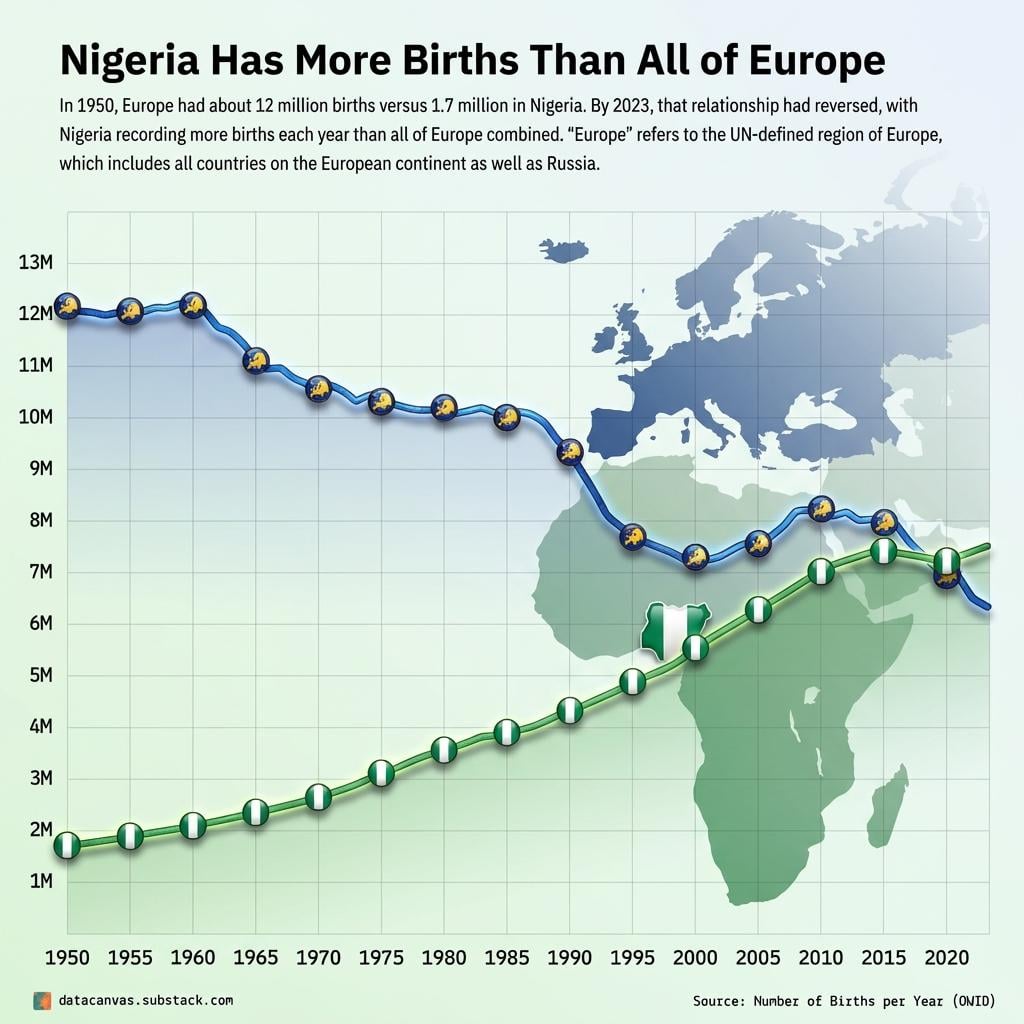
Europe going from 550M people in 1950 to 745M people today (36% increase), yet its births dropping from 12M to 6M (50% decrease) is pretty wild.
wndtrbn on
The child mortality rate is also 50 times higher. That’s not an exaggeration, you’re 50 times more likely to die before you’re 5 years old in Nigeria compared to Europe.
will_dormer on
life in nigeria must be wonderful since they want to have children and can afford it unlike us in europe
Smithy2232 on
This is not a feel good story.
CosminMotroc on
In the period from 2000 to 2010 the european birth rate grew by a milion, accually quite impressive. Too bad the 2009 crash ruined europe, first economically then socially.
Esilai on
This is the kind of data that is relevant when discussions of declining birthrates in developed nations come up. When humans feel safe, secure, and have access to contraception, they just don’t have kids at replacement rates. You can provide free child care, universal basic income, child tax incentives, it doesn’t matter. Humans have a ton of kids when they are overworked, impoverished, and don’t have good access to medical care. Nigeria will get there too one day. Either we become ok with slow, voluntary extinction or we find another solution. Not crazy to imagine a future where people are artificially conceived, in artificial wombs, and mass raised by the government as society needs them.
hbarSquared on
Every wealthy nation has seen declining birth rates, regardless of culture or economic pressure – the Nordics have phenomenal financial and social support for parents, and still have one of the lowest birth rates in Europe. As countries like Nigeria become more prosperous, the same thing will happen.
They have the benefit of watching the most established countries struggle with how to pay for their birth peak populations (e.g. boomers), and they have the opportunity to put in place more resilient systems for the inevitable decline. On the other hand, the last countries to “wealth up” won’t have immigration as a backstop to smooth out the growth curve.

10 Comments
Data source: [Births per Year (OWID)](https://ourworldindata.org/grapher/number-of-births-per-year?time=earliest..2023&country=NGA~UNM49_EUR)
Tools used: Matplotlib & Nano Banana
It happened in **2019**, but yes.
Oh no. Dont let the great replacement idiots get ahold of this.
Europe going from 550M people in 1950 to 745M people today (36% increase), yet its births dropping from 12M to 6M (50% decrease) is pretty wild.
The child mortality rate is also 50 times higher. That’s not an exaggeration, you’re 50 times more likely to die before you’re 5 years old in Nigeria compared to Europe.
life in nigeria must be wonderful since they want to have children and can afford it unlike us in europe
This is not a feel good story.
In the period from 2000 to 2010 the european birth rate grew by a milion, accually quite impressive. Too bad the 2009 crash ruined europe, first economically then socially.
This is the kind of data that is relevant when discussions of declining birthrates in developed nations come up. When humans feel safe, secure, and have access to contraception, they just don’t have kids at replacement rates. You can provide free child care, universal basic income, child tax incentives, it doesn’t matter. Humans have a ton of kids when they are overworked, impoverished, and don’t have good access to medical care. Nigeria will get there too one day. Either we become ok with slow, voluntary extinction or we find another solution. Not crazy to imagine a future where people are artificially conceived, in artificial wombs, and mass raised by the government as society needs them.
Every wealthy nation has seen declining birth rates, regardless of culture or economic pressure – the Nordics have phenomenal financial and social support for parents, and still have one of the lowest birth rates in Europe. As countries like Nigeria become more prosperous, the same thing will happen.
They have the benefit of watching the most established countries struggle with how to pay for their birth peak populations (e.g. boomers), and they have the opportunity to put in place more resilient systems for the inevitable decline. On the other hand, the last countries to “wealth up” won’t have immigration as a backstop to smooth out the growth curve.