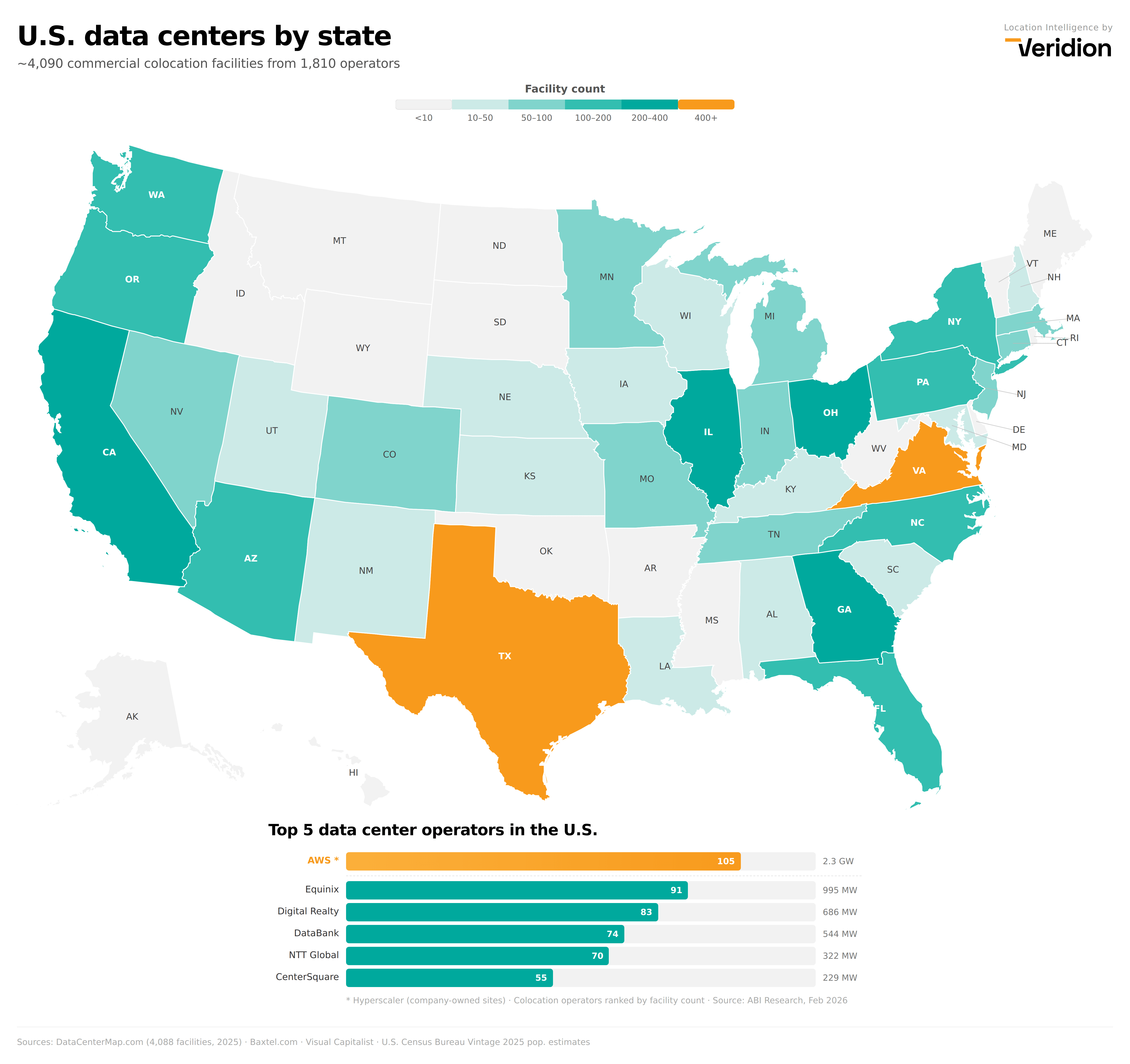
Facility counts from DataCenterMap.com (~4,090 commercial colocation facilities, 1,810 operators, 2025), cross-referenced with Baxtel.com (4,498; they include planned/under-construction facilities, hence the ~10% gap). Top 20 states pulled directly from DataCenterMap state pages; remaining 30 estimated by proportional scaling, anchored by Newsweek-confirmed counts for five small states.
Population: U.S. Census Bureau Vintage 2025 estimates. Company facility counts and MW capacity from ABI Research Top 25 (Feb 2026 edition). AWS 2.3 GW is active IT capacity across 105+ company-owned sites, not colocation.
Operator-to-facility matching and company identification are done using Veridion location intelligence data.
Map built in React with Albers USA projected paths from us-atlas TopoJSON.
The_Infinite_Cool on
That’s a lot of faith in the Texas power grid.
thefuninlearning on
Interesting to see the disparity between states. I know part of the difference is due to population so maybe a per capita number would be more reliable? I wonder why Texas and North Carolina have so many data centers? What is motivating these companies to build data centers there? Lower tax rates? Lower infrastructure and logistic costs? State-level economic policy?
Apparently for Silicon Valley it’s not a big deal…
Zealousideal-Yam3169 on
Why do they put them in Texas when cooling is an issue? Is it just because they have a lot of available space?
libra00 on
You can tell where the cheap power is. Meanwhile ERCOT over here sending out brownout notices every summer telling people to turn their AC off when it’s north of 100F outside so the data centers can have more power.
SeveralBollocks_67 on
So, the color representation is weird. California could have 399 data centers and Virginia can have 400 going off this map
SirHawrk on
Why does no one in this sub know how to use a continuous colour scheme?
AxDeath on
Why are so many of them located in leftwing coastal areas? In places where water and energy shortages are already an issue?
It would seem like, if you needed a very large piece of empty land, and almost nobody to operate it, you’d be putting them in the heartland territories. We’d have a ton of them in like, North Dakota. But somehow they are all located in heavily populated coastal states with very expensive land prices, and resource issues?
It’s almost as if they are taking a bunch of investor money and startup loans, buyin very expensive land in high value areas, knowing full well, that this AI bubble is going to burst and 90% of these places will shut down and be erased, and they can do a little business shuffle that land into the hands of another company conveniently owned by them as well.

9 Comments
Source & Methodology
Facility counts from DataCenterMap.com (~4,090 commercial colocation facilities, 1,810 operators, 2025), cross-referenced with Baxtel.com (4,498; they include planned/under-construction facilities, hence the ~10% gap). Top 20 states pulled directly from DataCenterMap state pages; remaining 30 estimated by proportional scaling, anchored by Newsweek-confirmed counts for five small states.
Population: U.S. Census Bureau Vintage 2025 estimates. Company facility counts and MW capacity from ABI Research Top 25 (Feb 2026 edition). AWS 2.3 GW is active IT capacity across 105+ company-owned sites, not colocation.
Operator-to-facility matching and company identification are done using Veridion location intelligence data.
Map built in React with Albers USA projected paths from us-atlas TopoJSON.
That’s a lot of faith in the Texas power grid.
Interesting to see the disparity between states. I know part of the difference is due to population so maybe a per capita number would be more reliable? I wonder why Texas and North Carolina have so many data centers? What is motivating these companies to build data centers there? Lower tax rates? Lower infrastructure and logistic costs? State-level economic policy?
Can be compared with electricity prices: [https://www.reddit.com/r/dataisbeautiful/comments/1s215ej/oc_electricity_rates_by_county/](https://www.reddit.com/r/dataisbeautiful/comments/1s215ej/oc_electricity_rates_by_county/)
Apparently for Silicon Valley it’s not a big deal…
Why do they put them in Texas when cooling is an issue? Is it just because they have a lot of available space?
You can tell where the cheap power is. Meanwhile ERCOT over here sending out brownout notices every summer telling people to turn their AC off when it’s north of 100F outside so the data centers can have more power.
So, the color representation is weird. California could have 399 data centers and Virginia can have 400 going off this map
Why does no one in this sub know how to use a continuous colour scheme?
Why are so many of them located in leftwing coastal areas? In places where water and energy shortages are already an issue?
It would seem like, if you needed a very large piece of empty land, and almost nobody to operate it, you’d be putting them in the heartland territories. We’d have a ton of them in like, North Dakota. But somehow they are all located in heavily populated coastal states with very expensive land prices, and resource issues?
It’s almost as if they are taking a bunch of investor money and startup loans, buyin very expensive land in high value areas, knowing full well, that this AI bubble is going to burst and 90% of these places will shut down and be erased, and they can do a little business shuffle that land into the hands of another company conveniently owned by them as well.