
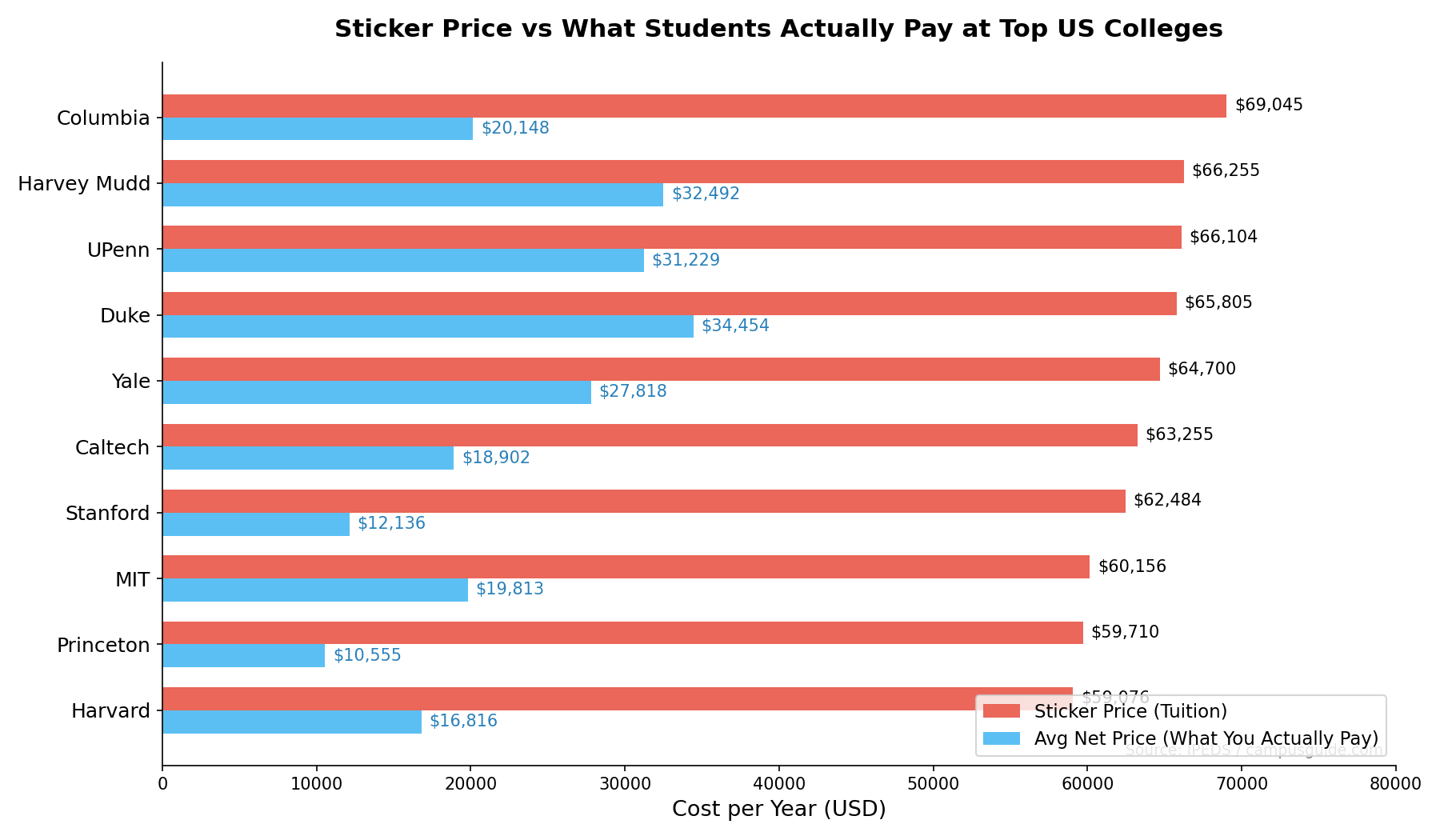
Source: IPEDS (U.S. Department of Education) Tool: campusguide.com
Some of the biggest gaps between published tuition and what students actually pay:
Stanford: $62,484 tuition → $12,136 net price. Harvard: $59,076 → $16,816. Caltech: $63,255 → $18,902. MIT: $60,156 → $19,813.
Meanwhile the cheapest net prices at 4-year schools are under $2K: Henry Ford College (MI): $576/yr. Chipola College
(FL): $832/yr. Texas A&M-Central Texas: $1,113/yr.
Highest earning graduates (median 10yr after enrollment): MIT: $143,372. Harvey Mudd: $138,687. Olin College:
$129,455. Caltech: $128,566. Stanford: $124,080.
Data covers all 4,153 accredited US colleges from the latest IPEDS release.
by dob312
9 Comments
How does the “what students actually” pay so low? Does it include just financial aid…or something else?
Is this a best case scenario? Like you got approved for EVERY scholarship possible kind of thing.
People always talk about how expensive Ivy League (and similar) schools are, usually to imply it’s not worth it, but they mostly fail to appreciate just how much financial aid is involved, as this shows. In fact, price becomes basically a kind of progressive “tax” so that families with more money pay more and poor families pay little/nothing (though, getting accepted is the harder part there).
Still seems fairly expensive to me. And in fact it seems like it will be expensive for everyone, because of course they make you pay something on the edge of what you can afford. Also is this tuition or tuition, room, and other expenses?
The fact that some kids go free means little, those kids were unlikely to make it in the first place so there aren’t that many of them. Just enough for the college to say there are free places there.
It’s a common misconception that elite schools are only for the wealthy. If you manage to get in, financial aid (usually need-based) often cover the majority of the tuition that is deemed high. I’ve met a lot of undergad students from low-income families where not only was their tuition fully covered, but they also receive a small stipend. Now if your family has several estates and a yacht, you bet you’re going to be paying the full 300-400K.
The ultimate unanswered question is what was the income of the given family? It’s on a sliding scale up or down based on family income and this may cause too high of expectations for some. How do I know ? I’ve worked in this field for over 20 years.
Elite schools are for families making less than $150k/year or over $400k/year. If your family is in between that, you don’t get much if any aid, but you really can’t afford $70k per year of new expenses.
This is why sticker price is kind of a useless metric on its own. The spread is so wide it almost feels like two different pricing systems.
I’ve looked at similar datasets before and the variance usually kills any simple comparison, averages hide a lot of weird edge cases here. Would be interesting to see distribution by income bands too.
ridiculous that Harvard isn’t the lowest when you look at the size of their endowment.