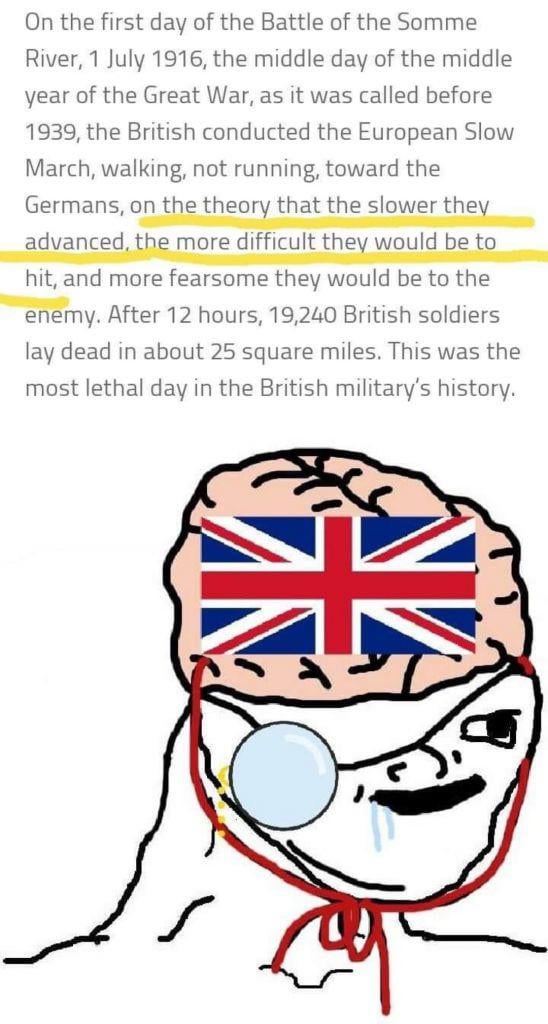
On what level does this make sense? How did anyone come to this conclusion?
The_last_trick on
They forgot that Germans can shoot.
Tall_Location_9036 on
The strategy was obvious. When the Chads walk down an aisle in high school, the Chuds become flusterd and stare at their shoes.
MagusBuckus on
Love a bit of ww1 misinformation in the morning
Legi0ndary on
Michael Myers inspiration?
rural_alcoholic on
Nope. They didnt Run for most of the way because that would absolutely exhaust the men. Most of the Units that achived theire first objektives did in fact walk.
ArchCerberus on
Lets hope that guy how got that idea got fired …
MogosTheFirst on
So Emus > British army?
acur1231 on
Source?
The reason they were walking is because they were carrying their full kit with them, in the expectation of having to dig in and hold newly captured territory.
The hardest part of a WWI offensive wasn’t getting through the wire, it was actually holding and exploiting beyond the forward line of trenches, while running a supply line over the devastated No Man’s Line behind.
At Loos and Neuve Chappell the previous year, the British managed to seize German trenches, only for the lightly-equipped assault troops to get bogged down fighting heavier German reserves. The hope at the Somme was that the troops would essentially deploy on the German forward line, ready to begin fighting eastwards.
Obviously, that didn’t happen, but it was another fair attempt at solving the central tactical/operational problem at the heart of the Western Front stalemate.
idreamofdouche on
Yeah, this isn’t true. The walked slow to keep formation,to not run into their own artillery fire and because many carried heavy equipment. The commanders also thought that the German defenses would be a lot weaker due to the artillery fire.
bobby_smiles179201 on
If this is about the battle of the Somme, i’ve read that they were told that the German were blown to pieces after the massive artillery preparation that took place beforehand (+ explosion of massive mines right under German lines) to only discover that the Germans knew about the upcoming attack.
So, was that order plain stupid ? Yes
Edit : Getting downvotes instead of an actual explanation. Nice job at being a toxic community.
BasedAustralhungary on
The Aslume have come, millions must jonkle and Officer Balls will be worshipped
PuzzleMeDo on
A more nuanced look at how the British troops advanced, and why:
Because the were ordered to by the toffs siting behind the front lines who saw them as nothing more than cannon fodder
Dominarion on
It’s not the battle of the Somme river, it’s the battle of the Somme. It wasn’t fought over the river, but all over the French departement of the Somme, in the Somme river valley.
That’s not why they told them to walk, it was because that during other attacks made at a run, the units lost cohesion, the soldiers got spread all over the place and were picked up by german moping units. Also, the Brits troops deployed in the Somme were mostly rookies, so there was a lot of anxiety over how they would perform and they thought the dispersion would be even worse. There was also a lot of Canadians and Newfies deployed for the battle, and there was an assumption that colonial troops would not be as good as good old British troops. They didn’t know about the Canadians yet.
In preparation of the assault, the Brits just had unleashed the largest artillery barrage in the world history at that time, so they expected the Germans to had been pretty much wiped out and the barbed wire cleared out when they started the attack. However, what they didn’t know is that to save some bucks, some assholes in the Ministry of Munitions had decided to replace the order of high explosive shells with a mix of high explosives and armor piercing shells, since they had way too much of these, and there was a shortage of high explosives. *But they didn’t tell the battle planners about it.*
Armor piercing shells were basically huge slugs of steel back then, they didn’t explode or anything. So the armor piercing shells just thudded in the mud all over the battle field. Since it was a foggy morning, and there was a mix of both types of ammo, nobody figured out that the barrage was way less effective than thought. So the rookies were sent over the top, walking towards the German lines, being told the Germans would have been cleared out already. Everything went Fubar all at once. the weather became clear and sunny, and the Germans just waited that the Brits had walked half the distance before they opened fire. By then it was too late, they couldn’t just walk back, as the only cover available was the too rare craters and the German trenches in front of them.
They initially thought that the barrage had failed because the artillery spotters were confused by the fog, they only figured out the switcharoo after the battle. The government put a lid on the story because the people would have rioted. Historians discovered about it way later, but by then, the trope had stuck.
Don’t get me wrong though, the British made a lot of stupid mistakes (like assuming the Canadians would suck) during WW1, but that wasn’t one of them. It was more of a terrible tragedy than an idiocy.
MuffinMountain3425 on
Early on in WW1 every one was kind of stupid.
The British wanted their officers to aura-farm too much, The French wanted their soldiers to be conspicuously dripped out, and the Italians failed to grow a pair and kill Luigi.
A--Creative-Username on
So far I’ve counted 18 different reasons people have listed, some of which even make sense. Please either do some reading or don’t guess.
GenosseAbfuck on
Absolutely wrong. I think the worst part in this is that it assumes no preceding artillery barrage. The moving barrage* was an area denial tactic, your enemy couldn’t attack you when no man’s land was being shelled. It’s also quite a good smokescreen, their sentries can’t exactly get a good estimation of your troop strength if their line of sight keeps getting randomly obscured. Those same sentries will also immediately need cover and they, along with everyone else, will keep in cover until you’re right on top of them. For the best coordination you need to keep the forward movement if the barrage rather slow, which also allows it to linger a bit on the actual trench to keep the enemy down just a bit longer.
Once you reach the enemy trench you’re still well rested, because you walked, but your enemy will leave cover dazed, a bit deaf, scared and sometimes weighed down by their suddenly very muddy underwear. Easy pickings.
Nothing to do with honor, but actually really smart and effective tactics. Useless only if both sides are doing it at the same time.
*phrasing intentional because IIRC the creeping and rolling barrages were different types of moving barrage developed following the Somme. Correct me on that if I’m wrong
LFGR_THE_Thing on
Creeping barrages, to exhausted to fight in their trenches,more likely to fall and everyone hits at once and not a bit here and a few there.
Fallenkezef on
It was the first and last time they tried the marching tactic.
WW1 was, despite the myths, a war of fire and manouver in trench assaults and well planned trench raids.
The British Guards division where very good at trech raids with grenade or “bomb” teams clearing German trenches and using Lewis gun teams to hold positions. They would carry sandbags in with them to block off side trenches to stop the Germans flanking and counter-attacking the raiding unit.

20 Comments
On what level does this make sense? How did anyone come to this conclusion?
They forgot that Germans can shoot.
The strategy was obvious. When the Chads walk down an aisle in high school, the Chuds become flusterd and stare at their shoes.
Love a bit of ww1 misinformation in the morning
Michael Myers inspiration?
Nope. They didnt Run for most of the way because that would absolutely exhaust the men. Most of the Units that achived theire first objektives did in fact walk.
Lets hope that guy how got that idea got fired …
So Emus > British army?
Source?
The reason they were walking is because they were carrying their full kit with them, in the expectation of having to dig in and hold newly captured territory.
The hardest part of a WWI offensive wasn’t getting through the wire, it was actually holding and exploiting beyond the forward line of trenches, while running a supply line over the devastated No Man’s Line behind.
At Loos and Neuve Chappell the previous year, the British managed to seize German trenches, only for the lightly-equipped assault troops to get bogged down fighting heavier German reserves. The hope at the Somme was that the troops would essentially deploy on the German forward line, ready to begin fighting eastwards.
Obviously, that didn’t happen, but it was another fair attempt at solving the central tactical/operational problem at the heart of the Western Front stalemate.
Yeah, this isn’t true. The walked slow to keep formation,to not run into their own artillery fire and because many carried heavy equipment. The commanders also thought that the German defenses would be a lot weaker due to the artillery fire.
If this is about the battle of the Somme, i’ve read that they were told that the German were blown to pieces after the massive artillery preparation that took place beforehand (+ explosion of massive mines right under German lines) to only discover that the Germans knew about the upcoming attack.
So, was that order plain stupid ? Yes
Edit : Getting downvotes instead of an actual explanation. Nice job at being a toxic community.
The Aslume have come, millions must jonkle and Officer Balls will be worshipped
A more nuanced look at how the British troops advanced, and why:
[https://www.reddit.com/r/AskHistorians/comments/1qzsxh/why_were_english_soldiers_at_the_battle_of_the/](https://www.reddit.com/r/AskHistorians/comments/1qzsxh/why_were_english_soldiers_at_the_battle_of_the/)
Spoiler: It’s actually kind of complicated.
Because the were ordered to by the toffs siting behind the front lines who saw them as nothing more than cannon fodder
It’s not the battle of the Somme river, it’s the battle of the Somme. It wasn’t fought over the river, but all over the French departement of the Somme, in the Somme river valley.
That’s not why they told them to walk, it was because that during other attacks made at a run, the units lost cohesion, the soldiers got spread all over the place and were picked up by german moping units. Also, the Brits troops deployed in the Somme were mostly rookies, so there was a lot of anxiety over how they would perform and they thought the dispersion would be even worse. There was also a lot of Canadians and Newfies deployed for the battle, and there was an assumption that colonial troops would not be as good as good old British troops. They didn’t know about the Canadians yet.
In preparation of the assault, the Brits just had unleashed the largest artillery barrage in the world history at that time, so they expected the Germans to had been pretty much wiped out and the barbed wire cleared out when they started the attack. However, what they didn’t know is that to save some bucks, some assholes in the Ministry of Munitions had decided to replace the order of high explosive shells with a mix of high explosives and armor piercing shells, since they had way too much of these, and there was a shortage of high explosives. *But they didn’t tell the battle planners about it.*
Armor piercing shells were basically huge slugs of steel back then, they didn’t explode or anything. So the armor piercing shells just thudded in the mud all over the battle field. Since it was a foggy morning, and there was a mix of both types of ammo, nobody figured out that the barrage was way less effective than thought. So the rookies were sent over the top, walking towards the German lines, being told the Germans would have been cleared out already. Everything went Fubar all at once. the weather became clear and sunny, and the Germans just waited that the Brits had walked half the distance before they opened fire. By then it was too late, they couldn’t just walk back, as the only cover available was the too rare craters and the German trenches in front of them.
They initially thought that the barrage had failed because the artillery spotters were confused by the fog, they only figured out the switcharoo after the battle. The government put a lid on the story because the people would have rioted. Historians discovered about it way later, but by then, the trope had stuck.
Don’t get me wrong though, the British made a lot of stupid mistakes (like assuming the Canadians would suck) during WW1, but that wasn’t one of them. It was more of a terrible tragedy than an idiocy.
Early on in WW1 every one was kind of stupid.
The British wanted their officers to aura-farm too much, The French wanted their soldiers to be conspicuously dripped out, and the Italians failed to grow a pair and kill Luigi.
So far I’ve counted 18 different reasons people have listed, some of which even make sense. Please either do some reading or don’t guess.
Absolutely wrong. I think the worst part in this is that it assumes no preceding artillery barrage. The moving barrage* was an area denial tactic, your enemy couldn’t attack you when no man’s land was being shelled. It’s also quite a good smokescreen, their sentries can’t exactly get a good estimation of your troop strength if their line of sight keeps getting randomly obscured. Those same sentries will also immediately need cover and they, along with everyone else, will keep in cover until you’re right on top of them. For the best coordination you need to keep the forward movement if the barrage rather slow, which also allows it to linger a bit on the actual trench to keep the enemy down just a bit longer.
Once you reach the enemy trench you’re still well rested, because you walked, but your enemy will leave cover dazed, a bit deaf, scared and sometimes weighed down by their suddenly very muddy underwear. Easy pickings.
Nothing to do with honor, but actually really smart and effective tactics. Useless only if both sides are doing it at the same time.
*phrasing intentional because IIRC the creeping and rolling barrages were different types of moving barrage developed following the Somme. Correct me on that if I’m wrong
Creeping barrages, to exhausted to fight in their trenches,more likely to fall and everyone hits at once and not a bit here and a few there.
It was the first and last time they tried the marching tactic.
WW1 was, despite the myths, a war of fire and manouver in trench assaults and well planned trench raids.
The British Guards division where very good at trech raids with grenade or “bomb” teams clearing German trenches and using Lewis gun teams to hold positions. They would carry sandbags in with them to block off side trenches to stop the Germans flanking and counter-attacking the raiding unit.