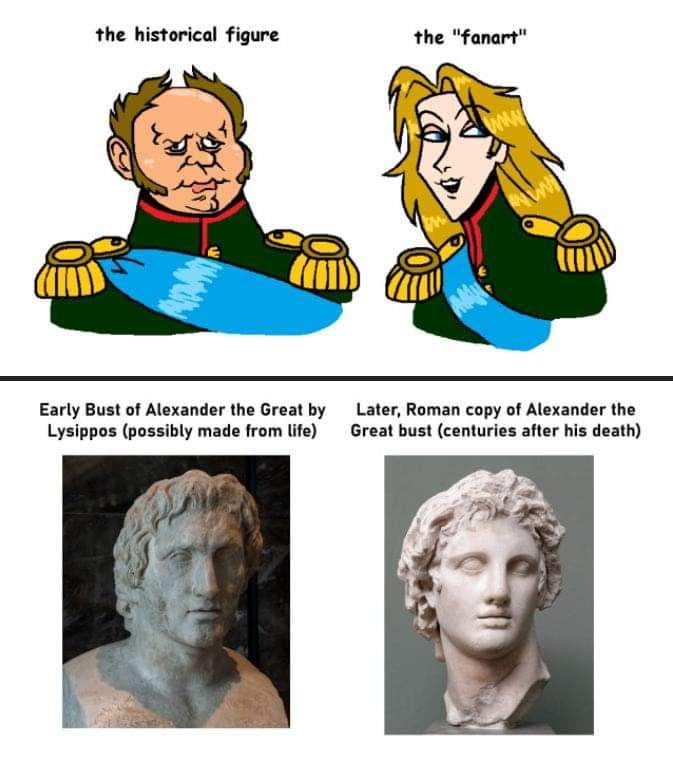
But both bust below looks like the same person though?
smallfrie32 on
Pretty privilege
Valkyrr03 on
Early bust actually looks better, second looks like the medieval version of AI slop.
HeyVeddy on
Pretty much the same person
Geolib1453 on
The first bust still looks really good wdym. The first one looks like an actual man who did the impossible, the second one looks like a boy who did the impossible.
Independent_Round861 on
DLSS 5 OFF/ON
Sekkitheblade on
Who’s to say that Alex couldn’t have looked like the bottom left image in his youth?
Doodles_n_Scribbles on
Imagine looking ruggedly handsome and being on your death bed like “remember me as a soft twink!”
FinalAd9844 on
Charisma to make yourself appear almost like a god-emperor throughout the ages, it definently worked for Alexander the Great
GLight3 on
The first actually looks like a conqueror.
Adeptus_Lycanicus on
Compared to the man on the left, you could easily convince me the one on the right is the Fate gender bent version of Iskandar.
CJohn89 on
Same reason Instagram has filters
Polandgod75 on
I feel the left one is still pretty, but in a macho way then a pretty boy way.
Also i imagine the left is a older Alexander after years campaigning, while the right is an younger one that is starting out
Kazinam on
W-N-A-O-M-P
What does it mean?
MasterpieceBrief4442 on
Those statues, busts, and paintings were probably the only way most of their subjects would ever know what they look like. It’s a bit difficult to claim divine right when you’re average-looking or ugly. It’s fine if you’re big as a bear or something like some kings were. Many were runty little shits though. They needed all the glow up they could get.
Bealzebubbles on
Generally speaking portraits commissioned by the subject or subject’s family will look more authentic. Commissioning a portrait was expensive and served as a status symbol. If it didn’t bear a strong resemblance to the subject then it would not be able to serve this purpose. However, like with modern portraiture, people naturally wanted it to look like the best version of themselves, so some zhuzhing was definitely expected. However, we can be sure that they were reasonably accurate.
BindermanTranslation on
To be fair these sculptures weren’t made by Alexander himself, and most monarchs didn’t do self portraits. Others made art of them and, in order to gain patronage and accolades or curry favor with popular trends, made them look good.
SnooBooks1701 on
The right one looks like a younger version of the left
FoldingLady on
People like attractive people.
There’s an argument that in ancient times, attractiveness was seen as a sign of good health (minimal smallpox scars, sign of not having leprosy, no rotting teeth, etc.) which was key to continuing the line of succession. Also, in the days before photographs, portraits were used in marriage proposals & let’s be honest, most people don’t want to marry a complete stranger who is also ugly.
Kaffe-Mumriken on
Anyone got the Polish (??) royal with the five head who actually was photographed for truth?
Few-Inevitable9233 on
isn’t it just one is better perserved
TalksMuchSaysNothing on
Holy shit, Fate got him right
6gv5 on
Mild reminder that back then the average human life duration wasn’t even half of what we have today.
EkyngYT on
They done Twinkified bro. He went from “Alexander The Great” to “Alex the Good Boy”
Glaedth on
The romans femboyified Alexander
Lvcivs2311 on
Just like the Charimonti Caesaar, that one famous bust of Julius Caesar you often see in the media: made long after his death and therefore practically a caricature. There’s a chance the Arles bust and the Tusculum were made during Caesar’s lifetime and they look both very different from the Charimonti one.
oh_YES_helios on
Alexander specifically seemed to be very difficult to identify in late portraits since he didn’t really have iconography that was exclusively applied to him and not to other historical characters or deities. As in, some of these busts were found in Mithraic shrines so they were most likely meant to represent the god Sol than Alexander (but of course, if the bust was found next to other depictions of rulers, it’d be easy to conclude it’s Alexander). Some other figures also were depicted with similar traits, like Achilles and the Dioskuri.
A relevant quote regarding the weird treatment that Alexander imagery got (Sorry, the book I have cites it as Smith 1988, but no idea what’s the actual name of the source itself):
>The Alexander-like appearance of a head, especially one of evident Roman date, is not a sufficient criterion for detecting an Alexander – not even a Roman Alexander, still less a copy of a fourth-century or Hellenistic Alexander. More of its context and function must be known, but they rarely are. In other words, unless a head has unmistakable portrait features, one can never be sure whether a given Alexander-like head is actually an Alexander or merely a mythological or ideal figure borrowing from the Alexander iconography.
upsidedowntoker on
Tbh he has a much stronger jaw line in the original .
jkpatches on
>Why do these monarchs/Nobles Actually have tO make themselves look More attractive in Potraits?
It’s not like Alexander the Great himself commissioned the Roman bust, centuries after his death. For all we know, Alexander might’ve been happy with the original bust.
Brabant-ball on
Then there is the Verism style, making yourself look old and weathered to look more dignified which really is the other end of the spectrum

31 Comments
I mean, wouldn’t you?
But both bust below looks like the same person though?
Pretty privilege
Early bust actually looks better, second looks like the medieval version of AI slop.
Pretty much the same person
The first bust still looks really good wdym. The first one looks like an actual man who did the impossible, the second one looks like a boy who did the impossible.
DLSS 5 OFF/ON
Who’s to say that Alex couldn’t have looked like the bottom left image in his youth?
Imagine looking ruggedly handsome and being on your death bed like “remember me as a soft twink!”
Charisma to make yourself appear almost like a god-emperor throughout the ages, it definently worked for Alexander the Great
The first actually looks like a conqueror.
Compared to the man on the left, you could easily convince me the one on the right is the Fate gender bent version of Iskandar.
Same reason Instagram has filters
I feel the left one is still pretty, but in a macho way then a pretty boy way.
Also i imagine the left is a older Alexander after years campaigning, while the right is an younger one that is starting out
W-N-A-O-M-P
What does it mean?
Those statues, busts, and paintings were probably the only way most of their subjects would ever know what they look like. It’s a bit difficult to claim divine right when you’re average-looking or ugly. It’s fine if you’re big as a bear or something like some kings were. Many were runty little shits though. They needed all the glow up they could get.
Generally speaking portraits commissioned by the subject or subject’s family will look more authentic. Commissioning a portrait was expensive and served as a status symbol. If it didn’t bear a strong resemblance to the subject then it would not be able to serve this purpose. However, like with modern portraiture, people naturally wanted it to look like the best version of themselves, so some zhuzhing was definitely expected. However, we can be sure that they were reasonably accurate.
To be fair these sculptures weren’t made by Alexander himself, and most monarchs didn’t do self portraits. Others made art of them and, in order to gain patronage and accolades or curry favor with popular trends, made them look good.
The right one looks like a younger version of the left
People like attractive people.
There’s an argument that in ancient times, attractiveness was seen as a sign of good health (minimal smallpox scars, sign of not having leprosy, no rotting teeth, etc.) which was key to continuing the line of succession. Also, in the days before photographs, portraits were used in marriage proposals & let’s be honest, most people don’t want to marry a complete stranger who is also ugly.
Anyone got the Polish (??) royal with the five head who actually was photographed for truth?
isn’t it just one is better perserved
Holy shit, Fate got him right
Mild reminder that back then the average human life duration wasn’t even half of what we have today.
They done Twinkified bro. He went from “Alexander The Great” to “Alex the Good Boy”
The romans femboyified Alexander
Just like the Charimonti Caesaar, that one famous bust of Julius Caesar you often see in the media: made long after his death and therefore practically a caricature. There’s a chance the Arles bust and the Tusculum were made during Caesar’s lifetime and they look both very different from the Charimonti one.
Alexander specifically seemed to be very difficult to identify in late portraits since he didn’t really have iconography that was exclusively applied to him and not to other historical characters or deities. As in, some of these busts were found in Mithraic shrines so they were most likely meant to represent the god Sol than Alexander (but of course, if the bust was found next to other depictions of rulers, it’d be easy to conclude it’s Alexander). Some other figures also were depicted with similar traits, like Achilles and the Dioskuri.
A relevant quote regarding the weird treatment that Alexander imagery got (Sorry, the book I have cites it as Smith 1988, but no idea what’s the actual name of the source itself):
>The Alexander-like appearance of a head, especially one of evident Roman date, is not a sufficient criterion for detecting an Alexander – not even a Roman Alexander, still less a copy of a fourth-century or Hellenistic Alexander. More of its context and function must be known, but they rarely are. In other words, unless a head has unmistakable portrait features, one can never be sure whether a given Alexander-like head is actually an Alexander or merely a mythological or ideal figure borrowing from the Alexander iconography.
Tbh he has a much stronger jaw line in the original .
>Why do these monarchs/Nobles Actually have tO make themselves look More attractive in Potraits?
It’s not like Alexander the Great himself commissioned the Roman bust, centuries after his death. For all we know, Alexander might’ve been happy with the original bust.
Then there is the Verism style, making yourself look old and weathered to look more dignified which really is the other end of the spectrum