
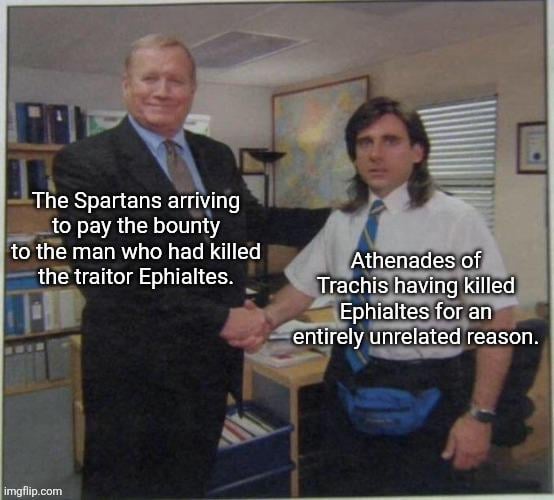
Context: After helping the Persians secure victory at the Battle of Thermopylae in 480BC by betraying his fellow Greeks, Ephialtes believed he would be rewarded for his efforts. This would not be the case. Later that same year the Persians would be utterly defeated at the Battle of Salamis and Xerxes would be forced to flee from Greece, taking most of his forces with him. With the Persians gone, Ephialtes would find himself a wanted man.
Justice would not be swift however, as Ephialtes would only meet his end about ten years later around 470BC. He was killed by a man named Athenades of Tachis for a reason unrelated to his great betrayal of the Greeks at Thermopylae. Despite this, Athenades would still be rewarded with the bounty the Spartans placed on Ephialtes years before.
by BSSCommander
3 Comments
MONEY IS MONEY. YOU DON’ LOOK INTO THE GIFTED HORSE’S MOUTH
Oh hey, someone created it.
> When some time had gone by, he returned from exile, and went to Anticyra, where he was slain by Athenades, a native of Trachis. Athenades did not slay him for his treachery, but for another reason, which I shall mention in a later part of my history: yet still the Lacedaemonians honoured him none the less.
From Herodotus on the Battle of Thermopylae.
I can’t find anything about the specific reason that Herodotus says he mentions later though.
Edit:
[Looks like Herodotus didn’t mention it later.](https://lexundria.com/hdt/7/mcly)
>Then some time afterwards having returned to Antikyra he was slain by Athenades a man of Trachis. Now this Athenades killed Epialtes for another cause, which I shall set forth in the following part of the history,[214]
>[214] An indication that the historian intended to carry his work further than the year 479.