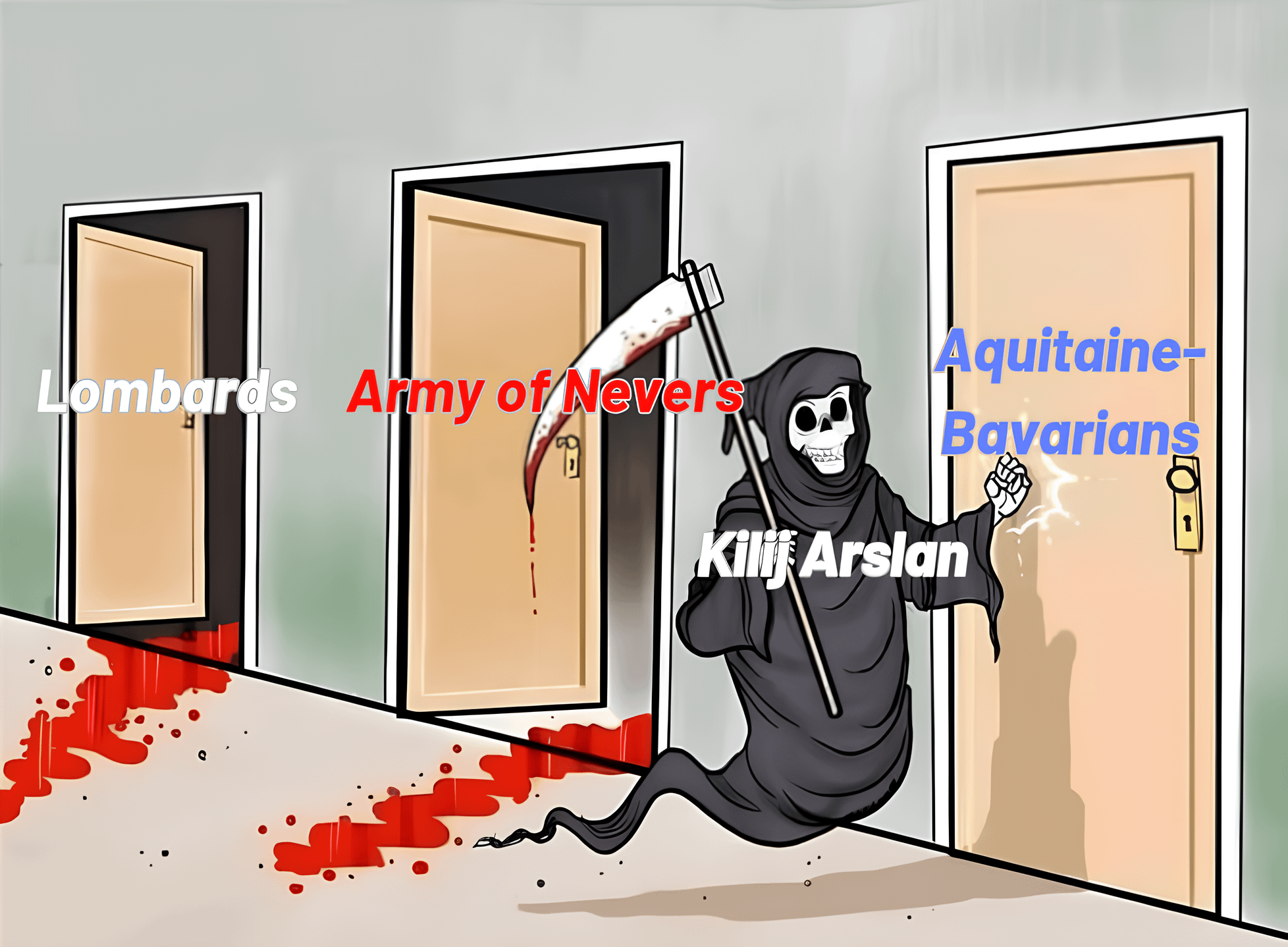
The Crusade of 1101 was launched in the summer of 1101 after the First Crusade. Its main goals were to send reinforcements to the Kingdom of Jerusalem and to try to rescue Bohemond of Taranto, who had been captured by Muslim forces after the First Crusade. This expedition was not one unified army; it consisted of several separate Western European groups including Lombards, French, Germans, and others, who left Europe in different detachments and did not operate as a single force.
Rather than taking the safer coastal route toward the Black Sea and then onward, many of these crusader contingents marched deep into Anatolia, moving into territory controlled by the Seljuks and their Danishmend allies in hopes of reaching Jerusalem and possibly freeing Bohemond.
Sultan Kilij Arslan I, who had learned from earlier Crusader invasions, prepared a strong defense. He formed an alliance with the Danishmends and Ridwan of Aleppo, and drew on his intimate knowledge of Anatolia’s terrain to choose the battlefield. Instead of meeting the Europeans in a large, open pitched battle, he relied on mobile cavalry tactics that constantly harassed the crusaders’ columns, cut off their supplies, and wore them down as they marched through inhospitable land.
The decisive engagement occurred near Mersivan (modern Merzifon) in northern Anatolia in early August 1101. Here, the Seljuk‑Danishmend coalition surrounded and nearly destroyed the main crusader host as they marched near the mountains of Paphlagonia. The crusaders, exhausted and low on supplies, could not form cohesive defensive formations against the swift Turkish horse archers and light cavalry.
Over the course of several days of fighting, the crusader divisions fell apart. The Lombards at the vanguard were defeated, many Pechenegs deserted, and the French and German contingents were forced to retreat or were cut off completely. By the end of the battle, the crusader camp was captured, knights fled the field, and most of the European soldiers were killed, captured, or scattered. Only a few leaders, such as Raymond IV of Toulouse, Stephen of Blois, and Stephen of Burgundy, managed to escape by sea or overland to Byzantine territory.
Another separate crusader force led by William IX of Aquitaine was destroyed near Heraclea by Turkish forces, with only a handful of survivors reaching Antioch.
In the end, the Crusade of 1101 ended in a decisive Seljuk victory. The campaign demonstrated that crossing Anatolia overland remained extremely dangerous for Western armies, and it reinforced Muslim control in the region after the disruption caused by the First Crusade.

3 Comments
The Crusade of 1101 was launched in the summer of 1101 after the First Crusade. Its main goals were to send reinforcements to the Kingdom of Jerusalem and to try to rescue Bohemond of Taranto, who had been captured by Muslim forces after the First Crusade. This expedition was not one unified army; it consisted of several separate Western European groups including Lombards, French, Germans, and others, who left Europe in different detachments and did not operate as a single force.
Rather than taking the safer coastal route toward the Black Sea and then onward, many of these crusader contingents marched deep into Anatolia, moving into territory controlled by the Seljuks and their Danishmend allies in hopes of reaching Jerusalem and possibly freeing Bohemond.
Sultan Kilij Arslan I, who had learned from earlier Crusader invasions, prepared a strong defense. He formed an alliance with the Danishmends and Ridwan of Aleppo, and drew on his intimate knowledge of Anatolia’s terrain to choose the battlefield. Instead of meeting the Europeans in a large, open pitched battle, he relied on mobile cavalry tactics that constantly harassed the crusaders’ columns, cut off their supplies, and wore them down as they marched through inhospitable land.
The decisive engagement occurred near Mersivan (modern Merzifon) in northern Anatolia in early August 1101. Here, the Seljuk‑Danishmend coalition surrounded and nearly destroyed the main crusader host as they marched near the mountains of Paphlagonia. The crusaders, exhausted and low on supplies, could not form cohesive defensive formations against the swift Turkish horse archers and light cavalry.
Over the course of several days of fighting, the crusader divisions fell apart. The Lombards at the vanguard were defeated, many Pechenegs deserted, and the French and German contingents were forced to retreat or were cut off completely. By the end of the battle, the crusader camp was captured, knights fled the field, and most of the European soldiers were killed, captured, or scattered. Only a few leaders, such as Raymond IV of Toulouse, Stephen of Blois, and Stephen of Burgundy, managed to escape by sea or overland to Byzantine territory.
Another separate crusader force led by William IX of Aquitaine was destroyed near Heraclea by Turkish forces, with only a handful of survivors reaching Antioch.
In the end, the Crusade of 1101 ended in a decisive Seljuk victory. The campaign demonstrated that crossing Anatolia overland remained extremely dangerous for Western armies, and it reinforced Muslim control in the region after the disruption caused by the First Crusade.
https://en.wikipedia.org/wiki/Crusade_of_1101
https://en.wikipedia.org/wiki/Battle_of_Mersivan
Real second crusade
Wait, why is this version of the image so high-quality? I’ve only ever seen this format crispy.