It’s literal *most optimal* to lead a coup in the capital while the executive is away, as you can consolidate control more easily and more rapidly.
Sukhmandeep99 on
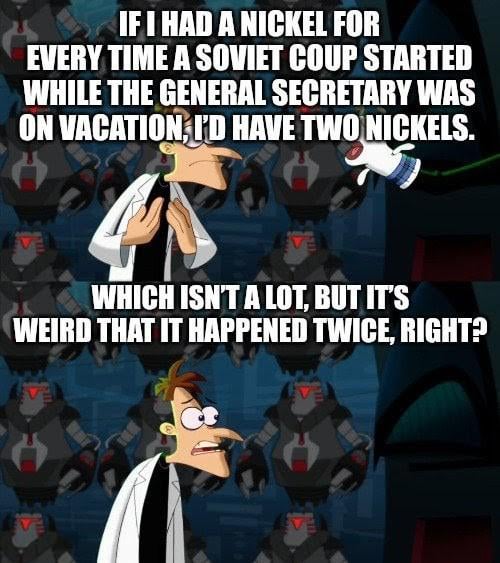
In 1964, Nikita Khrushchev-the First Secretary of the Communist Party-went on a seaside holiday, only for his colleagues in Moscow to hold a secret vote to strip him of power and announce he was retiring for “health reasons” while he was still away. Decades later in 1991, Mikhail Gorbachev-the last General Secretary of the USSR- went on a summer break to the Black Sea, and a group of hardliners cut his communication lines and placed him under house arrest to stage a coup. It happened twice—once to solidify the old guard and once to trigger the final collapse of the entire Soviet Union.
TL;DR: Twice in Soviet history, the leaders went on summer vacation only to have the government in Moscow immediately try to overthrow them.

3 Comments
Coups while the authoritarian executive is far removed from the capital are not a rarity in history. They are *endemic*.
Indeed such actions occur all the time in imperial states throughout history. From the very first real imperial power transition in China, [Where Eunuchs removed the previous crown prince before the emperors body got back to the capital](https://en.wikipedia.org/wiki/Qin_Er_Shi) and committed a coup in all but name, to [The incident at the Gaoping tombs](https://en.wikipedia.org/wiki/Incident_at_the_Gaoping_Tombs#:~:text=The%20Incident%20at%20the%20Gaoping,Jin%20dynasty%20in%20February%20266.) which established the Jin dynasty, to the failed [Attempt to remove the Qianlong emperor](https://en.wikipedia.org/wiki/Qianlong_Emperor#:~:text=When%20the%20Yongzheng%20Emperor%20died,wanted%20to%20usurp%20the%20throne%22.) it recurs from the beginning of Chinese imperial history to the end.
And well, lest we forget [Sejanus](https://en.wikipedia.org/wiki/Sejanus), and what he tried to do while Tiberius was at Capri.
It’s literal *most optimal* to lead a coup in the capital while the executive is away, as you can consolidate control more easily and more rapidly.
In 1964, Nikita Khrushchev-the First Secretary of the Communist Party-went on a seaside holiday, only for his colleagues in Moscow to hold a secret vote to strip him of power and announce he was retiring for “health reasons” while he was still away. Decades later in 1991, Mikhail Gorbachev-the last General Secretary of the USSR- went on a summer break to the Black Sea, and a group of hardliners cut his communication lines and placed him under house arrest to stage a coup. It happened twice—once to solidify the old guard and once to trigger the final collapse of the entire Soviet Union.
TL;DR: Twice in Soviet history, the leaders went on summer vacation only to have the government in Moscow immediately try to overthrow them.
The Summer Coup War