
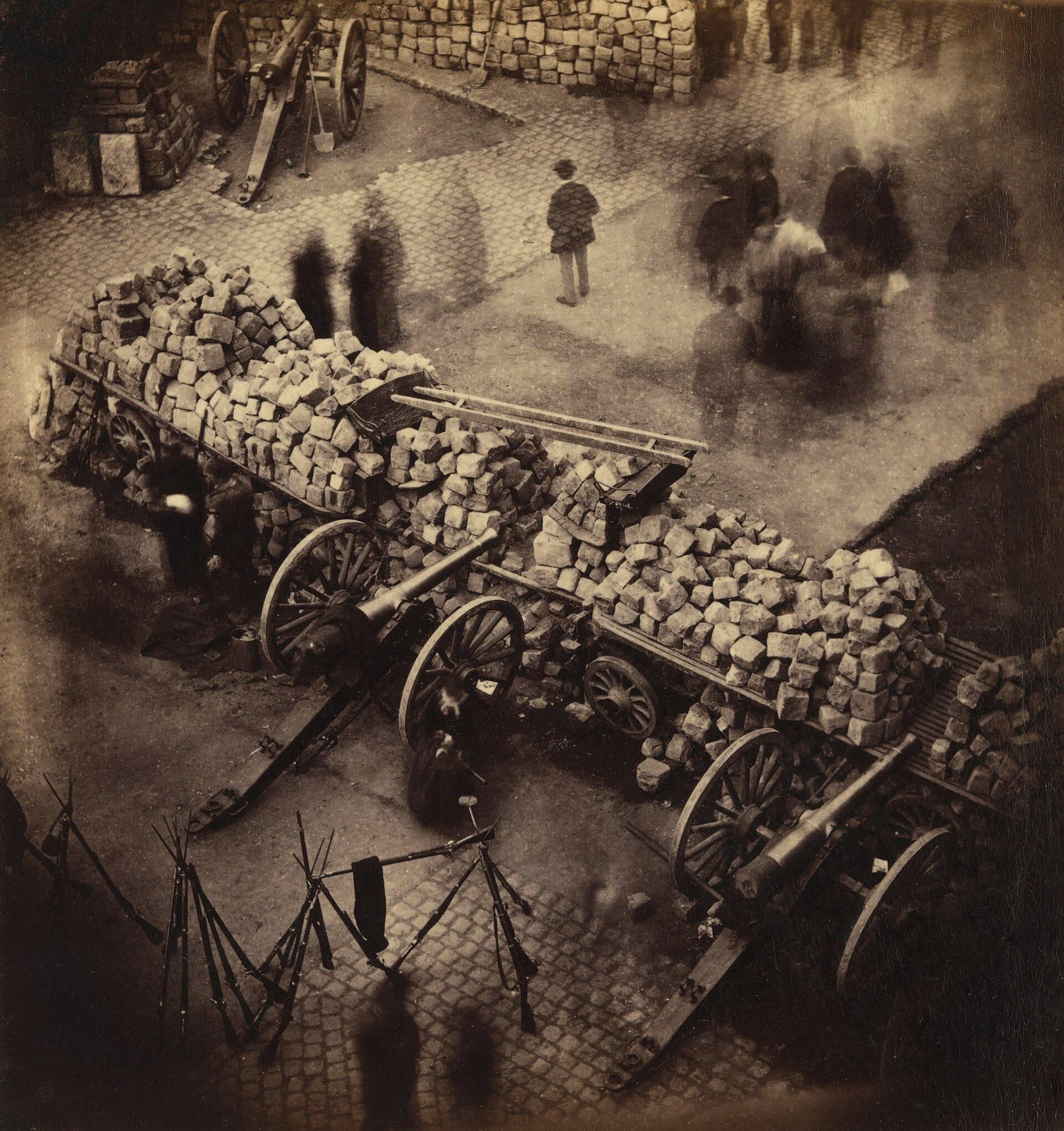
The Paris Commune was a radical, short-lived socialist government that controlled Paris from March 18 to May 28, 1871. It emerged after the collapse of the Second French Empire during the Franco-Prussian War, as the city endured siege, hunger, and political upheaval. The uprising began when the National Guard resisted an attempt by the provisional Third Republic government in Versailles to seize cannons in Montmartre .
The Commune formed an elected council and enacted reforms including the separation of church and state, suspension of rent and conscription, abolition of night work and the death penalty, and promotion of local self-governance. However, internal divisions and a lack of coordination with the rest of France left it militarily vulnerable.
As government forces advanced on Paris, barricades like this one, at the corner of the Place de l’Hôtel-de-Ville and Rue de Rivoli, were hastily constructed in preparation for fighting. The blurred figures reflect the long exposure times of early photography.
The conflict culminated in the Semaine Sanglante (“Bloody Week”), marked by intense street fighting, executions, and widespread destruction. Between 10,000 and 20,000 people were killed, with tens of thousands more imprisoned or exiled.
If you’re interested, I write more about the Commune: https://open.substack.com/pub/aid2000/p/hare-brained-history-vol-77-the-paris?r=4mmzre&utm\\\_medium=ios
by aid2000iscool